|
|
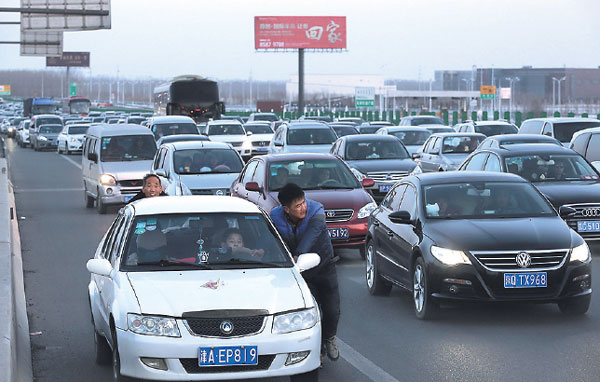
"It will take a long time to ease traffic congestion in Beijing," said Zhou Zhengyu, director of the municipal traffic committee.
"We need to make great efforts to tackle these problems and to present traffic system improvements for residents each year," he said.
One city initiative that could help keep the problem from growing is Beijing's plan to limit the population to no more than 23 million by 2020. According to the latest tally, in 2013, the capital has 21.14 million residents. And they are all on the move.
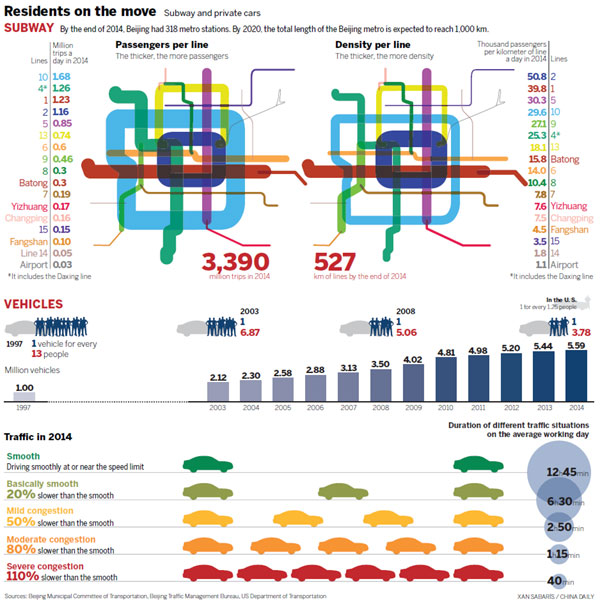
Last year, 5.6 million vehicles were registered in Beijing, and 8.5 million trips by car were made each day.
According to the traffic authority's 2015 work report on the transportation system, the city's traffic system has many problems, such as severe congestion on some roads, and insufficient transportation services for residents.
In 2014, Beijing residents spent about two hours in traffic congestion every working day, the same as the amount of time as in 2013. The traffic performance index, released by the Beijing Commission of Transportation, stopped increasing for the first time in four years, indicating the overall traffic situation did not worsen last year.
But in some areas within the Third Ring Road, traffic congestion did not improve and is instead deteriorating, Zhou said, adding that there are no easy solutions.
In addition, the difficulties of providing sufficient parking areas and regulating the chaos in parking has become one of the thorniest problems, he said.
One of the central initiations to counter these problems is the city's comprehensive effort to promote other, "green" means of transportation - buses, the metro and bicycles - which are projected to play a bigger role in 2015, accounting for 70.5 percent of the trips made in the city, compared with 60 percent the previous year, according to the Transportation Commission.
To stimulate greater use of public transportation, the city will complete work on two metro lines this year, adding 27 km, to reach a total of 554 km, the largest metro system in the nation. In addition, another two metro lines are under construction and will add 130 km.
The city will also crack down on illegal parking and driving on bicycle paths to protect bicyclists' safety, according the committee's work report.


Copyright 1995 - . All rights reserved. The content (including but not limited to text, photo, multimedia information, etc) published in this site belongs to China Daily Information Co (CDIC). Without written authorization from CDIC, such content shall not be republished or used in any form. Note: Browsers with 1024*768 or higher resolution are suggested for this site.
License for publishing multimedia online 0108263 Registration Number: 130349