

 Comments
  Print
Print  Mail
Mail  Large Medium Small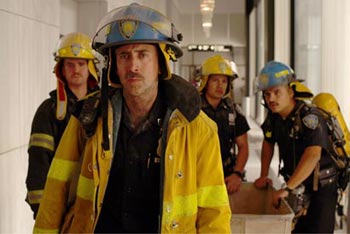
Don't look now, but it may be time to start trusting Oliver Stone.
Well, yes. Stone goes a long way to earn that trust with World Trade Center, a straightforward, stirring account of two police officers who were pulled alive from the rubble of the twin towers.
By avoiding politics and conspiracy theories, Stone's film is patriotic without being patronizing, a memorial to those who died that day almost five years ago. But it goes further than that. World Trade Center reminds us that despite the horror that day, heroes emerged - ash-covered, beaten up and tired - but heroes.
In World Trade Center, there are no schmaltzy, Michael Bay moments, only the grim business of survival. In an apparent plea for tolerance, Stone shows people around the world, including Arabs, reacting with concern over the attacks. It's about as close as he comes to a civics lesson.
Stone doesn't need to lecture because the message is clear. World Trade Center, similar to the documentary-like United 93, is the movie that no one wants to see but one that we all must see.
For many people outside New York and Washington, the memory of 9/11 is fading, replaced by the images of the war in Iraq. The images from 9/11 are painful, and some viewers won't be able to bear watching them. But at its core, World Trade Center examines the indomitable human will to survive, a quality of which we can all be proud.
In many ways, World Trade Center is very un-Stone-like. After all the "back, and to the left" in JFK, you'd think he'd be dying to re-create sequences of the planes hitting the towers, with computer effects. But Stone (Platoon, Natural Born Killers) doesn't even show the towers being hit, only the aftermath on TV.
Why? He says he was tightly focusing on his real-life subjects: John McLoughlin (Nicolas Cage) and Will Jimeno (Michael Pena), two Port Authority policemen who were trapped beneath tons of concrete and steel when the towers fell. They didn't see the towers hit, so it's not in the movie.
Utilizing parallel action, Stone switches back and forth between the trapped men and their wives, the quietly worried Donna McLoughlin (Maria Bello) and the younger, more hysterical and pregnant Allison Jimeno (Maggie Gyllenhaal). By zeroing in on the families, Stone makes World Trade Center personal for all of us.
For most of the movie, both Cage and Pena face the obstacle of acting without being able to move because their characters are trapped under rubble. Cage is sufficiently reserved, hidden behind a New York accent and Fuller Brush moustache; there's no sign of the cartoon character from Con Air or The Rock.
Pena (Crash) is uniformly believable as a man who only wants to see his child born. In a very Stone-like Doors sequence, the director delves deep into Pena's visions of Christ, who is conveniently carrying a bottle of water for the parched officer.
Another pivotal character is Dave Karnes (Michael Shannon), an accountant and ex-Marine who dons his uniform and begins searching for victims on his own. It's Karnes, along with another Marine, who find McLoughlin and Jimeno, real-life needles in a haystack. (Karnes is also bent on revenge, an area where Stone brushes with politics).
The rescue itself is incredibly dangerous. The men are trapped about 20 feet below the surface, and the rescue workers have to drop their gear to squeeze down into the crevices. They do, of course, without hesitation, and the men are rescued after 12 hours.
It's those kinds of risks, along with the self-sacrificing firefighters and police officers who rushed into the towers before they fell, that we must never forget.
With this unflinching account of that day, Stone has made the most important film of his long career.


Copyright 1995 - . All rights reserved. The content (including but not limited to text, photo, multimedia information, etc) published in this site belongs to China Daily Information Co (CDIC). Without written authorization from CDIC, such content shall not be republished or used in any form. Note: Browsers with 1024*768 or higher resolution are suggested for this site.
License for publishing multimedia online 0108263 Registration Number: 20100000002731