

 Comments
  Print
Print  Mail
Mail  Large Medium Small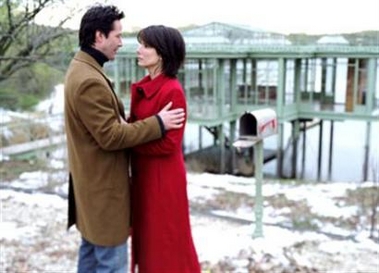
Keanu Reeves and Sandra Bullock in a scene from 'The Lake House' from Warner Bros. Pictures. (Handout/Reuters)
More a valentine to Chicago's architecture than the aching love story it purports to be, "The Lake House" is a slow-moving, never-igniting tale of calendar-crossed lovers that grows less convincing as it proceeds.
Facing no direct competition from romantic dramas and boasting the marquee allure of Keanu Reeves and Sandra Bullock, it will entice initial interest, particularly among women, before word travels that this tale of frustrated love is an unfulfilling fantasy, lovely to look at and confounding to the core.
Time-slip sagas have a built-in intrigue, and film is a perfect medium for exploring ruptures in the temporal continuum. But concept alone isn't enough.
The not-quite fully baked idea at the center of "Lake House" is an appealing metaphor for romantic destiny: Two lonely souls who live in the same house at different times begin communicating across a distance of two years.
Adoring shots of building facades notwithstanding, the story's passion is subdued to the point of absence. And even within its wobbly framework of metaphysical logic, the payoff is such a cheat that viewers who aren't punch-drunk from being pingponged between the film's two time periods will be left only with questions -- but not the kind that will bring them back for second viewings.
Adapting "Il Mare," a 2000 South Korean fantasy/romance, Argentine director Alejandro Agresti ("Valentin") and screenwriter David Auburn ("Proof") strain for a sense of portent and wonder.
Auburn forsakes dramatic tension and pacing to fill characters' mouths with dialogue that spells out his themes with such obviousness that Vanna White or Akeelah wouldn't be out of place. He further lards the proceedings with forced literary and cinematic allusions.
With the help of Rachel Portman's restrained score, Nathan Crowley's production design and the elegant, sumptuous precision of cinematographer Alar Kivilo's compositions, "Lake House" does capture the way certain places become imbued with feeling.
The titular abode is a breathtaking glass box on stilts (built for the film), whose symbolism is helpfully explained by characters using words like "disconnected" and "incomplete."
Moving from the North Shore retreat to take a hospital job in Chicago, Dr. Kate Forster (Bullock) leaves a letter for the next tenant requesting that her mail be forwarded.
The note's recipient, Alex Wyler (Reeves), having moved into the "abandoned dump" his father designed years earlier, is baffled by her claims. But soon they're exchanging daily missives via the house's mailbox, only to discover that he's writing from 2004 while she lives in 2006.
Introspection and solitude are rich cinematic subjects, but here the reunited "Speed" stars play characters whose personalities are so recessive that they inspire only indifference.
Bullock is quite good at conveying Kate's discontent without overstating the matter, even if the script does, pushing the worn notion that single career women are the saddest people on the planet.
Kate plays chess with her dog; her only real-world contacts are unsatisfying exchanges with an ex-boyfriend ( Dylan Walsh), her mother (Willeke van Ammelrooy) and a colleague ( Shohreh Aghdashloo).
Reeves, who like his co-star has done his most interesting recent work in small independent films and whose true forte is comedy, brings an inscrutability to Alex that's a detriment.
He's an architect who, unlike his younger brother (Ebon Moss-Bachrach), has taken a gauche detour into condo development.
Agresti stops the action, as it were, so that Christopher Plummer, as their imperious father, can deliver a lecture on the quality of light with a mad-artist twinkle in his eye.
But there is no illumination at the end of this time-lapse tunnel, whose participants sense a connection that the audience never does.
Though it's not without lovely moments -- a tree Alex plants for Kate in 2004 suddenly appears before her, full-boughed -- too much of this would-be love story unfolds via voiceover readings of letters loaded with backstory, trying to fill in what the film can't bring alive in the present.
Cast:
Alex Wyler: Keanu Reeves
Kate Forster: Sandra Bullock
Simon Wyler: Christopher Plummer
Henry Wyler: Ebon Moss-Bachrach
Kate's mother: Willeke van Ammelrooy
Morgan: Dylan Walsh
Anna: Shohreh Aghdashloo
Mona: Lynn Collins
Director: Alejandro Agresti; Screenwriter: David Auburn; Based on the motion picture "Il Mare" produced by Sidus; Producers: Doug Davison, Roy Lee; Executive producers: Erwin Stoff, Dana Goldberg, Bruce Berman, Mary McLaglen; Director of photography: Alar Kivilo; Production designer: Nathan Crowley; Music: Rachel Portman; Co-producer: Sonny Mallhi; Costume designer: Deena Appel; Editors: Lynzee Klingman, Alejandro Brodersohn.


Copyright 1995 - . All rights reserved. The content (including but not limited to text, photo, multimedia information, etc) published in this site belongs to China Daily Information Co (CDIC). Without written authorization from CDIC, such content shall not be republished or used in any form. Note: Browsers with 1024*768 or higher resolution are suggested for this site.
License for publishing multimedia online 0108263 Registration Number: 20100000002731