

 Comments
  Print
Print  Mail
Mail  Large Medium Small
|
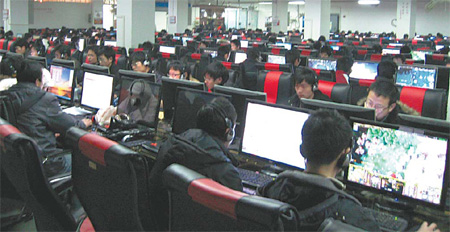
An Internet cafe in Wuhu, Anhui province. Many players prefer to play in such cafes where they can compete with friends. About 40 percent of Chinese online game operators' overall revenues come from Internet cafes. CFP |
Fanatical online gaming fan Wei Na used to moan about how little time and money she had to indulge her passion until she discovered a new vocation doing what she loves best.
The 27-year-old from Hejiang county in Sichuan province has become a professional gamer, selling bonuses she acquires from hours spent at the screen to fellow players.
Wei made the move from working at a debt-ridden chemistry factory three years ago and hasn't looked back.
Her area of expertise is the most popular online game of all, World of Warcraft (WOW) - and it has certainly given her finances and state of mind the "wow" factor.
Now her husband has joined the business and, with six desktop computers at home, the couple earn a very real $805 a month from the virtual world.
"Everyone can enjoy the game," she said. "You have to spend time and energy to get ahead when playing to get your character better equipped, but if you don't have the time you can buy advantages from us."
What encourages Wei and hundreds of thousands of other fellow professional gamers is the steady number of players who are willing to pay to get ahead.
One of the top anecdotes doing the rounds in the online gaming world is about a player who subscribes to a popular game called Miracle. It's generally agreed he must have spent $732,385 to attain his top status within the game.
Of China's more than 300 million netizens, the number of on-line gamers had grown to 49.36 million by the end of last year and is expected to further grow to 55 million this year, according to figures from the General Administration of Press and Publication (GAPP).
Chinese gaming professionals, known colloquially as gold farmers, are now attracting overseas attention.
The well known European gaming site Eurogamer released a report in March estimating the number of Chinese gold farmers to be 1 million.
For thousands of young Chinese gamers such as Wei, gold farming has become a career choice as the economy shrinks and unemployment rises.
"A professional gamer can earn several hundred dollars a month," said Wei. "It's hard to find a job that pays the same. Moreover, playing games is much more interesting and relaxing than running errands for stern-faced bosses!"
In China, 52.5 percent of online gamers are aged under 22. A total of 77.1 percent are educated to college degree level or lower and 31.2 percent of them, mainly students, have no regular income, according to a report released in March by the China Internet Network Information Center.
"The job of gold farming is not limited by age or educational background," said Bai Yang, a gold farmer from Beijing who runs a team of 25 professional players. "It just depends on how well you play."
Bai's team is made up of night and day workers who play in a small room containing 13 desktop computers.
He supplies three meals a day plus another at midnight and provides bunk beds free of charge for those who want to sleep on site.
Because of his success he is now looking to employ more staff.
|
Models display the different roles in the World of Warcraft game at an expo in Beijing last October. |
According to a report by Richard Heeks, of Manchester University in the United Kingdom, an estimated 400,000 Asian workers are now employed in gold farming in a business worth as much as $1.08 billion a year.
The industry is estimated to have a consumer base of 5-10 million. That number is expected to grow as Internet access increases.
Some fellow gold farmers of Bai and Wei in China have already been licensed for business by local governments.
The first license was granted last December by local authorities in the Hanyang district of Wuhan city in Hubei province to a gold farmer named Li Yang, who hired a couple of professional on-line game players.
"We granted the license as a way of regulating the industry regarding working hours and such," said Wang Zhong, the local officer for industry and business administration.
The business has since been permitted in other cities, including Wuxi in Jiangsu province.
Staff of those gold farming firms range from dozens to hundreds of young on-line game players.
To guide and monitor this emerging on-line gaming industry, the government has also worked on relevant supporting and regulatory means, including real name registration for on-line games and the construction of on-line gaming bases in Beijing, Shanghai, Sichuan and Guangdong.
Supporting domestic on-line game developers and their products is also a priority for the government, said Zhang Yijun, director of the GAPP's Technology and Digital Publication Department.
On-line games developed by home enterprises, such as Sohu and NetEase, made up seven of the top 10 most popular on-line games in China last year. The list included two developers from South Korea and one from the US.
Despite their popularity, online games are rasing health concerns, particularly regarding eye and back complaints caused by excessive playing.
Some parents also say they encourage their children to play truant from school.
"The gold farming business should be banned," said Zhou Hongyu, a professor at Huazhong Normal University and delegate to the National People's Congress. "It extracts time and energy from its workers, mostly college students or younger ones, but teaches nothing useful regarding their social lives. And the more gold farmers there are, the more problems there will be for proper employment."
(China Daily 05/25/2009 page6)

 Night views of Harbin through the lens
 Tibetans take train home after pilgrimage or travelling
 World's largest shaftless Ferris wheel built in China
 Ancient cities to be connected by Xi'an-Chengdu high-speed railway
 Snow turns Harbin into winter wonderland
 Reed Catkin Festival held in Wuhan
 Is it a building or a bookshelf?
 First flight
 Polar icebreaker Snow Dragon arrives in Antarctic
 Xi's vision on shared future for humanity
 UN's top environmental honors go to three in China
 German trains collide near Duesseldorf, several people injured
 China beats Germany 7-4 in men's curling Olympic qualification
 Bayern beat Paris Saint-Germain 3-1 in UEFA Champions League


Copyright 1995 - . All rights reserved. The content (including but not limited to text, photo, multimedia information, etc) published in this site belongs to China Daily Information Co (CDIC). Without written authorization from CDIC, such content shall not be republished or used in any form. Note: Browsers with 1024*768 or higher resolution are suggested for this site.
License for publishing multimedia online 0108263 Registration Number: 20100000002731