

 Comments
  Print
Print  Mail
Mail  Large Medium Small
|
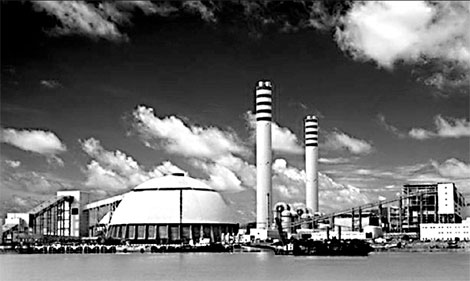
The Houshi power plant in Fujian province uses CEPT'S Natural Seawater-FGD Gas Desulphurization process. |
Early this year, China Environmental Project Tech Inc (CEPT) won a seven-year legal battle against FKK, a Japanese chemical engineering company for infringement of intellectual rights. An Intermediate People's Court in Wuhan, capital of Hubei province, announced that the Fujian Supreme People's Court has awarded the Chinese company 50 million yuan in damages, the highest compensation to date in an IPR case involving foreign parties.
CEPT, founded in 1994, was a pioneer in the technology of flue gas desulphurization (FGD) in the removal of SO2, a harmful pollutant, from coal burning gas. It had successfully developed and patented a process, which it called Natural Seawater FGD (NSW-FGD) that uses only seawater discharged from a power plant to reduce SO2 emissions. It does not require any chemical additives or fresh water consumption, nor will it result in the discharge of by-products that can produce secondary pollution. Its cost is the lowest of all FGD technologies being applied around the world.
This technology is very important for energy savings and pollution control. According to the International Energy Outlook 2007 published by the United States Energy Information Administration, coal accounted for 26 percent of the total world energy consumption in 2004. Of the coal produced worldwide, 65 percent was shipped to electricity producers, 31 percent to industrial consumers and most of the remaining 4 percent to coal consumers in the residential and commercial sectors.
Coal's share of total world energy consumption is projected to increase to 28 percent in 2030, and in the electric power sector its share is projected to rise from 43 percent in 2004 to 45 percent in 2030.
The technology invented by CEPT was first applied at Houshi Power Plant owned by Huayang Electric Ltd Co, a subsidiary company of Formosa Plastics Corporation. The plant was built in 1996. It has since been expanded to three phases.
At the beginning, Huayang Electric purchased a set of FGD equipment from FKK, a Japanese chemical engineering company. But the wastewater produced by FKK's FGD technology contained harmful pollutants beyond the national standard. It needed to be treated with a large quantity of magnesium minerals and fresh water.
As Fujian province could not provide enough magnesium needed by the Houshi plant, the chemical was transported at high cost from Liaoning.
At that time, CEPT made a sales pitch to Huayang's parent, Formosa Plastics, suggesting that its seawater technology could help solve Houshi's problems. In response, Formosa Plastics requested that CEPT do a feasibility study of the FGD project using the mainland company's technology in waste treatment.
So from February 1997 to February 1998, CEPT began to develop and design waste treatment technology for the Houshi Power Plant. On June 17, 1998, China Environmental Protection Agency authorized the construction of a Natural Seawater-FGD for the Houshi power plant put into production in August 1999.
After it was installed, the China Environmental Protection Agency authorized the installation of another one.
But in the process of transforming MGO-FGD to CEPT's NSW-FGD, Houshi terminated the arrangement with CEPT, claiming that the desulphurization technology was already provided by FKK.
IPR attorney Xu Xiaoheng of the Beijing-based Unitalen law firm says: "Chinese company's consciousness of IP protection should be enhanced. In the past, whenever we mentioned filing an IP tort, people always believed it must be a case of a 'Chinese company infringes on a foreign company's IP rights'. But Chinese companies should not be afraid to stand up for themselves and defend their legal rights against foreign companies."
EPT appealed to the Hubei branch of the State Intellectual Property Office to conduct a review of the installation at Houshi's plant to see if there was an infringement of CEPT's patent rights. In 2001, State Intellectual Property Office of China confirmed that the Houshi plant was using the CEPT patent technology. Huayang contested the finding.
CEPT filed a suit in the Fujian Supreme People's Court in 2001 claiming damages amounting to 31 million yuan.
During the court proceedings, FKK requested that the State Intellectual Property Office of China declare CEPT's patent invalid. The request was rejected, but due to it the case dragged on, Xu claims
"This case lasted seven years due to (FKK's) patent nullity claim, " Xu says.
Fujian Supreme People's Court ordered Japan FKK to immediately stop infringing, and compensate CEPT 50.6 million yuan. Huayang company has been ordered to pay 240,000 yuan annually for every year it uses the technology.
FKK is appealing the ruling.
In a telephone interview, CEPT's director assistant surnamed He, says: "Although we won the first trial, we will continue appeal, too. Because CEPT thinks Huayang and FKK should assume joint responsibility for the infringement."
(China Daily 08/11/2008 page9)
 Night views of Harbin through the lens
 Tibetans take train home after pilgrimage or travelling
 World's largest shaftless Ferris wheel built in China
 Ancient cities to be connected by Xi'an-Chengdu high-speed railway
 Snow turns Harbin into winter wonderland
 Reed Catkin Festival held in Wuhan
 Is it a building or a bookshelf?
 First flight
 Polar icebreaker Snow Dragon arrives in Antarctic
 Xi's vision on shared future for humanity
 UN's top environmental honors go to three in China
 German trains collide near Duesseldorf, several people injured
 China beats Germany 7-4 in men's curling Olympic qualification
 Bayern beat Paris Saint-Germain 3-1 in UEFA Champions League


Copyright 1995 - . All rights reserved. The content (including but not limited to text, photo, multimedia information, etc) published in this site belongs to China Daily Information Co (CDIC). Without written authorization from CDIC, such content shall not be republished or used in any form. Note: Browsers with 1024*768 or higher resolution are suggested for this site.
License for publishing multimedia online 0108263 Registration Number: 20100000002731