
 Comments()
  Print
Print  Mail
Mail  Large Medium Small
分享按钮
0
Large Medium Small
分享按钮
0TOKYO - Japan's economy contracted more than expected in the fourth quarter as manufacturers were pummeled by a strong yen, slowing global growth and floods in Thailand. While some economists are leaning towards the growth rate turning positive this year, a lot will hinge on the nation's ever-so fragile export sector.
The 0.6 percent drop logged in the fourth quarter, in some instances, was more than double the size of economists' median forecasts and presents a further headache for the Japanese government, already grappling with post-earthquake reconstruction costs and trying to urge a reluctant nation to accept a doubling of its sales tax rate.
 |
|
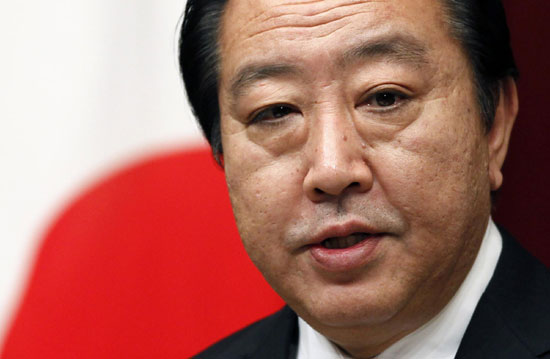
Japan's Prime Minister Yoshihiko Noda speaks during a news conference, after the Reconstruction Agency was inaugurated at his official residence in Tokyo February 10, 2012. [Photo/Agencies] |
Hence it would appear that based on these figures and coupled with weakening domestic demand, the fate of the world's third- largest economy could become yet more bleak if, on the back of four contractions in five quarters and a nearly 1.0 percent decline in industrial output, the debt-crisis in the eurozone rumbles on and exacerbates a global downturn.
Positive spin
"We're hearing that Prime Minister Yoshihiko Noda's government and the central bank are expecting an uptick this year," a representative from Nomura Holdings, Inc. in Tokyo told Xinhua.
"But the outlook is somewhat cloudy as so much is dependent on intangibles, such as debt contagion in the eurozone, national credit downgrades, the full implementation of reconstruction funding and the growth potential and demand from emerging economies," he said.
To this point, Japan's Economy Minister Motohisa Furukawa said via the Cabinet Office that December's export figures boded well for the first half of this year and even went as far as saying that the momentum was likely to continue.
"In December, exports and production increased after the initial damage from flooding in Thailand, and if we take those factors into account and look at the overall economic situation, I think we can say that upward movement is continuing," the Economy Minister said in a statement.
However, despite the positive spin, not even Furukawa could ignore the looming downside risks that have led to many private economists stating that the deflationary recession here was set to continue, compounded by skittish corporate capital spending, waning consumer and household sentiment and a harsh employment environment.
"We expect steady increase of exports amid moderate improvement of the global economy. However, we need to be fully aware of the downside risk," Furukawa said.
While suggesting that the US economy is showing signs of a moderate recovery, leading to a shift towards more positive global business sentiment, Furukawa had to concede, along with a consensus among observers close to the matter, that Japan can no longer rely on its core export sectors, which accounts for 16 percent of real GDP, to solely drive its economy forward.
"It's very important to create domestic demand in the fields of environment, energy and medical and nursing care services. We must switch from external demand-led growth," Furukawa said. "We've been saying this since the '80s," he added.
Furukawa's notion speaks to broader problems inextricably linked to Japan's economic predicament and contributing to the nation last month posting its first trade deficit since 1980.
The economy grew 1.7 percent in the July-September quarter as initial funds for post-quake reconstruction efforts were made available, but this spike was quashed by the yen surging to post- WW II highs against the US dollar and fluctuating unfavorably against the euro due to the crisis in the single currency bloc there, triggering an exodus of Japanese manufacturers to overseas locations where operational costs are lower.
But observers have said that this, in some cases, has culminated in a double negative for Japanese manufacturers and the export sector in general, as it has led to a hollowing out of the economy here. Noda, his finance ministry and the central bank are grappling with the phenomena, while Japanese manufacturers based in Thailand are still reeling from the effects of the flooding there, proving that production risks exist beyond foreign exchange rates and are a global concern.
Copyright 1995 - 2010 . All rights reserved. The content (including but not limited to text, photo, multimedia information, etc) published in this site belongs to China Daily Information Co (CDIC). Without written authorization from CDIC, such content shall not be republished or used in any form. Note: Browsers with 1024*768 or higher resolution are suggested for this site.
License for publishing multimedia online 0108263 Registration Number: 20100000002731