


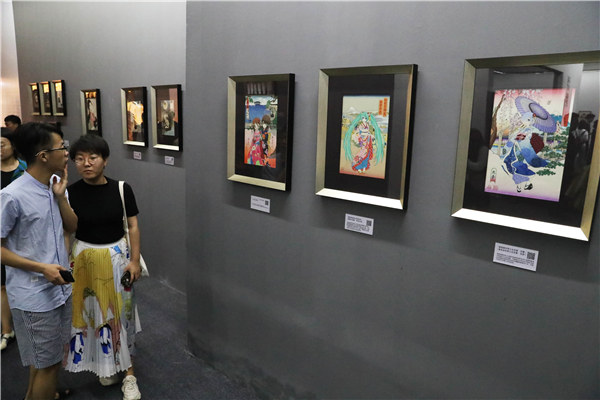
Chinese woodblock prints and ink-wash painting were then introduced to Japan, and they had a profound influence on the way ukiyo-e developed. In fact some ukiyo-e works portrayed famous Chinese stories such as Romance of The Three Kingdoms.
Perhaps not surprisingly, given the fame of Kanagawa Okinamiura, Hokusai Katsushika is one of the most well-known exponents of ukiyo-e. The revered Mount Fuji appears in that work and 35 others he did as part of a series. In 2017 a print of Kanagawa Okinamiura sold at auction at Christie's in New York for $940,000.
Another well-known ukiyo-e artist is Hiroshige Utagawa, a contemporary of Katsushika.
"Comparing the two, I prefer the poetic beauty of Utagawa's works," said Dong Bingyue, a researcher with the Chinese Academy of Social Sciences.
"You can see and feel the artistic conception of poetry of the Tang Dynasty (618-907) in Hiroshige's works."
Hiroshige was widely known as tabinoshijin, or poet of the journey.
Other works featured in the exhibition include yakusha-e, or paintings of actors, by Sharaku Toshusai, and bijin-e, paintings of beauty, by Utamaro Kitagawa.
As a consequence of the development of modern printing technology and photography, the market for ukiyo-e has waned in recent years.
The curator of the 798 Art Zone exhibition, Cheng Pengzi, said: "Through this exhibition, we are keen to arouse the interest of visitors from wherever they come to the inheritance and development of traditional handicraft, respecting craftsmanship and safeguarding our heritage."






