Ecuador slams UK threats to seize Assange
|
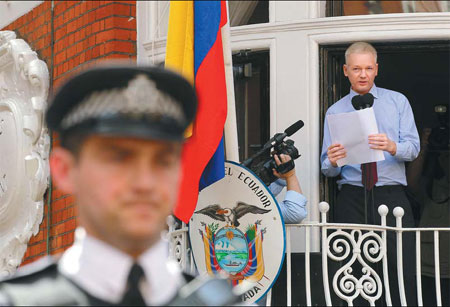
WikiLeaks founder Julian Assange speaks to the media outside the Ecuador embassy in London on Sunday. Assange used the balcony of the embassy to call on US President Barack Obama to end what he called a witch hunt against WikiLeaks. Olivia Harris / Reuters |
Ecuador cast its dispute with Britain over asylum for WikiLeaks' founder Julian Assange as a struggle against colonialism on Saturday, drawing growing support from its neighbors in the international diplomatic saga.
Incensed by London's threat to break into the Ecuadorian embassy where the former hacker is taking refuge, Ecuadorian President Rafael Correa's government has accused Britain of bullying and has formally granted Assange asylum.
Britain says it will not allow the anti-secrecy campaigner from Australia to travel to South America because it is obliged to extradite him to Sweden, where he is wanted for questioning over rape and sexual assault allegations.
"They're out of touch. Who do they think they're dealing with? Can't they see that this is a dignified and sovereign government which will not kneel down before anyone?" Correa said in his weekly address on Saturday.
"What a mentality, eh? They have not realized that Latin America is free and sovereign and that we'll not put up with meddling, colonialism of any kind, at least in this country, small, but with a big heart."
Trying to present the affair as an international David-versus-Goliath battle, Ecuador was playing host this weekend to foreign ministers from both the ALBA - the Bolivarian Alliance for the Peoples of Our America - group of leftist-led Latin American countries and the Union of South American Nations.
On Saturday, Venezuelan President Hugo Chavez called on ALBA members - which also includes Cuba and Nicaragua, among others - to stand behind Ecuador.
"Latin America must be respected, our people must be respected, but only united can we earn that respect."
Support growing
Support for Ecuador appears to be growing in the region.
"Britain ... is wrong. The threat is not only an aggression to Ecuador, it's against Bolivia, it's against South America, against the whole of Latin America," Bolivian President Evo Morales said on Friday.
Ecuadorian state media said other nations, including Colombia and Argentina, were backing Correa's position.
On Friday, representatives of the hemispheric Organization of American States called for a foreign ministers' meeting this week over the Assange affair.
Canada and the United States voted against holding the meeting.
"The central issue is not the right of asylum, it is the inviolability of embassies," OAS Secretary-General Jose Miguel Insulza said after the vote.
Experts and ex-diplomats say Britain's Foreign Office, which warned Ecuador of a little known law that would allow it to side-step usual diplomatic protocols, made a misstep by issuing a threat it couldn't act on.
"It was a big mistake," said Oliver Miles, a former British ambassador. "It puts the British government in the position of asking for something illegitimate."
Britain's warning was carried in a set of notes delivered to Ecuadorian diplomats on Wednesday as they tried to negotiate an agreement over Assange.
The notes, published by Britain on Thursday, said ominously that keeping Assange at the embassy was incompatible with international law. They added: "You should be aware that there is a legal basis in the UK - the Diplomatic and Consular Premises Act - which would allow us to take action to arrest Mr Assange in the current premises of the embassy."
Britain passed the law in 1987, after a deadly shooting in 1984 in which a Libyan diplomat opened fire on demonstrators from within his country's London embassy, killing a British police officer.
Ecuador is furious Britain said it could use the law to break into its embassy, where Assange has been for more than two months.
"Is the threat of a European government to the sovereignty of a South American country not important because we're a small nation?" Ecuadorian Foreign Minister Ricardo Patino said.
The Ecuadorian government shares Assange's fears that he ultimately could be extradited to the United States, which is angry that his WikiLeaks website has leaked hundreds of thousands of secret US diplomatic and military cables.
The leftist Correa, who is popular and is expected to run for re-election in February 2013, had developed some rapport with Assange during an online interview the WikiLeaks founder conducted with him this year.
Correa's stance has been largely cheered by Ecuadorians, and there have been scattered protests at the British Embassy.
"The whole world should back Ecuador for giving Assange asylum and because this country is the first one to promote freedom of expression," said Mary Valenzuela, a 39-year-old restaurant owner.
Assange makes speech
Assange called on US President Barack Obama to stop its "witch hunt" against his whistleblowing website, as he gave a speech from Ecuador's embassy in London on Sunday.
"I ask President Obama to do the right thing, the United States must renounce its witch hunt against WikiLeaks," said Assange, making his first public statement since he was granted political asylum by Ecuador.
Speaking from a balcony at the embassy in an upmarket district of London, Assange praised the "courage" shown by the Correa for granting him asylum.
"I thank President Correa for the courage he has shown in considering and in granting me political asylum," Assange told journalists and a handful of his supporters gathered outside the embassy.
Reuters-AFP-AP