


Hit by job crunch, China trains entrepreneurs
Yiwu, China - Jia Shaohua is offering an alternative solution to China's employment crunch: he teaches his students not just the skills they will need to find jobs, but how to create jobs of their own.
An educator at a vocational school with about 8,000 students, Jia is at the forefront of efforts to make higher education more relevant to China's job market at a time when an economic downturn means university graduates face bleak prospects.


"What's the weakness of the Chinese education system? It's as though we're trying to train swimmers in a classroom," said Jia, vice-president of the Yiwu Industrial and Commercial College in the eastern province of Zhejiang.
"They can all pass the test, but once they see water, they start shivering. And when they get in the water, they drown."
|
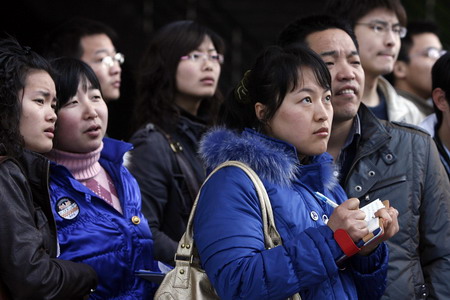 Job-seekers look at information on a recruitment poster at a job fair in Shanghai March 15, 2009. [Agencies] |
The challenge of shifting China's educational focus to prepare students for the workplace is nothing new. Multinational firms have long complained that the traditional education system fails to teach students analytical and problem-solving skills.
"China's schools favour rote memorisation versus practical application. This method of learning does not translate well to daily operational communication," the American Chamber of Commerce in China said in a policy paper issued in April.
The chamber has been delivering that message for years. But the issue has taken on greater urgency with the global economic slowdown and is now attracting attention at the highest levels.
The leadership in Beijing has made it a priority to create jobs for this year's crop of 6.1 million university graduates.
So far, the central government has published a slew of policies to help graduates find jobs or start their own businesses, and is aiming to increase the proportion of students in vocational colleges, where the focus is more on technical knowledge than academics.
For instance, graduates will be able to apply for loans of up to 50,000 yuan ($7,300) to start their own businesses. Less than one percent of graduates each year currently do so.
Innovative Education
In a sign of the growing support for novel education methods, domestic media have reported widely on Jia's school, many citing it as a welcome example of necessary innovation.
"China is desperately looking for new ways to create jobs, and running stores online is, in my view, one of these ways," said Jiang Dayuan, a researcher with the Central Institute for Vocational and Technical Education in Beijing, a think-tank under the Ministry of Education.
"Running an online store is a relatively easy step for a college student to start his or her own business," Jiang said.
Armed with know-how and preferential policies, the students at Jia's college are excited about their prospects.
Big red banners congratulate those who have achieved elite status on Taobao.com, an online retail website known as China's eBay.
The portrait adorning the wall of one group of students' makeshift office attests to their aspirations: it is of China's most famous Internet entrepreneur, Jack Ma, the founder of the Alibaba Group, Taobao's parent company.
One student, Pan Wenbo, sees a future in selling tissue box covers, slippers, women's underwear, shirts and socks online.
Starting a business would put his parents' mind at ease that he will not end up jobless after three years of tuition payments.
"My parents fully support me in this," Pan said.
Not everyone is so convinced.
Jia's college is located in Yiwu, the world's biggest market for small consumer products, giving students access to cheap wholesale goods that young entrepreneurs elsewhere do not have.
Some experts also question the efficacy of pushing students to start their own businesses so early.
"Students are in school to learn, not to make a living on their own," said Su Hainan, an expert with the China Association for Labour Studies, a think-tank affiliated with the Ministry of Human Resources and Social Security.
And businessmen can do a better job than teachers of showing students how to run a business, said Gao Yang, executive director of Junior Achievement China, a worldwide organisation dedicated to teaching entrepreneurship through its network of volunteers.
"These people bring the real world, they bring their business experience and expertise, and share them with their students," Gao said. "I think the volunteer model is a better one."
Jia admits that his own model will not work everywhere, and that entrepreneurship is not the silver bullet that will solve China's employment crunch.
Still, he insists, it introduces greater diversity into a largely homogenous educational system, giving students training more attuned to their needs and talents.
Elite institutions such as Tsinghua University in Beijing will always have their place, but schools like his should not be ashamed of delivering more practical training, he said.
"The pity is, Chinese vocational schools are trying to become universities, and universities are all trying to become Tsinghua -- and that is a dead end," he said.
- Job situation not as bad
- Graduates face poor job prospects
- Nielsen survey: Job security key concern among Chinese
- Stimulus package doing its job: Chinese Premier
- China's job market still grim as exports falter
- Is it wise to change a job under such a situtation ?
- Do you want to have a job-hopping in financical crisis?













Registration Number: 130349


