



Center gives hope to Russian parents









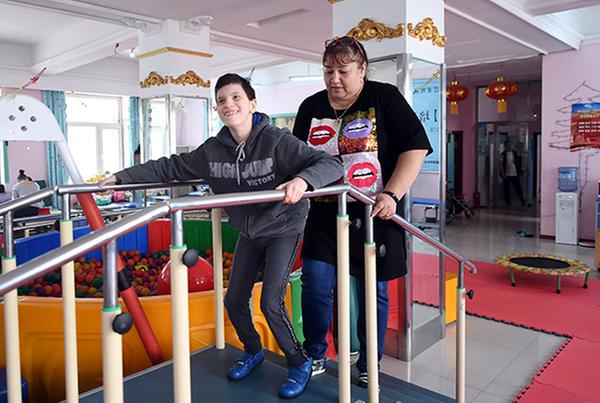 |
| Mariia Kilian watches a Russian cerebral palsy patient exercise at the Cerebral Palsy Rehabilitation Center in Harbin, capital of the northeastern province of Heilongjiang.[Li Yang/For China Daily] |
Mother of boy with cerebral palsy helps introduce effective treatment to others in similar situations across the border
On Mariia Kilian's desk is an enormous stack of notebooks labeled with the names of dozens of Russian children with cerebral palsy.
She records the condition and treatment information about each of the children in the corresponding notebook and organizes them so they are easy to refer to.
Kilian, 48, has been a volunteer at the China Disabled Persons Federation's Cerebral Palsy Rehabilitation Center in Harbin, capital of Heilongjiang province, since arriving from Nakhodka, Russia, in 2010.
"Since 2009, our effective treatment methods have attracted nearly 500 new patients from Russia," said Liu Lu, the director of the center.
Mariia's 12-year-old son, Zakhar, is one of them.
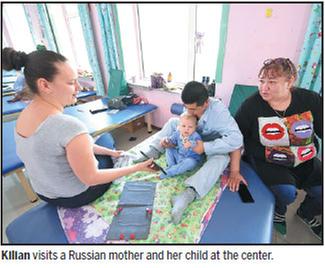
He was diagnosed with cerebral palsy when he was 2 years old, and in the following three years, he was given treatment at hospitals in Moscow, which cost his family about $700,000. However, the treatment had almost no effect.
"At that time, I tried my best to find information about effective treatments," Kilian said.
"It gave me great hope when I found out online about the Cerebral Palsy Rehabilitation Center, so I decided to bring my son to Harbin."
They arrived in the northeastern city in April 2010, and Zakhar's brain function began to improve after just a few months of treatment.
Kilian was able to relax more and began paying attention to other Russian families at the center.
Since she can speak some Mandarin, she began to help her fellow Russians communicate with the doctors in her spare time.
"As a mother whose child has the disease, I can empathize with parents who are in the same situation," Kilian said. "So I hope I can do something to help them."
When a doctor at the center told Kilian that her son required long-term rehabilitation over a matter of years, she made a decision.
"My son likes Harbin very much and he has made several friends at the center, so I decided to stay in Harbin instead of regularly traveling between the two countries," Kilian said.
She rented an apartment near the center and employed an overseas student from Russia to help her look after Zakhar.
"I know there are lots of children with cerebral palsy in Russia and I hope I can introduce information to their parents about the effective treatment at the center," she said.
By coincidence, Liu had the same idea.
"We constructed a website in Russian, on which people can find detailed information about the center," Liu said.


- Chinese scientists develop new nanoparticles to make pesticides more efficient
- China braces for heavy rain, flood risks as cold air brings sharp cooling
- Shanghai conference explores digital lifelong learning amid AI era
- Russian, Indonesian, Yemeni students experience Jincheng's cultural treasures
- Tianjin University hosts first AI+Synthetic Biology competition final
- Intl students witness grassroots modernization in Dalian





