Earlier on Oct 6, the New York Times carried an article, complaining that "while America is sacrificing its blood and treasure, the Chinese will reap the benefits".
Global environmental crises, from vanishing biodiversity and degrading forests to collapsing fish stocks and climate change, will not be resolved without some tough thinking about international governance.
The Chinese mainland and Taiwan agreed to start formal talks on the Economic ECFA, which will help Taiwan economy.
People's attention has been attracted to another field with high incidence of corruption - China's ever-enlarging universities.
In recent years, military transparency has been mentioned repeatedly in military contacts between China and other countries, especially the United States.
She has more than a taste of two different lives. First, she has had the privilege of going to two of the best institutions in the US and the UK (Harvard University and Imperial College, London) and returning to China to the comfort of Beijing's Finance Street to establish its financial regulations and set up some of its first national funds. Second, she is living a life most social activists would be proud of: advising the government of the country that is one of the largest greenhouse gas emitters on climate change and new energy.
The latest gloomy news from journalism's battered front lines is that the prestigious New York Times (NYT) is laying off 100 staff. Paper-and-ink newspapers are in deep trouble, there's no doubt about that. But the NYT, as comprehensive as its news coverage sometimes is, is hardly in a position to offer the real story on its current woes, anymore than a psychoanalyst is able to objectively analyze him or herself.
Leaders of Asia said regional cooperation will be built in the spirit of openness and tolerance, with respect for diversity.
When free market has received a battering, an Economics Nobel laureate has jumped to the defense it.
In rejecting G2 to replace G8, China paved the way for the full recognition of G20 as the new global economic forum. This demonstrates once again that China has no desire for dominance even when the role is thrust upon it, as this is in line with traditional Chinese thinking inherited from Lao Tze more than 2,000 years ago.
India should dump the G77 grouping and align itself with the G20 countries in an attempt to get closer to the US in the pursuit of some larger geopolitical objectives.
The problem of China's current economic operation is the coincidence of the global financial crisis and China's periodic adjustment.
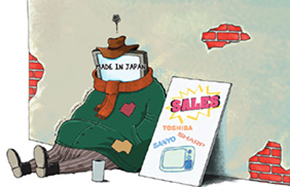
Japan has been occupied by the United States, since its defeat at the end of World War II. Nominally speaking, Japan is an independent country now. But in essence, Japan is not an independent country in the real sense of the word.
The idea for a community in East Asia has been constantly raised and endowed with different political meanings at different stages.
Zhu Qingshi, former president of the USTC, and an elite member of the CAS, was appointed founding president of the SUST for a five-year term.
From being restricted and regulated, the floating population is now being encouraged to better integrate into the local community.
Baby boomers have finally attained power in Japan through a historic change. The thought filled me with deep emotion, perhaps because I, too, belong to that generation.
Grassroots democracy can have a bottom-up effect in shaping higher-level democracy. For example, a village affairs committee in Guizhou province has designed a five-part seal, one each held by a member of the committee. Any village expenditure can be approved only if three or more members stamp their agreement. The village committee gives us an idea of how people's affairs can be managed by the people instead of for the people.
It has become an indisputable fact that there is a great disparity between the haves and the have-nots in China and the gap is widening over time.
Pakistan and Afghanistan had been the target of terrorist attacks till just a few days ago. But the recent attacks in Iran show terrorists have widened their targets.
As world leaders are slated to gather in Copenhagen this month to find a replacement to the Kyoto Protocol, talks about climate change are gathering steam. But is climate change the most pressing threat for mankind?
I was appalled to read China Daily's piece reporting the humanitarian and social activities of US forces in Afghanistan.
Asia has rebounded fast from the depth of the global crisis. Initially, the region was hit extremely hard, with output in most countries shrinking by much more than even those nations at the epicenter of the crisis.