Waste-sorting enforcement put in motion


Latest green measures gear up in major cities following Beijing, Shanghai lead
Out on her daily walk one warm summer's evening, 65-year-old Qu Fang noticed something particularly pleasant about her residential compound.
The air at her Hushan Flower Garden community seemed especially crisp and clear, with no mosquitoes bothering her.
"With the new rules about sorting household waste before disposing it, the community is much more beautiful now," Qu said.
Qu is one of the latest beneficiaries of new regulations for domestic waste sorting in Qingdao, Shandong province, with the measures already improving their surroundings.
Coastal Qingdao itself is part of an unprecedented national green campaign that will see nearly 50 cities putting in place a basic collection system for classifying and disposing household trash by next year, according to the Ministry of Housing and Urban-Rural Development. By 2025, cities at the prefecture level and above are expected to have the systems in place.
From different categories of garbage bins dotting residential areas to detailed penalties for families not classifying their domestic refuse, major cities are gearing up to follow the leads by Beijing and Shanghai this month to roll out comprehensive, multilevel trash-sorting measures as rising affluence amid rapid urbanization fuel the need to better manage waste.
Businesses have also been catching up. At the popular Ginza Mall in Qingdao's southern district, more than 40 retail and food outlets are part of a waste collection system separating kitchen, recyclable and other categories that inspectors ensure are adhered to before distribution to major garbage points in the complex.
In Guangzhou, urban management committees are planning to offer incentives to companies, organizations and individuals who sort their trash, to complement penalties for those who do not comply with waste-sorting.
The novel moves will help raise more awareness about the benefits of trash classification among residents and spur them to take a more personal role in their environment, they said.
Guangdong, an economic powerhouse, has been at the forefront of the country's reform and opening-up. But its provincial capital, with a population of more than 16 million, also produces over 28,000 metric tons of domestic garbage every day, putting an increasing strain on its waste-handling facilities, according to the urban management authorities.
"Urban management committees and the relevant departments should spare no effort to promote waste classification among local companies and residents to help tackle one of the city's worsening problems," said Peng Ziliang, an urban management official in charge of garbage classification in the city.
According to a recent survey conducted by the Guangzhou-based Southern Metropolis Daily newspaper, about 70 percent of residents in the provincial capital did not know that the city government implemented new garbage classification regulations last July, requiring them to sort their waste before disposal. Most residents do not fully comprehend related policies and rules, the poll covering more than 30 neighborhoods found.
In the past year, Guangzhou urban management committees reported issuing more than 2,400 notices requiring local companies and related organizations to sort their garbage, following inspections to nearly 19,000 groups.
More than 200 of those were fined a total of 86,800 yuan ($12,600) for failing to sort their waste, according to a statement from the committees.
Similarly, in Hangzhou, Zhou Jiangyong, Party secretary of Zhejiang provincial capital, has said that more efforts must be made to improve awareness among residents about the need to sort their domestic waste.
Innovation and the latest technologies, such as artificial intelligence and "smart city" management systems, should also be tapped to enhance the waste recycling drive, Zhou said.
On the ground, more residents are noticing the green rollout. Lin Zexin, 20, a resident of Xiaoshan district in Hangzhou, has spotted many trash-sorting bins in her residential community in the past two months.
The bins are expected to help residents classify their trash into the various categories, but they do not seem to be fully used yet, with garbage still "randomly disposed of", she said.
"I think better education and promotion is needed to push the green moves forward," she said.
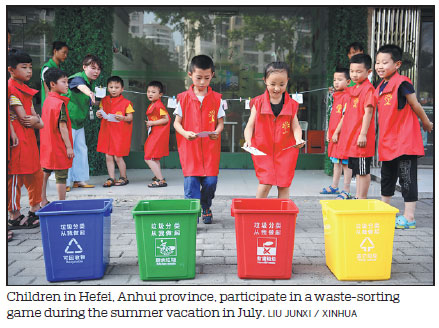
In Xiamen, Fujian province, city authorities are focusing on early education to help build firm foundations for its household waste-sorting measures.
More than 1,160 kindergartens and schools citywide have launched programs for students to learn the importance of garbage classification, with over 700,000 youngsters encouraged to be closely involved with their families' new environmental responsibilities, according to officials.
Students are also taught to record their daily waste-classification activities, via photos and micro-videos, to be uploaded for evaluations and feedback.
Xie Chuanjiao in Qingdao, Zheng Caixiong in Guangzhou, Ma Zhenhuan in Hangzhou and Hu Meidong in Xiamen contributed to this story.
alexishooi@chinadaily.com.cn
(China Daily Global 08/02/2019 page3)