Let's eat some flowers


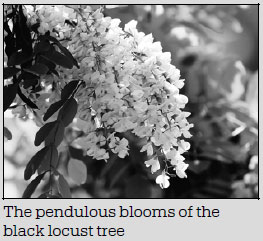
Nothing declares spring is here louder than the pendulous blooms of the black locust tree, yanghuai. It announces the season by bursting into huge clusters of ivory-colored flowers.
These will often become lunch.
Our Nanny (ayi in Chinese) guards the locust tree in front of our backyard like a dragon and when she sees the buds appear, she will go forth with a pair of scissors and harvest the flowers.
This has become an annual ritual, this spring foraging.
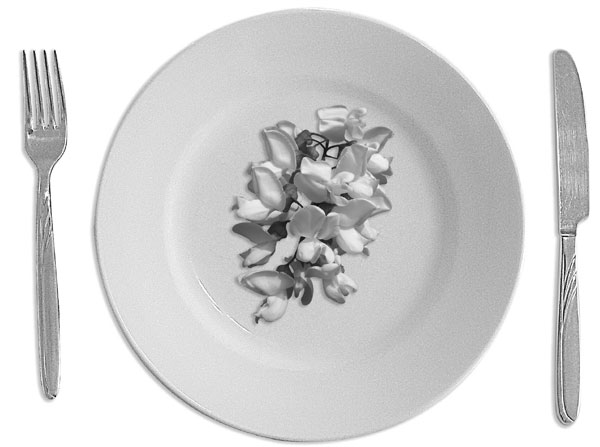
The black locust is a naturalized tree with fragrant white pea flowers. It is a popular tree all around Beijing and it seeds very freely. While it grows unnoticed most of the year, in spring, it becomes the focus of many, because its pea flowers are sweetly scented, and edible.
Around here, the country folks pluck the flowers, coat them in cornmeal or flour and then steam them. It's eaten like rice, a fragrant seasonal treat.
Ayi makes both cornmeal and plain flour versions, and she loves both.
What do they taste like? They're faintly fragrant, with just a hint of sweet from the nectar, but otherwise ... I'm afraid I think it's a waste of so many flowers.
But I can imagine these being special delicacies when times were hard back then. I guess nostalgia for the "good old bad old times" makes ayi want to recapture that taste.
I don't have that baggage and frankly I prefer looking at the blooms on the tree.
I have seen my neighbors raid the trees, breaking off huge branches and carting them off. It disturbs me to see such carnage, but the trees seem to survive quite well, and they bounce right back the next year.
There are two types of locust trees grown in Beijing. The imported black locusts are so naturalized that they are everywhere. The native locust, also known as the scholar tree, is known as guohuai.
This is an immensely popular decorative tree, and is used for landscaping in many traditional gardens, including the Jingshan Park and Prince Gong's Palace behind the Forbidden City enclave.
They grow to impressive heights naturally and will bloom freely later in summer. They will develop fat green pods that hang low from the branches.
My husband, raised in the Beijing hutong, remember buying packets of these boiled pods as a childhood snack.
They didn't taste like anything much, he says, but they were cheap and fun to eat.
It was all part of growing up in old Beijing, a city that is slowly fading from memory.
These days, scholar trees are trimmed into gnarly-stemmed man-height bonsai and planted along roadsides. Their branches, trimmed and trained to look like knobby dragon digits, are forcefully curved back from the central trunk.
These bonsai versions are known as longzhuahuai, or dragon's claw locusts.
At this season, though, it is the honeyed black locusts that are still center-stage, and a huge basin of the flowers and buds is soaking in salted water in our kitchen.
Drained and air-dried, the flowers would be eaten several ways.
They will be dredged in a mixture of cornmeal and flour and then steamed. This slightly fragrant and chewy mixture will be eaten as a staple.
The rest of the flowers would be chopped and mixed with locust honey to enhance sweetness and scent and the mixture used to fill up dumplings and buns, and then steamed.
paulined@chinadaily.com.cn
Honey Locust Dumplings
Here is a recipe we use often in our kitchen. If you are fortunate enough to have these lovely flowers growing near you, try and make some.
• 500g locust flowers, washed and drained
• 3 large tablespoons honey (preferably locust honey)
• 50g chopped peanuts
• 50g toasted black and white sesame seeds
• 2 tablespoons sugar
• 50 dumpling skins
Chop up the flowers and macerate in the locust honey. Set aside.
Mix the sugar, chopped peanuts and sesame seeds together in a bowl.
Prepare to wrap the dumplings.
Place a spoonful of flower mixture in the center of the dumpling skin and top it with a teaspoon of peanuts and sesame. Pinch the edges shut.
Complete the dumplings. These dump-lings are best shallow fried.
Arrange the dumplings in a lightly oiled non-stick pan and fry the dumplings till the bottoms are golden brown. Sprinkle with a little water and cover the pan to cook the tops.
Remove the cover, dry out the dumplings to crisp, then turn out on a plate, Dust with powdered sugar to complete the dessert.
(China Daily Global 05/15/2019 page15)