Govt moves to end small firms' funding problems


Small, independent businesses are wary of loans, but positive about market-led growth. Hu Yongqi reports.
Last year was tough for Cen Qichu, general manager of Ningbo Dongjing New Fabric Co, after banks reduced the number of loans his company had been promised in 2017.
About one-third of the 300 private enterprises in Cen's hometown, Cixi in Zhejiang province, saw their loan quotas cut by about 10 percent compared with the previous year, which resulted in a corresponding rise of about 10 percent in interest rates.

Now, Cen's company's bank loans total roughly 50 million yuan ($7.3 million), about 40 percent less than two years ago.
"I just don't want to see anybody from a bank. My priority is to pay off the loans in the shortest time possible with the profits my company earns," he said.
This dilemma has been a constant problem for the entrepreneur, who has worked in the manufacturing sector for 18 years. In recent years, difficulties obtaining financing have become a headache for many small, private businesses, despite supportive measures from the local government.
Cen said that since 2015 the government has tried to help small, private businesses to obtain funding, but its coordination with the banking regulatory authorities and commercial banks has been ineffective for his company and other local players.
Business insiders said interest rates charged to private enterprises in many areas are three times the 3.25 percent rate for one-year deposits at most commercial banks. Some are even as high as 20 percent.
Despite its loan quota being cut, Ningbo Dongjing New Fabric was able to generate revenue of about 300 million yuan last year, with overseas sales rising by about 10 percent.
Cen said entrepreneurs have learned how to survive the financial difficulties by making better products and exploring demand, both domestically and overseas.
"All my employees and suppliers will get their money before Spring Festival, so everyone should be happy," he said.
Different conditions
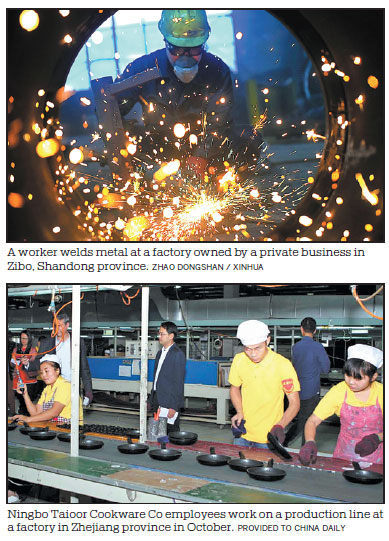
By comparison, Ningbo Taioor Cookware Co, also in Zhejiang, had an uneventful year. By taking out low-interest loans and exploiting the appreciation of the US dollar, the company's net profit rose by 45 percent compared with 2017.
With steady rises in revenue and profit, the company is regarded as a good partner by commercial banks and can easily obtain low-interest loans - paying no more than 5 percent per annum.
Taioor, founded in 2003 as a manufacturer of nonstick aluminum cookware, exports its products to more than 40 countries in Europe, Southeast Asia and the Middle East.
Benefiting from China's free trade agreements with countries such as Australia, Taioor's exports rose last year, generating more revenue, but the absence of expensive loans and related risks was also a factor in the company's success.
While other companies struggled to repay old loans and obtain more money for new contracts, Taioor capped its borrowing at 50 million yuan, which is a low figure for a company generating such high revenue.
"Some companies like us were mocked as foolish for not borrowing from banks during a period of credit easing several years ago, but now these companies are turning out to be winners in the deleveraging campaign and slowing economic growth," Shen Guozhang, Taioor's general manager, said.
"We were laughed at for being 'muddle-headed' by keeping loans at such a low level. However, many of the companies that took out expensive loans were overloaded with huge financial burdens within two or three years. In retrospect, our choice was best," he said.
Another manufacturer, located near Taioor, earned net profit of 20 to 30 million yuan a year, but it borrowed 200 million yuan in 2015. Two years later, it went bankrupt under the burden of annual interest payments totaling 80 million yuan.
In December, China Daily contacted about 30 small businesses, including startups, in eastern, central and western parts of the country. More than 70 percent said they will borrow less this year to avoid paying large amounts of interest.
"The manufacturing sector has very low rates of return, and huge debts will crush a manufacturer if it's not careful about risk control," said Shen, who noted that his company's net profit represented just 4.5 percent of the revenue it generated last year.
Interest rates remain low for profitable companies with good credit ratings, but others have to pay higher rates because it's more risky for banks to lend to them, he added.
He said the financing difficulties facing many businesses stem from their radical operations in recent years. Now, banks are more cautious about how loans will be repaid, preferring companies that have good credit records, adequate collateral and strong ability to generate profits.
Government support
In October, Vice-Premier Liu He said private businesses are a vital part of the national economy. They contribute more than half of the country's taxes, more than 60 percent of GDP, more than 70 percent of technological innovations.
They also employ more than 80 percent of the urban population and account for more than 90 percent of new jobs and startups.
Last year, the government conducted a deleveraging campaign to guard against major risks. However, some small, private companies were found to lack liquidity, so they experienced even greater difficulty in obtaining funding.
By the end of 2017, China had more than 27 million private enterprises and more than 65 million individual business owners, according to the National Development and Reform Commission, which acknowledged that financing difficulties are still a problem for small, private businesses.
The State Council, China's Cabinet, has prioritized the easing of financing difficulties and other problems that affect small, private enterprises. Last year, eight of 38 executive meetings of the State Council, presided over by Premier Li Keqiang, focused on these topics and introduced a raft of supportive policies.
At a meeting on Dec 24, the State Council decided to further reduce taxes and fees on disadvantaged companies and to improve financing services for them.
On Jan 4, during a visit to the inclusive financing departments of three commercial banks, including Bank of China, Li reiterated that the financial sector should provide better services for small and micro-sized enterprises.
Also, on Jan 9, an executive meeting of the State Council decided to further reduce taxes for small, private enterprises by 200 billion yuan.
This month, the People's Bank of China, the central bank, said local governments will be encouraged to establish financing funds for private businesses, especially small and micro-enterprises, while boosting supportive measures for equity and bond financing.
Under a rule introduced on Jan 2 that came into effect immediately, financial institutions can deposit less in the central bank as reserves if they extend a certain proportion of total loans to small and microcompanies.
Each of these companies is allowed to lend up to 10 million yuan, the threshold for inclusive financing having been lifted from 5 million yuan to enable banks to lend larger sums to small businesses.
Meanwhile, on Jan 4, the central bank cut the reserve requirement ratio for commercial banks by 1 percentage point.
One half of the cut was applied on Jan 15, and the remainder will come into force on Friday, injecting 800 billion yuan into the market.
These policies are expected to improve liquidity and reduce costs, help ease financing difficulties and better meet the demands of small businesses, said Wu Wen, a senior researcher at Bank of Communications.
Yu Yongding, a senior economist at the Chinese Academy of Social Sciences, said injecting more money into the market should benefit private enterprises.
With the economy facing growing downward pressure, Yu suggested that special financial institutions should be established to lend to small, private businesses.
Meanwhile, the government should build an information platform of small and medium-sized enterprises that would allow financial institutions to keep track of them and help lenders to decide whether to offer loans, he said.
Improved management
Despite recent difficulties, Cen, from Ningbo Dongjing New Fabric, is optimistic about the potential of the domestic market, and he stressed the importance of being diligent in terms of management and producing high-quality goods.
He said the overall tax burden should be reduced further and the government should crack down on tax evasion to improve social justice.
Shen, from Taioor, said companies should be as pragmatic as they were during their startup phase, and they should focus on their core business and do their utmost to make a profit and ease funding difficulties.
"Companies should make themselves appealing to capital - then they would easily obtain funding," he said.
"Managements should borrow in line with their capabilities. Our experience is that not all loan quotas should be used to reduce risks."
The national economy is growing at a slower pace, as is the global economy, which will require new measures, according to Shen.
"Managements should improve the quality of their products and explore more markets around the world," he said.
For him, the economy has its own laws, and the government should think from the perspective of businesses and reduce their burdens.
"Our biggest desire is to have stable expectations and a service-oriented government," he said.
Contact the writer at huyongqi@chinadaily.com.cn
|
Entrepreneur Su Tao checks national costumes at his plant in Weining, Guizhou province. His company settled in an innovation park with the support of the local government.Wang Chunliang / Xinhua |

(China Daily 01/21/2019 page5)