Chinese FDI into US records sharp drop


Chinese foreign direct investment (FDI) in the United States plummeted more than 80 percent in 2018, and the downturn is expected to continue, given tighter US regulatory screening and policy shifts in China, analysts said.
After declining from a peak of $48 billion in 2016 to $31 billion in 2017, Chinese FDI in North America dropped to $8 billion in 2018, and total investment in Europe was also down, according to the latest analysis from law firm Baker McKenzie.
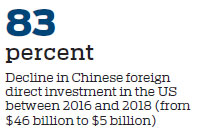
The US was responsible for the majority of this decline, falling from a peak of $45.63 billion in 2016 and $29 billion in 2017 to just $5 billion in 2018, down 83 percent, said the report released on Monday.
"FDI flows are declining for both Europe and America, and the decline is because Europe and America are getting more restrictive, particularly in technology areas, so that's having a negative effect," Yukon Huang, former World Bank China director, said on Tuesday.
Huang, a senior fellow at the Carnegie Endowment for International Peace in Washington, said the Committee on Foreign Investment in the US (CFIUS), a multiagency federal panel that determines whether deals with foreign corporations raise antitrust or national security issues, is a particular cause of Chinese concern.
While a 2015 committee report to Congress ranked China top in terms of CFIUS reviews - even though the country ranked 14th in FDI to the US - Huang said the US has tightened the review process which will subject more Chinese investments to review.
But technology investment represents a small share of China's investment in the US, according to "The Facts and China's Position on China-US Trade Friction", a white paper released by China's Ministry of Commerce in September.
From 2005 to 2017, of the 232 direct investments from China, only 17 involved high-technology, while others were mainly in real estate, finance and services, said the report, citing figures from the American Enterprise Institute.
"Historically, they have been welcoming, they want the jobs, they want Chinese companies to be moving to America," Huang told China Daily.
"But I think there's still a question of - under the political environment today - how willing are localities to encourage this, and I would say that, generally speaking, probably, if Washington is so hostile, then many Chinese companies will have reservations," Huang said.
Huang said year-to-year FDI flows can vary tremendously, and he tends to look at changes over five-to-10-year periods. Although it is unclear if China's FDI to the US would be at "permanently lower levels" in the future, "certainly the trend is down", he said.
Huang said that China's outbound investment, not just in technology but also in property-related investments, is declining, because Chinese firms and households are being discouraged from investing in property overseas.
While encouraging its citizens to invest abroad, China has put restrictions in place to prevent irrational growth in outbound investment in recent months.
For example, no new projects were reported in sectors such as property development, sports and entertainment in the first seven months of 2018, according to statistics from China's Ministry of Commerce.
The Baker McKenzie report also said a divestiture spike in 2018 turned net FDI flows to the US "negative".
A handful of prominent investors driving much of the 2015-16 FDI boom have begun selling their overseas holdings. The wave of divestitures is mostly hitting the US and consists mainly of real estate, hospitality and entertainment assets, according to the report.
"Accounting for the completed divestitures, net Chinese FDI inflows to North America were negative to the tune of $5.5 billion in 2018," it said.
Douglas H. Paal, vice-president of the Asia Program at the Carnegie Endowment for International Peace, said he believed China's currency outflow-control efforts had partly reduced the heavy flow of outbound investment.
"Moreover, the US has strengthened its supervision of technology-related investments, reducing the willingness of Chinese investors to risk undergoing the review process," Paal said.
huanxinzhao@chinadailyusa.com
(China Daily 01/17/2019 page3)