Transparency and consistency crucial to the US-China business relations
US companies doing business in China are pushing Washington to accelerate reform of its exports control policies and China is expected to play a key role in fulfilling the US president's plans for increasing US exports, according to chairman of the American Chamber of Commerce.
Beijing has urged the US to ease its tight control on high-tech exports, which is regarded as one reason for the cross-border trade deficits.
"The good news is that the US government will reform export controls, with the general idea being to reduce the number of items that are controlled. We welcome that general direction," said John Watkins, chairman of the Chamber.
Watkins said that products such as machine tools or material items, which are available in China today or China can buy it from other countries very easily, would be removed from the controlled list. Export bans on products relevant to American national defense would be preserved.
"The reform is in process but has yet to be finalized. The reformed list will reflect the reality of what is happening in China today," he said.
US president Barack Obama aims to double US exports over the next five years. Watkins said China would play a "key role" in efforts to achieve that goal.
"The US is going to increase its exports and China will be at the core of that strategy for many years based on the size of its economy and growth rate," Watkins said.
To have a chance to achieve its goal, the US government has to reform exports control, protect US firms' intellectual property and work on market access issues, he said. In the Chinese market, made-in-America products ranging from natural resources to agricultural products, or machinery and manufactured goods would be competitive, he said.
The US government has been pressing China to allow its currency to appreciate and Beijing announced a move to a more flexible currency regime on June 20.
Watkins said the RMB appreciation against the dollar would have limited impact on China's trade surplus.
"From a US company's point of view, especially a US company doing business in China, according to our annual Business Climate Surveys, currency is never in our top 10 concerns," Watkins said.
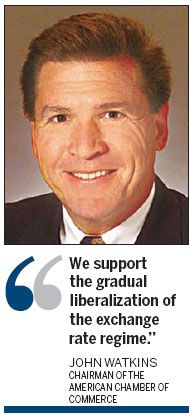
"We support the gradual liberalization of the exchange rate regime. However, any one-off, very deep change may cause too many issues," he said.
Both Chinese and American companies want predictability in doing business, thus increased dialogue, more transparent regulations and consistency are all important.
For high-tech exports control, the US government needs to speed up reforms so that Chinese companies and consumers can know what and when they can buy from the US.
On the other side of the bargain, US firms working in China want to make sure China continues its commitment to openness and reform to secure their returns from doing business in the country.
While most members remain very positive about China, some US companies in China have expressed concerns on policies like indigenous innovation and other areas, such as certification, testing, and standards.
"China has done an incredible job over the last 30 years in opening and reforming its economy; it's very impressive, and maybe we could even say in the history of mankind we have never seen such a positive and huge transformation in such a short amount of time," Watkins said.
American companies have benefited from that and American companies have also contributed to that through investment of financial capital, human capital and technology, he said.
"We want to continue to participate and get returns on our investment," Watkins said.
"We were pleased with the outcome of the China-US Strategic and Economic Dialogues and the US-China relationship is much better than several months ago," he said.
We believes that in the next 30 years of US-China relations, we can achieve 'Three On Trillions'. We can see US$1 trillion each of US annual exports of goods and services to China, US companies' annual production in China for that market, and cumulative Chinese investment in the US," he said.
Seventy percent of US companies working in China surveyed last year said investing in China is for the Chinese market, not for export.
Watkins said US industrial, consumer and retail sectors are exploring opportunities in the second, third and fourth tier Chinese cities because of the increasing prosperity in these cities and the trend of urbanization.
(China Daily 07/02/2010 page17)