![]() Savoring a Super Bowl
By Eric Nilsson (China Daily)
Updated: 2009-02-18 08:10
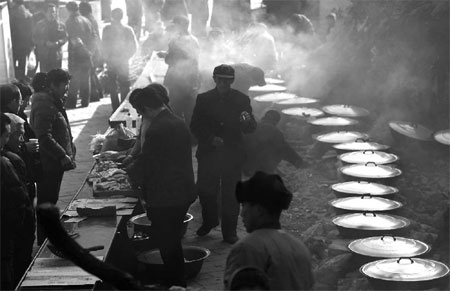
While Spring Festival celebrations come to a screeching halt on the 16th day of the first lunar month, that's when things really start cooking at Yangshudixia village in northern Beijing's Huairou district. More than 100 woks were burbling outdoors on Monday in the settlement of 300 people, which is host to the Lianqiao Festival, a 180-year-old fete centered on soup, porridge and sparrows that is little-known elsewhere. "This is a very important tradition for us, because it's a very happy time," 71-year-old Jin Shuzhi says as she sloshes a ladle through an urn full of meat and vegetables. About 6,000 visitors descended on the hamlet on Monday and more than 5,000 in the previous two days. The local government invested more than 1 million yuan ($147,059) in the admission-free event.

The annual celebration is born of a legend in which the Jin and Huo families - most residents of Yangshudixia's 150 households still carry these surnames - fled Shandong province to settle in the area but had no seeds to sow. They traveled to a distant village to borrow some millet but while they rested on a rocky outcropping, a blustering wind swept the seed into a stone crevice. Try as they might, the men couldn't squeeze their fingers into the narrow cleft to scoop out the millet. They were overcome with despair until a flock of mystical sparrows flitted in and dug the seeds out for them. The thankful men kowtowed to their avian saviors and vowed to share their harvests with them every spring, when food is scarce for the birds.
"We still feel very grateful, respectful and loving toward the sparrows," says Liulimiao Party chief Tian Zhengke. Every year since, young girls have gone door-to-door collecting Spring Festival leftovers on the day after the Lantern Festival. After feeding the birds, the families cast the remaining food into massive cauldrons bubbling above wood-fires and serve the concoctions to the townsfolk. The cooking fires belch smoke plumes that twist up the mountainsides like slow-motion tornadoes, and this year, hundreds of villagers and visitors joined snaking lines to savor the porridges and soups. "It's worth the wait, because it's interesting and fun," farmer Shan Jingming says. The 46-year-old drove more than an hour from Hubei province to the festival with his 14-year-old daughter Shan Yunhong and waited for more than two hours to relish the traditional fare. The cooks also plop threaded needles into the woks and the girls who discover these in their bowls are said to have "nimble fingers" as seamstresses. Finding a coin also heralds good fortune. Jin recalls walking door to door, collecting food for the kettles from the age of 5. "Back then, we only had small things to put in because we were poor but now we have much more and better food," she says. Lianqiao is also a time for feuding villagers to make amends. This tradition started long ago when an old man seized the festival as a chance to arbitrate a dispute between two families, one of which owned an ox that devoured the other's corn. "This festival expresses the harmony in our village," says local Party secretary Jin Hongan. "It creates a joyful atmosphere for the villagers to celebrate as their lives get better and better." Visitors were also shown dancing on stilts, Peking Opera and erkui, a local tradition in which entertainers feign wrestling contests with life-sized effigies sewn to the fronts of their costumes. Wang Yufeng, who traveled from a village 50 km away to dance on stilts in Yangshudixia, said he was honored to showcase his skill. "This is real Chinese culture and art, and there are so many people here, which makes it more interesting," the 36-year-old says. Beijinger Wang Jiannan came to the festival to snap photos and sample the traditional nosh. "This is quite unique - you can't see it anywhere else," the 46-year-old says. "I read that it would be hard to get a bowl ... so I brought my own lunchbox.
"I believe the taste might not be so good but it will remind me of my childhood." Village Party chief Jin says attendance has grown annually, with 5,000 people coming over three days last year. He hopes the festival will soon grow into a profitable brand name through media and word-of-mouth. "Whether the festival is commercialized or not, the villagers' traditions, hospitality and kindness won't change," Jin says. "This is the unique and real life of these villagers."
(China Daily 02/18/2009 page20) |