|

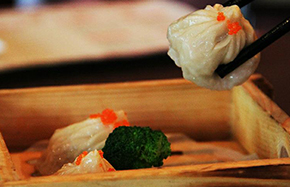
Hangzhou cuisine is a pleasure to both the eyes and taste
buds. |
Hangzhou, the capital city of East China's Zhejiang Province and known
worldwide for its natural beauty, is also a gourmets' paradise, even in a
country with a cuisine that enjoys international renown for its variety.
Chinese cuisine has a number of well-known variations, thanks to the vast
areas in the country that employ particular ingredients and different cooking
techniques.
Among them, four regional styles are particularly recognized nationwide:
those of Sichuan, Guangdong, Shandong, and of the Jiangsu and Zhejiang
provinces.

Sichuan food, with its famed spiciness, and Guangdong's reputed seafood
cuisine are the best known and probably the most popular cuisines in the
country.
Hangzhou is also a place that offers gourmets and other visitors alike a
chance to appease both their eyes and stomachs.
Hangzhou food, like its natural beauty, is renowned for its refined style and
delicacy.
Three striking features specifically characterize Hangzhou cuisine.
The first is lightness of taste. Most dishes are not as greasy as those from
other regions
Second, Hangzhou cuisine always incorporates locally produced and fresh
ingredients, either from the West Lake and the Qiantang River, or from the
nearby farmlands. For example, the much-loved bamboo shoots are stewed in peanut
oil and served immediately after being dug up in spring.
Finally, Hangzhou dishes are also known for their sweetness and the delicate
efforts devoted to their preparation.
Elaborate cooking methods characterize almost all dishes, which are so well
prepared that Hangzhou cuisine is said to be fit for an emperor.
Best-known dishes
Probably the best-known dish in Hangzhou cuisine is the Dong Po Rou, or Dong
Po Pork. The dish, labeled a casserole on many menus, is made by steaming a
square chunk of belly pork until the fat turns into a gelatinous substance.
The dish is actually named after Su Dongpo, a great poet and governor of
Hangzhou in the Northern Song Dynasty (960-1127).
The local legend goes that city residents in the Northern Song Dynasty, when
Su was the Hangzhou governor, presented numerous gifts to him after he built a
causeway in the West Lake. Su accepted the gifts, which included pigs and wine,
but ordered his subordinates to use them to prepare special pork dishes for the
residents.
Su, who was a great poet of the time, offered specific instructions to his
cooks regarding steaming the pork in wine over a moderate flame until it was
thoroughly cooked, and the dish that was later to be called Dong Po Pork was
born.
Although it is less appealing to the eye, anyone who has tasted the dish
would tend to testify to its deliciousness.
And, more importantly, even though it is made of pork, the dish is
surprisingly less greasy.
Another signature dish of Hangzhou cuisine is the Long Jing Xia Ren, or Baby
Shrimp with Longjing Tea.
Still prepared in the same fashion as during the Qing Dynasty (1644-1911),
the dish is probably the second best known in Hangzhou cuisine.
All the main ingredients of this popular dish come from Hangzhou itself.
The tasty shrimp, which is stir-fried, comes from the Qiantang River that
flows through the city, while Longjing Tea is grown in the surrounding hills.
Recommended places to visit:
Lou Wailou, or "Tower Beyond Tower"
Built in the 1840s, this restaurant is the most famous dinning establishment
in the city, to be frequented later by famous writer Lu Xun and Chinese Premier
Zhou Enlai.
Address: 30 Gushan Road
Tel: 0571-87969023
Zhi Weiguan
This one-stop shop is the most popular snack restaurant in the city where you
can pick up your favorite Hangzhou snacks.
Address: 83 Renhe Road
Tel: 0571-87066933
Zhang Shengji
Established in 1988, Zhang Shengji is a newly emerging Hangzhou cuisine
restaurant chain, with outlets in Beijing, Shanghai and other major Chinese
cities.
The trademark dish at the restaurant is "Lao Ya Bao" or "Stewed duck soup
with dried bamboo shoots," which is now considered one of the new representative
Hangzhou dishes.
Address: 77 Shuangling Road
Tel: 0571-86026666
(China Daily 06/22/2007 page7)