


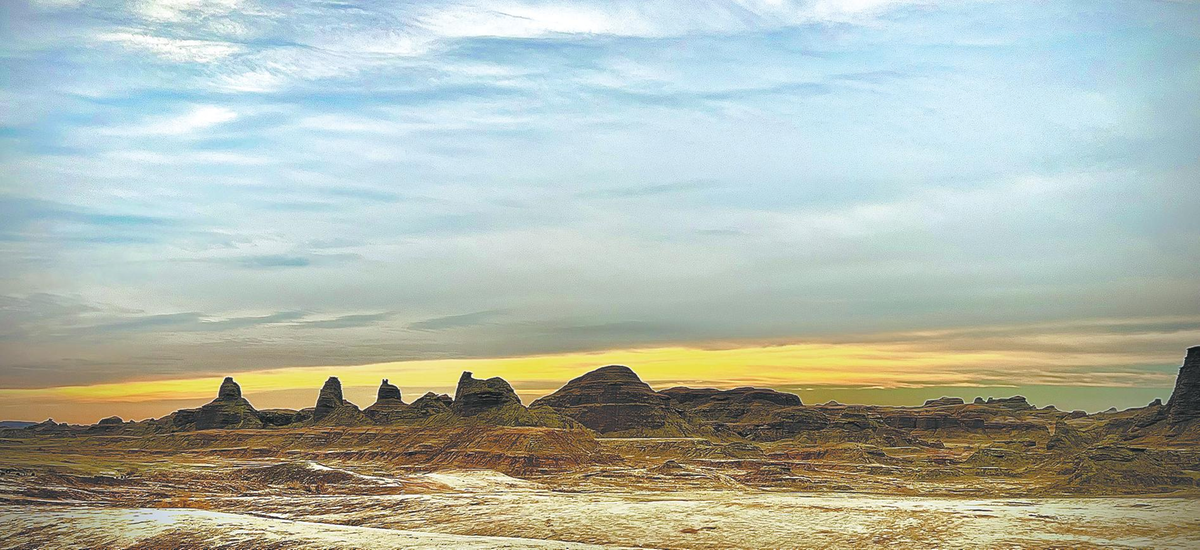
Legend has it that the Granary of the World hoards enough cereal to feed the whole planet. The nearby Bell of the Century is said to chime with a timeless and soundless toll that reminds us to cherish and save food.
The way culture shapes perceptions can be seen in the Sphinx, which looks like the Egyptian chimera to outsiders, but ethnic Mongolians liken it to a figure from their folk epic, Jangar. Pandora's Box resembles the chest from which arose all the evils and misery on Earth. But ancient nomads who'd never heard of this Greek myth envisioned it as a dungeon for the yowling devils or as the palace of their malevolent king.
The Ghost Couple presents perhaps the most magical morphology. One angle reveals the crisp silhouette of a man's face. Walk several steps, and his visage dissolves into random rock, until the clear profile of a woman's countenance suddenly emerges on the other side.
This image, along with an unblinking, all-seeing eye, serves as the destination's official symbol. The giant man-made metal eye floats 30 meters in the air, hovering between two towers, its gaze fixed on the peculiar horizon.
Within its purview, a smaller arched gate opens to a sweeping expanse where visitors hunt for golden-silk jade. While this rosy crystal isn't jade in the strict geological sense — it's a blushing quartz rather than nephrite or jadeite — it fits the broader classification within Chinese gemology.
For generations, locals considered these pebbles little more than ordinary gravel. The "jade gold rush" began in the early 2000s, when wealthy collectors from prosperous coastal cities came to covet their luster.
Since then, treasure hunters have continued to arrive with backpacks, combing the desert for these luminous stones that swirl with tangled veins of glittering yellow. A superb specimen can sell for over 10,000 yuan ($1,400).
Yet the most precious rocks remain the looming yardangs, whose haunting geology not only inspired tall tales but also served as a filming site for martial arts movies. Scenes were filmed here for Ang Lee's Oscar-winning 2000 martial arts blockbuster, Crouching Tiger, Hidden Dragon, and Tsui Hark's 2005 film, Seven Swords.
Some scholars believe these outlandish landforms were landmarks for nomads and traders trekking the northern Silk Road's less-trodden Steppe Route.
Yardang translates from Uygur as "steep hill". But they're distinguished less by their gradients than by their idiosyncratic ribbed, fluted, and crinkled texture.
They're striped red by iron, tinged blue by manganese, and dyed beige by sandstone. These muted mineral rainbows stand beneath the pastel streaks that daub clouds at sunset. This paints a horizon of mirrored dualities, tracing the line that delineates Earth and heaven, the terrestrial and celestial, the divine and the devilish.
So, the Ghost City stands as a monumental meeting point of elemental forces and human imagination.
For millions of years, the hissing wind has been its eternal sculptor, carving the land into surreal contours.
For centuries, humanity has been the interpreter, imbuing these forms with demons, beasts and myths. Across time, this built a fantastical and phantasmal realm, where "ghosts" lament loudly and the living silently celebrate meaning, story and beauty.





