



Graviton modes observed for the first time by Chinese scientists









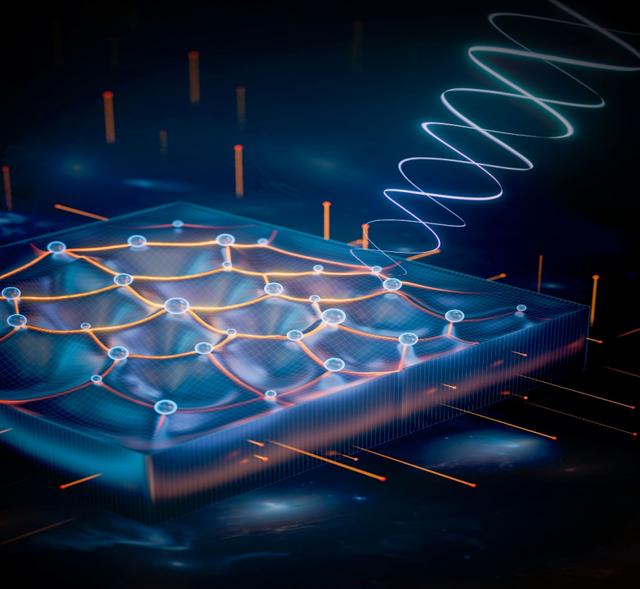
Chinese scientists have for the first time observed graviton modes that are condensed-matter analogs of gravitons, a major discovery for understanding new correlated quantum physics.
The research team, led by Du Lingjie from Nanjing University, spent more than three years designing and assembling an experimental apparatus that utilized resonant inelastic scattering of circularly polarized light to study low-energy collective excitations of the fractional quantum Hall liquids in a gallium arsenide quantum well.
The graviton modes in fractional quantum Hall liquids manifested as chiral spin-2 long-wavelength magnetorotons. (The hypothetical spin-2 bosons was pointed out as early as 1939.), which appears to be similar to a graviton.
"Gravitons correspond to gravitational waves, the latter of which has been experimentally confirmed, while gravitons have not been directly observed." Du Lingjie was quoted as saying by Xinhua News Agency.
"Gravitons are a product of the combination of general relativity and quantum mechanics. If the existence of this mysterious particle can be confirmed, it may help to achieve the unification of these two major theories, which is of great significance for contemporary physics," said Du.
The discovery was published in Nature on March 27.


- Shandong capital unveils Novi Sad-inspired sister city garden
- China's port throughput expands in early 2026 on strong container growth
- Sandy land miracle: Old friends to meet again
- Traditional dragon boat race in Hunan highlights local flair
- Xizang children's hospital joins charity program for severe illness aid
- Hand-carved dragon boats take shape in Hubei ahead of June festival





