



China's 'artificial sun' achieves breakthrough, key step toward fusion reactor









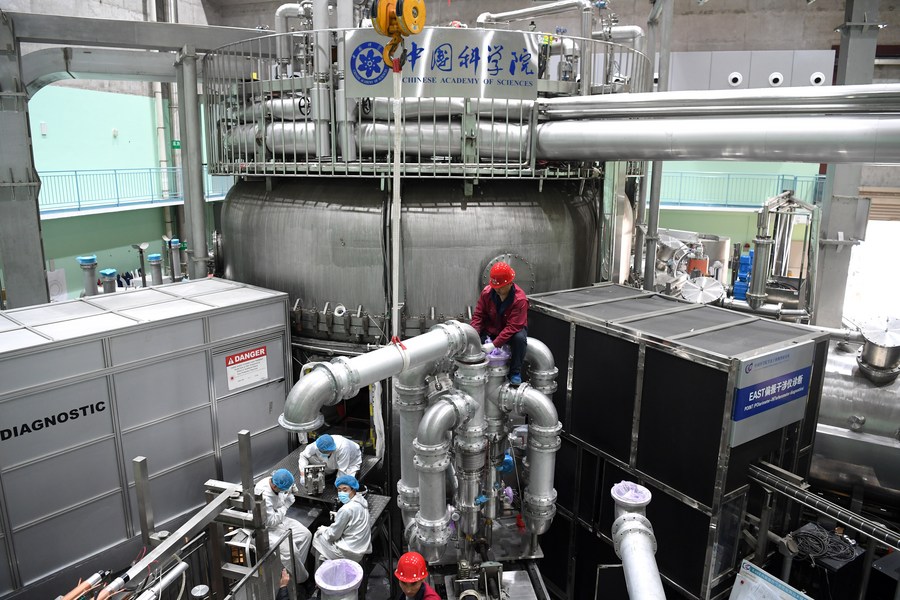
HEFEI -- The experimental advanced superconducting tokamak (EAST), or the Chinese "artificial sun," achieved a steady-state high confinement plasma operation for 403 seconds on Wednesday, a key step toward the development of a fusion reactor.
The breakthrough, achieved after more than 120,000 shots, greatly improved the original world record of 101 seconds, which was set by EAST in 2017.
The ultimate goal of EAST, located at the Institute of Plasma Physics under the Chinese Academy of Sciences (ASIPP) in Hefei, is to create nuclear fusion like the sun, using substances abundant in the sea to provide a steady stream of clean energy.
Song Yuntao, ASIPP director, told Xinhua in an exclusive interview that the main significance of this breakthrough lies in the high confinement mode.
The temperature and density of particles have been greatly increased during high confinement plasma operation, which will lay a solid foundation for improving the power generation efficiency of future fusion power plants and reducing costs, he said.
As opposed to fossil fuels such as coal, oil, and natural gas, which are in limited supply and have great environmental impact, the "artificial sun" requires raw materials that are almost unlimited on earth. Fusion energy is considered safer and cleaner, and therefore the ideal "ultimate energy" for the future of humanity.
Since its operation in 2006, the Chinese-designed and -developed EAST has been an open test platform for Chinese and international scientists to conduct fusion-related experiments and research.
At present, the engineering design of the future China Fusion Engineering Test Reactor (CFETR), which is seen as the next-generation "artificial sun," has been completed, aiming to build the world's first fusion demonstration reactor.


- Shanghai airports welcome intl arrivals with Dragon Boat festivities
- Rail service hotline expands role beyond passenger inquiries
- Plateau railway expert builds reliability on frontline experience
- Beijing nursing home flood disaster: Govt takes action against 17
- Hengqin Port sees surge in foreign arrivals under visa-free transit policy
- More Taiwan compatriots travel to mainland for Dragon Boat Festival celebrations





