



Chinese Cretaceous fossil sheds new light on evolution of mammalian middle ear









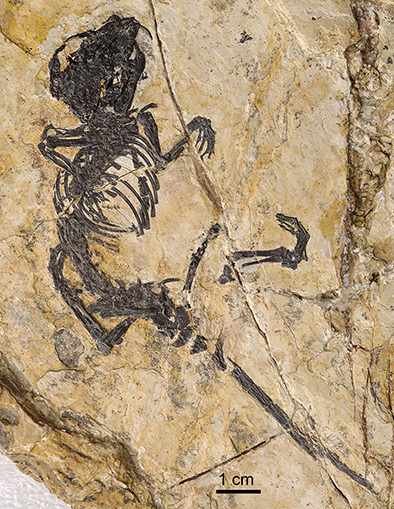
BEIJING -- Chinese scientists have found the fossil of a new Cretaceous mammal species in Northeast China's Liaoning province, shedding new light on the evolution of the mammalian middle ear.
The research was jointly conducted by paleontologists from the Institute of Vertebrate Paleontology and Paleoanthropology under the Chinese Academy of Sciences and the American Museum of Natural History. Their findings were published Wednesday in the journal Nature.
Attached to the dentary, the middle ear of early mammals moved when the animal chewed, which was inefficient. In modern mammals, the middle ear is detached from the dentary and is only responsible for hearing, making their hearing sharper and feeding more efficient, said Wang Haibing, one of the researchers.
The fossil, with its middle ear bones well preserved and detached from the dentary, has revealed a transitional stage in the evolution of the mammalian middle ear, offering direct evidence to scientific studies.
Based on morphological and phylogenetic analyses, the researchers have proposed a new pattern for the middle ear evolution in early mammals.
The peculiar jaw joint structure of the species allowed a more distinct jaw movement when chewing, which means more pressure on the species to detach the middle ear from its dentary in order to increase its feeding efficiency, Wang said.
The feeding pressure may have accelerated the evolution of the species' middle ear. As such, this group is believed to have developed the typical mammalian middle ear at least 160 million years ago before all other mammal groups, according to the research.


- Prosecutors step up legal protection for elderly people
- Hudong-Zhonghua Shipbuilding secures deal to build five LNG carriers
- Gansu kindergarten operator sentenced to life in lead poisoning case
- Japan needs to face history and reflect on past crimes
- Guangdong releases probe report on Shantou fire that left 12 dead
- China tightens fireworks safety oversight ahead of peak season





