



Power tower team tackles Taklimakan









Inspectors battle high temperatures and frequent sandstorms as they monitor more than 300 pylons in China's largest desert
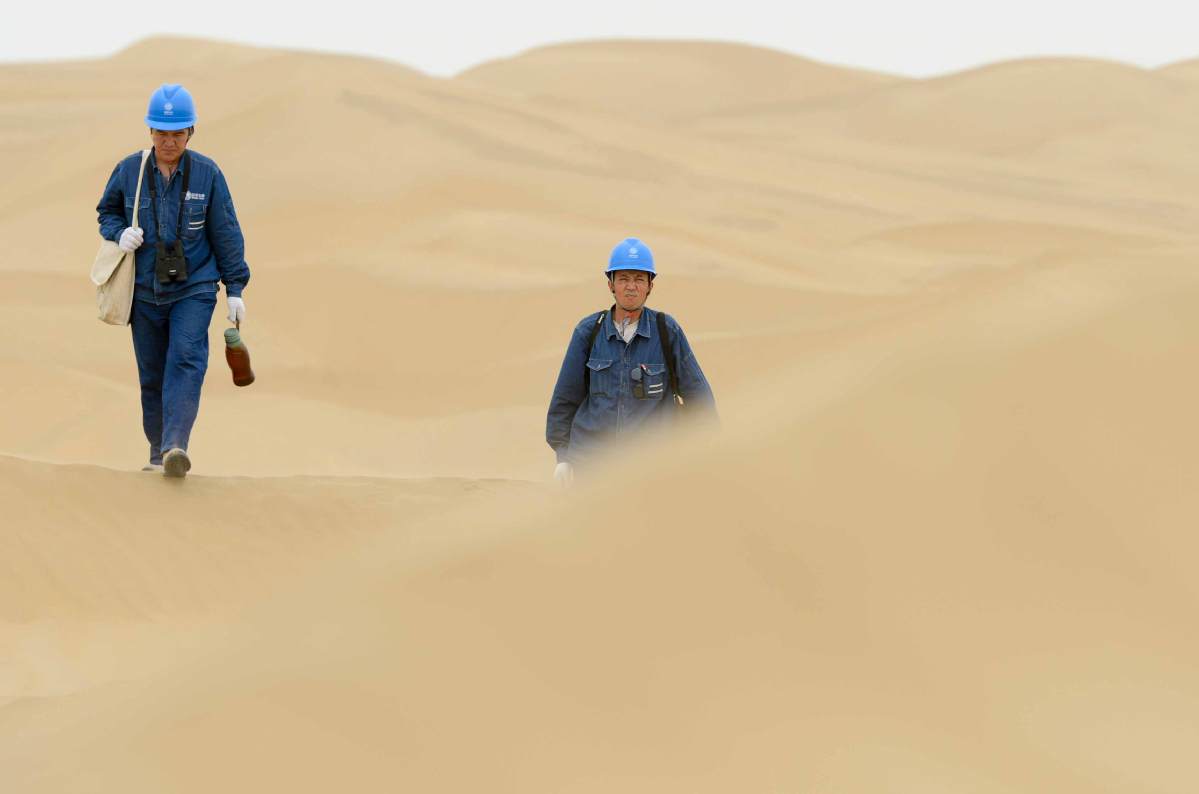
Knocking his wrench on a power tower while standing alone in the middle of the vast Taklimakan Desert, Ahmat Tohti listens attentively to the sounds it makes.
Differences in the sound can tell Tohti - a power tower inspector in northwestern China's Xinjiang Uygur autonomous region - whether the bolts and screws are securely tightened.
Xinjiang is the country's powerhouse, transmitting electricity to around 16 provinces and cities and serving 250 million people, according to official statistics.
An expansive network of transmission towers has been built across the cities, deserts and marshes of the region. Tohti and his seven colleagues are responsible for the safety of a sector in the Taklimakan, China's largest desert.
During summer, when air temperatures can rise to 40 C and ground temperatures can exceed 70 C, their jobs become more challenging.
Tohti has been a tower inspector for 28 years and carries binoculars, a camera and a gear bag weighing around 4 kilograms on a normal trip. When he works in the desert he also brings naan bread and a 1-liter bottle of water.
"They add to the weight, but once you're in the desert you never know when you will get out. It's essential to bring food and water," Tohti said.
In the sector Tohti inspects, State Grid Corp has built a 563-kilometer transmission line with 1,542 power towers, making it the world's longest 220,000-volt transmission line.


- Li calls for closer China-DPRK ties at bridge opening
- Scholars look to future of archaeology
- Chengdu kicks off 6th Park City Forum
- Foreign journalists trace history, influence of Long March
- Spirit of Long March fuels rural revitalization in Yunnan
- Doctor stripped of medical license for sharing false formamide data





