


 |
"It takes a month to photograph a painting and process the information online," Yu said.
The Dunhuang digitization began in the 1990s after it became apparent that the frescoes needed protection from heat, humidity and carbon dioxide.
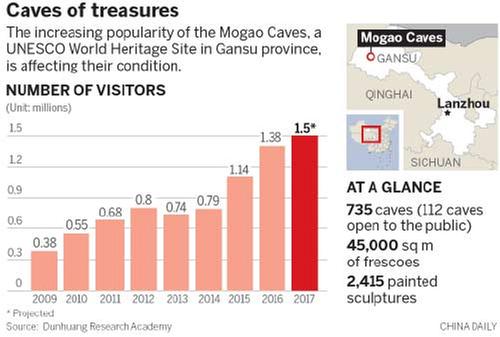
"The odor of perfume can linger in a cave for days and harm the frescoes," said Bian Lei, a tourist guide at the caves. "The colors are fading, too. I can see that."
It will be difficult to complete the digitization of all the caves. A photo of a painting on a wall now needs 60 gigabytes of storage space, similar to that of a smartphone, because one photo often has more than several thousands of parts.
In July, Seagate Technology, a US data-storage company, provided the academy assistance and donated $78,000 to support the digitization of cave 307, which has many images of children.
"Lots of high-tech companies want to cooperate with us. But many soon leave because they underestimate the time and patience that is needed for the preservation," Yu said. "It's a lifetime career."
Apart from taking photos and processing them over months, Yu and his team also use the data to replicate the look of sculptures and murals through 3D printing technology. Visitors to the caves can go to the replicas of eight caves in front of the real caves. They also are part of the academy's digitization project, and have been exhibited in many cities in China, and also in the United States, Japan, Australia and Russia.





