



Satellite ground stations provide key link in stable data flow









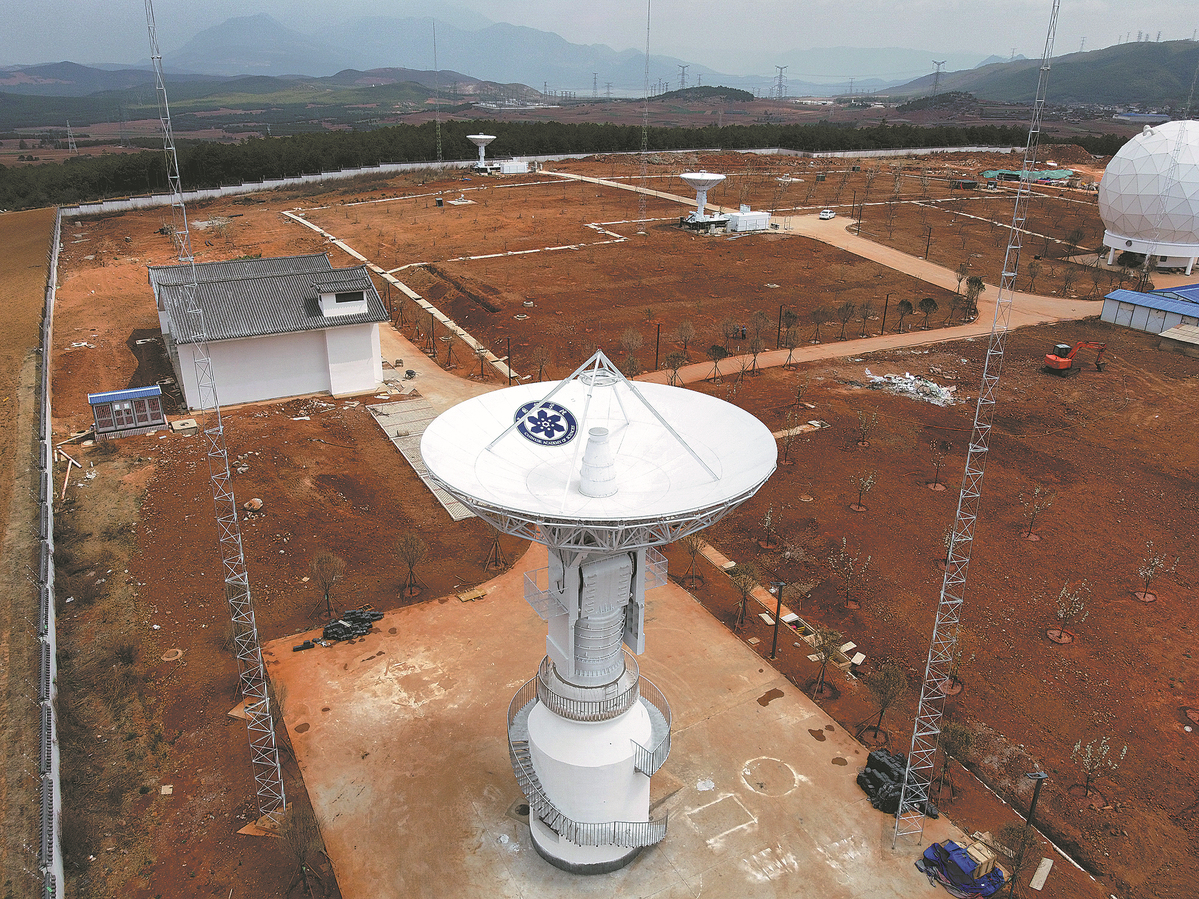
During a business trip to Beijing, Tang Mengyue talks with his colleagues on the phone in Lijiang, Yunnan province, about how to address a sudden power outage at the satellite ground station.
As the head of the Lijiang Satellite Ground Station at the Chinese Academy of Sciences Aerospace Information Innovation Research Institute, Tang's primary responsibility is to ensure the equipment runs smoothly.
"The equipment is backed up by an uninterruptable power supply, so a power outage doesn't happen unless there is a short circuit, leakage or overload. However, after investigating over the past few days, we didn't find any of these issues," Tang said.
"So we suspected there might be a poor connection in a certain section of the wiring. Therefore, we decided to open the distribution box and indeed found a loose wire, resolving the issue," he added.
To ensure no electromagnetic interference in the vicinity, satellite data receiving stations are typically situated in remote areas. Since the establishment of the first ground station in Miyun district, Beijing, in 1986, the China Remote Sensing Satellite Ground Station has built a network of satellite receiving stations in Lijiang; Kashgar, West China's Xinjiang Uygur autonomous region; Sanya, South China's Hainan province; and Mohe, Northeast China's Heilongjiang province.
The satellite data receiving station network, composed of these five stations, boasts 38 large-diameter data receiving antennas and over 10 high-speed optical fiber data transmission links, leading the world in scale and technical specifications, according to the Aerospace Information Research Institute under the Chinese Academy of Sciences.


- Alshaa named 'World Camel Milk Capital' at intl conference
- Lao woman finds belonging in Yunnan village through food and friendship
- Xi: Build more 'China Services' brands
- European students explore Shanghai's delivery drones, traditional crafts
- AI tools created to combat telecom fraud, blockchain-related crimes unveiled
- Man sentenced to 3.5 years for inciting ethnic hatred, discrimination





