Sichuan's environmental treasure go up on the big screen worldwide


Panda Rong Rong was happy to hear that kung fu panda Po in his new movie returns to his hometown on Qingcheng Mountain in Sichuan province. Rong Rong appreciates the province's efforts in guarding and nurturing its unique natural treasures. Also this month, Rong Rong invites foreign readers to share their Chengdu stories. In doing so you will have the chance to win prizes including laptops, iPads, Kindle readers and Udisks. Stories should be around 500 to 600 words. Please send them to siluyu@chinadaily.com.cn.
The first two installments of the movie series Kung Fu Panda, the latest of which came out in China and the United States last month, includes Chinese elements such as Sichuan cuisine, tai chi and the colored belt dance. However, those who see the film may be more interested in the Panda Village to which the hero Po returns with his father.
 |
|
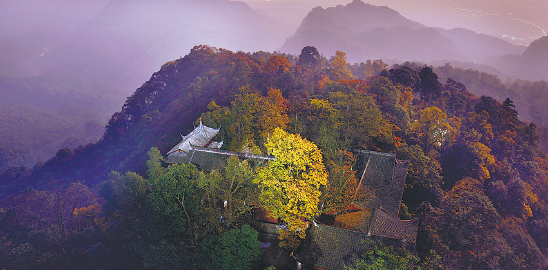
Qingcheng Mountain, northwest of Chengdu, is known as a birthplace of Taoism and for its peaceful natural environment. |
Po is amazed by the magnificent scenery on Qingcheng Mountain, where the Panda Village is located. Po finds his long-lost father and returns with him to the Panda Village, which is set on picturesque Qingcheng Mountain in Sichuan province.
"When Po and his father come to the Panda Village, the first things that come into sight are the wreathes of mist and the green forest, which are what the production team saw," said Raman Hui, director of the promotional music video for Kung Fu Panda 3.
Hui said the production team visited Sichuan many times looking for ideas and thought Qingcheng Mountain the perfect place to locate the fictional village.
 |
|
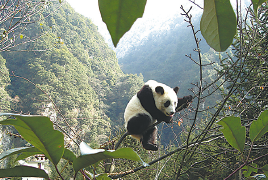
A panda in Baoxing county. French priest Jean Pierre Armand David discovered and documented the animals in Baoxing county in 1869. |
They also visited the pandas at the Chengdu Giant Panda Breeding and Research Base.
Qingcheng Mountain, northwest of Chengdu, capital of Sichuan, is well known as a birthplace of Taoism and for its tranquil natural environment in the world.
In 2000, the mountain was listed as a UNES CO World Cultural Heritage site, together with the nearby Dujiangyan irrigation system. In 2006 it was listed as a World Natural Heritage site as a corridor region of the giant panda habitat.
 |
|
Kung Fu panda Po plays with a friend. The movie featuring Po was released in China last month. |
"Dujiangyan, where the mountain is located, is a Panda Village really," said Chen Yongzhong, deputy director of the Longxi-Hongkou National Nature Reserve, one of the country's 67 giant panda reserves. "Thanks to the improving environment, it is home to 14 wild pandas now, but there used to be only six to eight."
Administered by Chengdu, Dujiangyan has two important wild populations of giant pandas. It is part of the ecological barrier in the upper reaches of the Yangtze River as well as a key region for the survival and reproduction of giant pandas, Chen said.
 |
|
In Kung Fu Panda 3, Po has a lot to digest. |
The city is also home to a rescue and disease control center and a field research center for the study of panda disease control and prevention, rescue and quarantine, rehabilitation and wilderness-survival training.
The two centers house 44 pandas that were bred in captivity. Some of those animals will be released into the wild.
 |
|
Twin pandas at the Chengdu Giant Panda Breeding and Research Base in northern Chengdu, which is home to more than 100 pandas. |
Chen said the city has enlarged the living space for its pandas by protecting the forest around the panda habitat and building a nature reserve. It has returned 12,355 acres of farmland to forest, and built the Longxi-Hongkou National Nature Reserve that covers 76,602 acres, expanding the giant panda habitat to nearly 98,000 acres.
Ecological barrier
The good ecological environment of the mountain and Dujiangyan is the result of protective measures throughout the entire province.
Luo Jianguo, chief engineer of the Sichuan Forestry Department, said the province is a large forestry province and one of the world's 25 most critical ecological zones. The province has taken the lead in the country to launch a Natural Forest Protection Project.
Sichuan has also started a Grain for Green project initiated by the central government, which aims to control soil erosion and restore the environment by returning farmland to forests.
In another development, the Sichuan government proposed to build the ecological barrier in the upper reaches of the Yangtze River for the sake of the Yangtze River Basin.
So far, the province has afforested more than 16.5 million acres of land. Its total forest stock ranks third and forest area ranks fourth in the country. "The sediment that enters the Yangtze River every year has been reduced by 300 million metric tons, nearly 80 percent of the flow, during peak season in the past," Luo said.
"Nature is the true treasure," Luo said. The annual value of ecological services provided by the province’s forests and wetlands, such as water conservation and air purification, is put at 1.65 trillion yuan ($251 billion).
The province has also protected more than 10,000 higher plants and 1,200 land vertebrates. Many of its endangered species, including the giant panda, have seen their number rise.
According to the fourth National Panda Census issued last year, there are 1,864 wild pandas in China, of which 1,387 are in Sichuan.
The province has been known to the world as home to giant pandas since French priest Jean Pierre Armand David discovered and documented the animals in Baoxing county in 1869.
Located on the western edge of the Sichuan Plain, Baoxing county is an important ecological area at the upper reaches of the Yangtze River. It covers 1,202.3 square miles, 99.7 percent of which is mountainous and 75 percent of which belongs to the core area for the protection of pandas.
"Sichuan province strove to improve its ecological environment during the 12th Five-Year Plan (2011- 15)," Luo said.
By the end of 2015, forests covered 36 percent of the province, 14 percentage points higher than the national average and 0.3 percentage point higher than in the previous year.
"Though a small number, the 0.3 percentage point means the forest area of Sichuan increased by 741,316 acres in 2015," Luo said.
During the 13th Five-Year Plan (2016-20), Sichuan will continue to cultivate its forest ecosystem, restore the wetland ecosystem and control the desert ecosystem and, as a result, to essentially complete the construction of the ecological barrier in the upper reaches of the Yangtze River, Luo said.
By 2020, the forest coverage of Sichuan province is expected to reach 37 percent.
Protection plans
Another major task for Sichuan is to enhance the protection of critically endangered wild animals, such as giant pandas and golden monkeys.
The province aims to provide effective protection for 95 percent of the national or provincial key protected wild animals and plants in nature reserves. The province also plans to build three national parks for giant pandas in Chengdu, Ya'an and Mianyang.
Experts believe the national parks will help break administrative barriers and create a better living environment for pandas as well as other endangered wild animals.
A giant panda national park planned to cover 623.9 square miles in Chengdu will be on Longmen Mountain to the west of the city. By building the park, Chengdu plans to enhance the protection and recovery of the forest ecosystem on the mountain and protect biodiversity.
The city also plans to add 16,570 acres of forest on Longquan Mountain to the east of the city over three to five years, raising the mountain's forest coverage by 8.75 percentage points to 59.8 percent, the Chengdu Forestry and Garden Bureau says.
By protecting and planting forests on Longmen and Longquan mountains and in other parts of the city, Chengdu aims to raise its forest coverage to 41 percent and its forest stock to 43.2 million cubic yards by 2025, the bureau says.
Longmen and Longquan mountains are ecological barriers for Chengdu and important parts of the ecological barrier in the upper reaches of the Yangtze River.
Chengdu launched an Ecological Belt Around the City project in 2012 to improve the ecological environment of its urban areas. The project aims to create an ecological preservation area along the city's ring expressway by 2020.
Under the plan, land within 656 feet of both sides of the ring expressway will be used for ecological construction.
The ecological belt, with a total length of 32.8 miles and a total area of 72.2 square miles, will connect six rivers and lakes and eight wetlands, increasing the city's total water area to five times that of the West Lake in Hangzhou, Zhejiang province.
The city is also planning to build several large-scale wetlands in its satellite cities.
Under the latest green space system plans, Chengdu will meet the standards of a National Ecological Garden City by 2020, with urban green coverage to reach 45 percent, green space ratio to reach 40 percent and parkland per capita to reach 17.9 square yards.
In July 2014 Chengdu was one of the first cities to be named a National Ecological Environment Demonstration Area by the National Development and Reform Commission and five other departments.