|
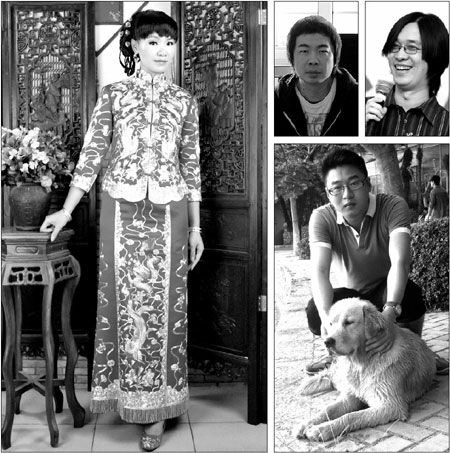
Clockwise from left: qungua designer Tang Zhiru, Web cartoonist Gao Youjun, Internet writer Tangjiasanshao, Internet writer Xia Yi. Provided to China Daily |
Young people use Internet to spread stories about their special creations

A recent online post on Sina Weibo carried a link to an intriguing new list published by the Chinese business magazine, Investment & Finance.
Highlighted were what the magazine considered the 10 "best paid emerging jobs of the year".
An online novel writer, for example, can make millions of yuan, apparently, by writing fictional stories about princes and princesses in ancient China.
No actual names were used, and none of the salaries were verified, but China Daily thought it would be worth digging out some people who actually do the jobs highlighted, to see how much they earn and whether their jobs are as appealing as the post suggested.
Web cartoonist
Despite being the boss of an advertising company that employs dozens of the most creative people in town, Gao Youjun thinks there's no better job than being an anonymous satirical Web-based comic cartoonist, whose job is to entertain tens of thousands of netizens for free.
By day, the 46-year-old Shanghai native is a senior executive serving high-spending clients.
But by night, after a day of toil - or in his own words, a day of frustration and rejection of his proposals from clients - the art graduate picks up a pen to entertain his loyal online followers, which have been built up to more than 58,000 on Sina Weibo.
"It's a process of self-healing," said Gao, who has also now had some of his work published in magazines and newspapers.
However, the company executive said any payment for the work is so "insignificant" that he hardly notices it when it gets credited to his account.
Gao's Web comic du jour started two years ago, over a casual dinner with a friend, who said he didn't think he had the patience to draw a strip every day.
But after three months or so, Gao's comic - posted under the ID name Tango2010, usually with few words and closely related to the news of the day or week - had begun to be widely reposted online.
"People seem to be more interested in seeing pieces aimed specifically at individuals, or those making a fool of someone," he said.
Female office workers from big cities like Shanghai, Beijing and Guangzhou make up the lion's share of his following.
"It's something I never expected," he said, adding that however late he posts his works online, there are people leaving a message or giving it a thumb-up almost instantly.
"It's strange, but when I can't be bothered doing a post, or I really feel like giving up the whole idea, that's when I tend to draw posts that get the best responses.
"When I'm really in the mood to draw, my followers appear to think I suck," he said with a laugh.
Of course, there are critics who complain that the popularity of social networks like Sina Weibo has done little more than breed an oversupply of so-called web cartoonists, who draw substandard illustrations.
Gao added that while some Web cartoonists in foreign countries have managed to make a living by allowing advertising on their sites, in China, publishing a book or drawing for other publications is usually the only major source of income.
Wedding gown designer
It might still be too early to say Tang Zhiru is a Chinese version of Vera Wang, the famed queen of bridal couture who has dressed Victoria Beckham and Chelsea Clinton, daughter of former US president Bill Clinton.
But for every stitch she knits, the 33-year-old wedding gown designer and tailor - or southern Chinese style qungua designer and tailor, to be more exact - is weaving a fairytale life of her own.
The centuries-old traditional longfengqungua (wedding costumes with dragons and phoenixes) was said to be first given as a gift by an emperor to one of his favorite ministers for his daughter's wedding ceremony.
Special permission had been granted to the daughter to wear a dragon and phoenix illustration, which were previously exclusive to the imperial family.
But the costume - consisting of a long skirt or qun, and a jacket or gua - gained popularity in Guangdong province, the hometown of the minister, which then spread all over China.
The tradition of wearing the qungua has been revived especially over the past decade, helped in part by the return of emigrants and by their wide use by celebrities in Hong Kong.
Tang, a native of Guangdong, has made her fortune through what she calls "taking advantage of an old trick in a new era".
The daughter of a veteran qungua embroiderer, Tang has been dreaming about starting her own qungua studio since watching her mother "magically produce flying dragons" as a child.
But things only really picked up in 2006, with the creation of Taobao, the online shopping bazaar.
Until then her business was mainly reliant on word of mouth.
But since the start of the online retail revolution, "everyone wants to wear a qungua in China", she said, and interest has spread around the world.
And with the advent of Weibo, on which photos of blushing brides smiling sweetly can be published, business has soared at her XiaoruQungua Studio.
"Now I have to limit the number of costumes produced," said Tang, who employs about 50 embroiderers, most older than 50, who can make a maximum of 150 costumes a year, with the most delicate, dubbed the guahuang, or the king of gua, taking three months to make.
A guahuang, with at least 80 percent of the space of the dress covered by embroidery, is priced at around 50,000 yuan (US$8,000), while the simplest designs cost 6,000 yuan.
"Many don't want to do this job. Making qungua is an art, and it's been undervalued," said Tang, who, together with her team, now runs a multimillion-yuan business.
It is thought there are less than 30 embroiderers in China younger than 30, who have the skills needed to design a traditional qungua.
It takes about 300 stages, from drawing a sketch to the final ironing, to complete a qungua, according to Tang, the majority of which is done by hand.
"It's different from machine work. A hand-embroidered phoenix, for example, is 3-D and should look as if there is a real one wrapped around the body of the bride," said Tang.
Her biggest worry is finding embroiderers. "It's much too painstaking a job for many. One has to sit there embroidering for 12 hours a day - poor eyesight and shoulder pain come with the territory."
Online writers
Xia Yi never expected that publishing his own online novel would bring him a fortune. "But I am just transfixed by looking at the click rate on my story soar," he said.
Xia's novel, The Last Taoist, first published on the online community site Baidutieba, has now attracted about 200 million hits.
"I work in IT and that has nothing to do with my writing. But I started the novel to share some of my life experiences with others," said the 27-year-old from Hangzhou, the capital of Zhejiang province.
The novel is based around the legend of a Taoist who is skilled in spells and magic, who fights with various devils to save people's lives, but who ends up being punished as he interrupts the order of destiny.
"My aunt and uncle told me the story when I was young, so it is rooted in my mind," he added.
To enrich the story, Xia interviewed some old men from his hometown in Anji county, Zhejiang province, and started writing the story in May last year.
"I write for three to four hours every night when it is quiet, so I can focus on the story," he said.
He first posted the story on BaiduTieba, which is free to readers. But when he reached about 70,000 words, a professional online reading website, Motie.com - a branch of China's biggest private publisher, Beijing Motie Book Ltd - contacted him and asked him to sign a deal with them.
Online readers can still see some chapters of his story for free but they pay for VIP chapters. He gets about 60 percent of the earnings, meaning he can make an extra income of about 10,000 yuan per month.
Given the popularity of the novel, Motie Book has now decided to publish a print version, which means Xia could earn about 100,000 yuan from royalties, according to Mo Zihan, the publisher, who was also a popular online writer before becoming a publisher in 2011.
He added that very few online novels ever get the chance to be published in print.
"Most online writers are part-time and earn only 20,000 to 30,000 yuan a year. Those with an annual income of millions are very rare," he said.
In November, the 2012 Chinese Writers Rich List launched its ranking of Internet writers for the first time.
It showed Tangjiasanshao, who topped the list, earned 33 million yuan from royalties and other commercial earnings generated by his works between 2007 and 2012.
But Xia said money is not his main concern.
"We in the post-'80s generation are immersed in the Internet. The high click rate means recognition by my peers, which brings me a great happiness that cannot be measured by money."
Malicious online critics
China's growing online shopping sites have created a new breed of critic, who can earn big money from posting feedback and comments on participating vendors.
"These people are like parasites, relying on China's fast-developing e-commerce sector," said Dong Yingqun, the chief technology officer for Hotsales.net, an Internet technology company focusing on online marketing.
Taobao.com, China's popular online shopping site, has a rating system to evaluate shops. Negative feedback from buyers can harm shop ratings and deter potential buyers.
These people, been dubbed malicious critics by the online retail industry, collectively make negative comments, allegedly on their online shopping experience and ask for "compensation" from vendors, many of whom simply pay up instead of risking further negative feedback.
According to Dong, these payments are never more than 1,000 yuan - not significant enough for vendors to file a lawsuit.
Last November, Taobao and the police launched a joint crackdown on a gang of malicious critics.
Seven suspects were arrested on extortion charges, according to a report in the Shanghai Morning Post.
Official data from Taobao shows that 65,000 malicious online buyer comments have been identified by the site.
Dong said that most of the malicious critics are part-time and gather on Internet chat rooms such as QQ.
"Individually they don't earn much, maybe a few thousand yuan a month, but the leaders of the groups, who find target vendors and works out the best strategies to attack a shop, can earn tens of thousands of yuan per month."
Posting positive feedback can also earn money, Dong said.
"If someone posts a negative comment on Dianping.com (an online platform for people to comment on service providers, mainly restaurants), you can hire a group of people to post larger numbers of positive comments so that the negative ones cannot be seen."
A positive posting pays 10 yuan but it has no legal risk, he said.
These groups of people, according to Dong, are often familiar with the rules of online shopping, many having been online vendors themselves, and lack the ethics of legitimate retailers.
"They live in the murky corners of society, but you can do nothing to stop them because they do no serious harm to society," Dong said.
Contact the writes at xujunqian@chinadaily.com.cn and wuni@chinadaily.com.cn

(China Daily 02/16/2013 page4)