left corner left corner
China Daily Website

Contemporary Cathay

Updated: 2013-02-02 08:28
By Matthew Fulco ( China Daily)

 Contemporary Cathay

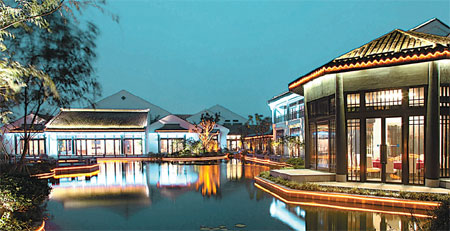
A view of the hotel grounds at night. Photos Provided to China Daily

Contemporary Cathay

A new Wuxi resort channels the China of legend, Matthew Fulco reports.

Rarely does a destination in China today evoke the ancient, mystical land in Western imagination. That China, which surely existed in many variations between the Xia and Qing dynasties, has largely disappeared. Tourist mobs siege the remains of it, from the Ming dynasty walled city of Pingyao in Shanxi province to the 1,000-year-old water towns of Jiangsu and Zhejiang pronounces.

Yet suppose an international hotel brand teamed up with a local government to build a sprawling resort in an historic Chinese architectural style. Surrounded by tranquil ponds and gardens, the resort lies adjacent to a wetlands preserve in the fertile Yangtze River Valley. The resort cleverly showcases the esoteric China we long to experience but retains the creature comforts most of us can't live without. Minus the karaoke bar and plasma televisions, this place looks like somewhere Marco Polo might have stayed here during his travels through southeastern China in the late 13th century.

The new 196-room property, Radisson Blu Resort Wetland Park Wuxi, is the creation of the Wu Culture Expo Park Co, owned by the district government, and the Minneapolis-based hotel company named for the 17th-century French explorer Pierre Esprit Radisson.

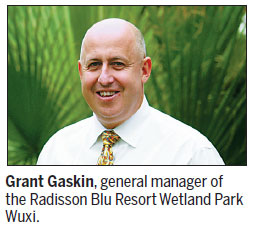
"Our charter is Wu culture," says general manager Grant Gaskin, referring to the region of China south of the Yangtze River that encompasses Jiangsu province, Zhejiang province and Shanghai.

In Chinese history, Wu was also a state that flourished during the Spring and Autumn Period (771-476 BC). It was then that Sun Tzu, the eminent military strategist and philosopher credited with writing The Art of War, visited the kingdom to lend his services.

Refinement and an implicit sense of beauty characterize traditional Wu culture. Elements of its rich aesthetic tradition fill the resort, including graceful calligraphy, elegant landscape paintings and handsome woodcarvings.

Water forms the basis for the hotel's interior design, chosen for the important role it plays in Wu cultural identity. The Wu people liken themselves to water, an element of nature which can be gentle or forceful. The white walls, gray stone floors and dark wooden surfaces of the resort represent water as it appears under different light, according to DPD International, the firm that designed the property.

Bamboo, which grows naturally throughout the Yangtze River Valley, also figures prominently in the resort's interior design. Warm and neutrally toned, it shows up in decorative line elements, screen patterns, furniture and even the lanterns hanging from the ceiling.

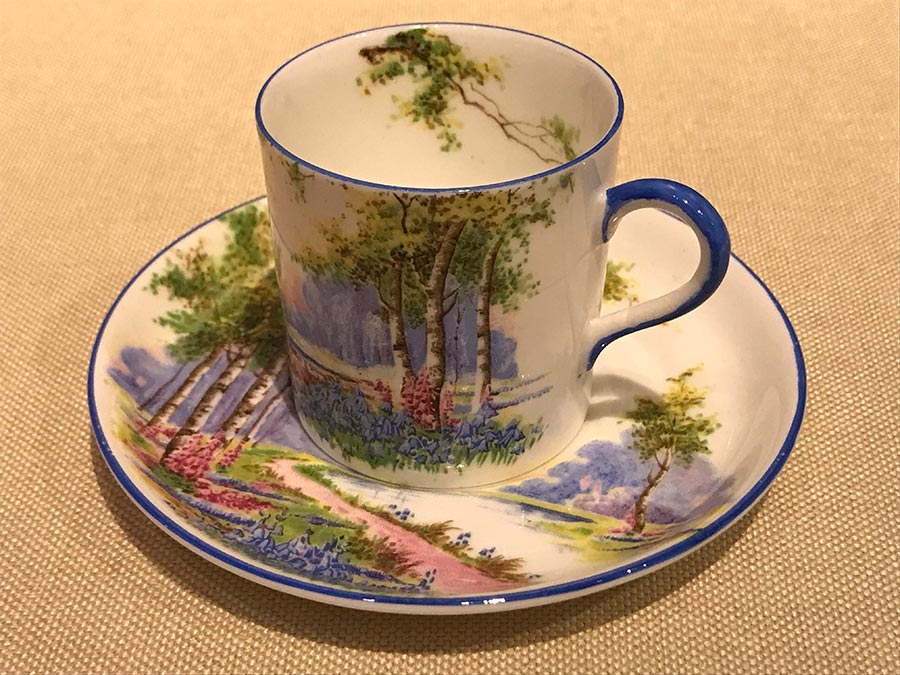
The soft color palette, accented by azure and celestial-blue celadon porcelain, mirrors the pleasant calm of the resort's environs.

With guests coming to the Radisson Blu Wuxi "more as a destination than just a place to sleep", Gaskin recommends visiting the nearby cultural attractions, many which tie into the Wu theme, including a museum of ancient tomb ruins, a stone park expo, the surrounding wetlands preserve and a giant Buddha statue.

The 88-meter, 700-ton Grand Buddha, located at the foot of Lingshan Mountain, is the ninth-tallest statue in the world.

Lake Tai, the third-largest body of freshwater in China, is also easily accessible from the Radisson Blu Resort. The picturesque lake has more than 90 islands, with some as large as several square kilometers. Lake Tai's unusual limestone rocks, eroded by chemicals that occur naturally in the water, are of particular interest. In dynastic China, scholar-gentry favored the water-worn stones as decoration for their private gardens.

After a day of sightseeing, Gaskin recommends dinner at Pisa, Wuxi's first authentic Italian restaurant - and they mean it when they say the head chef comes from Italy. There is plenty Marco Polo would like here, from the crispy stone pies to multiple pasta dishes made with homemade noodles from China, naturally. Tripe served in a rich meat sauce at room temperature just might be good enough to convert organ-meat skeptics.

Asked his thoughts on enjoying an authentic Italian meal in an otherwise very Chinese setting, Gaskin says: "It's nice to have a change."

Contact the writer at matthew.fulco@chinadaily.com.cn.

(China Daily 02/02/2013 page13)

...