|
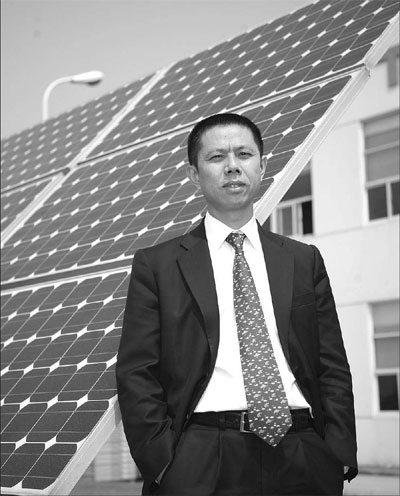
Gao Jifan, chief executive officer of Trina Solar Ltd, opened his headquarters for Asia-Pacific, the Middle East and Africa markets in Singapore in October. Under a ruling by the US International Trade Commission, punitive tariffs are imposed on the solar panels produced within China. It creates the possibility that ones produced by factories outside the country but owned by Chinese companies may not be included. Provided to China Daily |
Photovoltaic manufacturer expands globally to ride tough times

Smart businesspeople always try to avoid danger before it happens and that is certainly the case with China's photovoltaic solar companies as they face a trade war and shrinking global demand.
After the United States announced in October its final decision to impose punitive anti-subsidies and anti-dumping tariffs on imported PV solar panels made in China, many Chinese companies started seeking opportunities by cooperating with overseas partners or setting up factories abroad to survive the market onslaught.
One early bird in this respect was Trina Solar Ltd, one of the top four biggest PV solar products manufacturers in the country. It has been expanding its overseas business beyond the United States and Europe to other markets for years, trying to lower risks and increase its profitability.
It opened its headquarters for Asia-Pacific, the Middle East and Africa markets in Singapore on Oct 23.
Although the company had already established offices or subsidiaries in overseas markets over the past few years, it was the first Chinese company in the industry to set up its headquarters outside its home city - Changzhou, in East China's Jiangsu province.
The move indicates its international strategy under the background of growing solar trade disputes between China and the European Union which followed the US' move to start an anti-dumping probe in September and an anti-subsidies investigation in November into imported PV solar cells produced in China.
Under a ruling by the US International Trade Commission, punitive tariffs are imposed on the solar panels produced within China. It creates the possibility that ones produced by factories outside the country but owned by Chinese companies may not be included in the punishment list.
Trina Solar's headquarters in Singapore will provide management functions covering administration, sales, project development, research and development, logistics and purchasing operations, according to the company's statement.
The administrative regions include Singapore, Thailand, Malaysia, the Philippines, India, Japan, Australia, New Zealand, South Korea, the Middle East and Africa.
Gao Jifan, chief executive officer of the company, said the new headquarters will help the company's presence and capabilities in these regions to be strengthened considerably.
"Japan has set attractive tariffs for solar energy power generation as part of its efforts to replace nuclear power, while both India and Saudi Arabia have proposed ambitious solar power strategies," said Sun Haiyan, president of Asia-Pacific, Middle East and Africa at Trina Solar.
He said Southeast Asia and Africa also present solid business opportunities and is encouraged by the fact that solar energy has already reached grid parity in Australia.
During the third quarter in 2012, Trina Solar realized $21.2 million in revenue in the Indian market, accounting for 7.1 percent of its total revenue globally. Meanwhile, revenue from the Japanese market grew from zero in the second quarter to $9.8 million in the third, accounting for 3.3 percent of the total figure, according to the quarterly report from the company.
The revenue from Australia remained stable, growing slightly from about $24.2 million in the second quarter to $24.4 million in the third, according to the report.
Conversely, both the volume and shares of the company's revenues from the US, Germany and Italy all fell sharply from the second quarter to the third, affected by the solar trade disputes.
As early as the beginning of 2011, Gao said he planned to lead Trina Solar to become the world's biggest manufacturer of PV products by the end of 2015, during an exclusive interview with China Daily.
He predicted the US will have a growing market and said the company will make more efforts to provide integrated services, which are expected to contribute from 20 to as much as 50 percent of its profits in the coming years.
Although Gao didn't foresee the US probe into China's PV products, he did predict an industrial shakeup in the PV solar sector.
"The Chinese PV industry has undergone rapid development in the past few years but by the end of 2015 the speed of the development will slow down, resulting in consolidation in the industry," he said.
He also estimated that the number of big players in the solar power market will be fewer than 30 to 40 globally by 2020.
Because of the solar trade war started by the US and the EU, the process has been accelerated.
Gao formulated a strategy for the company's globalization early in 2010 and has followed it accordingly.
In May 2011, the company established an office in Sydney aimed at further exploring the Australian market after selling products there since 2009.
Now the company has a "notable" market share in Australia's PV solar sector, it said in an e-mail to China Daily.
Meanwhile, shipments to Europe and the US remain stable. The number of clients grew gradually in 2012 as the company made strenuous efforts to reduce trading costs, the company said.
The company will adjust its strategy to expand its presence in Japan and the Middle East in the near future, it added.
In July 2012, the company announced the establishment of a Canadian subsidiary in Ontario, a sign of the company's ambitions in the fast-growing Canadian market.
At the same time the company announced a partnership with Silfab Ontario Inc, a Canadian subsidiary of Italian-based international PV provider Silfab Spa, a move enabling Trina Solar to offer modules that are locally manufactured for the Canadian market.
Fueled by its tariff policy, Ontario has become the second largest North American solar PV market after California in the US.
"We foresee strong growth for the Canadian solar industry that could reach 1gigawatt by 2015," said Mark Paddison, the representative for Trina Solar in Canada. "We look forward to participating more directly in the growth of the industry and to collaborating with our Canadian partners to bring solar PV to the next level of adoption and popularity."
To cope with the tough environment now faced by China's PV solar industry, Trina Solar is actively working on increasing its original equipment manufacturers globally. At present, the company has offices or branches in 25 countries covering Europe, America and Asia-Pacific.
China's PV solar industry experienced about 40 percent growth in 2011 on the previous year. In 2012, the figure dropped to 15 percent, according to Gao.
However, the figures at least show that the industry is not shrinking. Instead it is still growing but at a slower rate.
Gao estimated the industry will maintain 15 percent growth in 2013.
dujuan@chinadaily.com.cn

(China Daily 01/14/2013 page16)