|
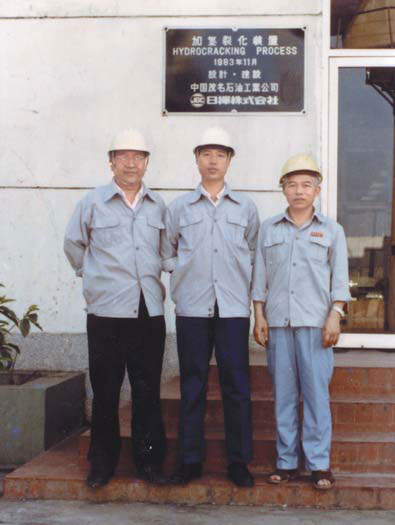
Zhang Gaoli poses for photos as he inspects developments at Maoming Petroleum Industrial Co of China Petroleum Chemicals Corp on March 9, 1984. |
|
Zhang Gaoli discusses post-disaster reconstruction work with local officials at Wulipo Group in Kangjiadong village of Hanyuan township in Ningqiang county, Shaanxi province, on June 18, 2008. |
When Zhang Gaoli was born into an impoverished peasant's family 66 years ago, no one might have imagined that he would become one of China's most powerful people.
The self-dubbed "poor boy", however, made it when he was elected last month to the top slate of leadership of China's ruling party.
Zhang became a member of the Standing Committee of the Political Bureau of the Communist Party of China Central Committee on Nov 15, along with Xi Jinping, elected general secretary of the CPC Central Committee, Li Keqiang, Zhang Dejiang, Yu Zhengsheng, Liu Yunshan and Wang Qishan.
The story of Zhang, who has ascended step by step to the top ranks, is a typical example of personal struggle in the Chinese political sphere.
Zhang's ancestors were all poor peasants in coastal Panjing village, located in Jinjiang, Fujian province.
His father died when Zhang was 3 years old. His mother managed to sustain his schooling despite family poverty. The diligent Zhang entered the prestigious Xiamen University in 1965, studying statistics at the school's economics department.
After his graduation in 1970, four years into the "cultural revolution" (1966-76), Zhang worked at the Maoming Oil Company in Guangdong. He spent more than a year working as a crane operator and loader, backpacking cement almost every day.
He later became an office clerk, deputy secretary of the oil company's committee of the Communist Youth League of China and deputy secretary of the Party committee of the company's refinery.
In 1984, he made his way to general manager of the company and concurrently served as deputy secretary of the CPC Maoming city committee.
An economist by training, Zhang began to lead the Guangdong provincial economic commission in 1985, and three years later became vice-governor of Guangdong.
Old hand at economic management
Tianjin residents pinned great hopes on Zhang when he became Party chief of the port city neighboring Beijing in March 2007. They hoped the old hand in economic management groomed in the country's reform and opening-up frontiers, such as Shenzhen, would help the city regain its past glory as one of the country's economic hubs.
Zhang did not let them down.
Despite slowdowns in both the Chinese and global economies from 2007 to 2011, Tianjin scored continuous growth in its gross domestic product, with an annual increase of 16.5 percent for five consecutive years.
The city's per capita GDP growth topped $13,000 last year, putting it ahead of all others in the country.
More than 1,000 highly polluting and resources-consuming enterprises were shut down during the five years, while hi-tech industries, such as supercomputers, new-type carrier rockets and aircraft, gradually became the city's economic backbone.
The Airbus assembly line in Tianjin has assembled more than 100 A320 planes and has been hailed as a model for China-Europe cooperation.
The city has also become a rotating host of the World Economic Forum Annual Meeting of the New Champions, also known as the Summer Davos Forum.
Zhang's achievements in Tianjin owed much to the experience he amassed while working in both Guangdong and Shandong.
As a provincial leader handling economic issues, he spent more than 10 years in Guangdong and for many years served concurrently as Party chief of Shenzhen, the showcase of China's reform, witnessing how new economic policies transformed the province and the city.
When the Asian financial crisis occurred in the late 1990s, Zhang promoted infrastructure improvements in Shenzhen, including airport expansions and subway construction, aiming to narrow the development gap between the boomtown and neighboring Hong Kong.
After he was transferred to Shandong and became the province's governor and, later, its Party chief, Zhang directed his focus toward the development of foreign trade, hi-tech industry and the private economy.
In 2006, GDP in Shandong exceeded 2 trillion yuan ($256 billion), second only to that of Guangdong.
Do more, speak less
Zhang is known among local officials for his down-to-earth work style and rigorous requirements.
He always called district and county officials at night, asking them how their work was going.
Some local officials joked that they were afraid of "neither the god of heaven nor the god of earth, but only Secretary Zhang's night call".
"Do more, speak less" is his motto.
The day after he arrived in Tianjin in 2007, Zhang went to the Binhai New Area, a comprehensive reform pilot zone regarded as a new economic engine of the country, for an inspection of factories and the port. He also visited residential communities and talked with residents.
In the following years, he conducted an inspection tour of Binhai almost once a month to spot problems in its development and to help find solutions.
"Serve the people, work in a pragmatic manner and be clean", are the words Zhang always uses to advise himself and his colleagues.
While in Tianjin, he often went to markets, parks and residential compounds accompanied by just one or two aides to get to know what the public was really thinking.
He could also be seen riding in a taxi or playing chess on the sidewalk with gray-haired senior citizens - all in the hope of soliciting public opinion.
"I, myself, was born a poor boy, and so I feel my duty as an official is to try my best at work, be upright and serve the people whole-heartedly," Zhang told a journalist on the sidelines of the annual session of the national legislature in March.
A netizen commented, if an official remembers he was previously "a poor boy", it means he understands the people's troubles.
For Zhang's native villagers, however, the person behind the big name remains almost a stranger, as he seldom returns to Panjing, where his brother still lives.
As a member of the top leadership, Zhang said after his promotion that he is ready to continue to be under the scrutiny of the people.
"If anybody comes to you for favor under the name of my family, relatives or friends, please never hesitate to refuse him or her," Zhang was quoted as saying to senior officials who welcomed him to work in Shandong.
(China Daily 12/26/2012 page8)