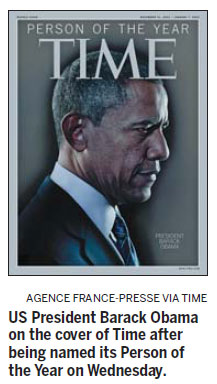
Time magazine on Wednesday named recently re-elected US President Barack Obama as its person of the year for 2012 - the second time it has accorded him the accolade.
With re-election as the first black president of the United States and a Nobel Peace Prize under his belt, Obama beat favored runners-up in the magazine poll, including Pakistani girls' rights activist Malala Yousafzai, to be enshrined again as Time's dominant personality of the year.
"We are in the midst of historic cultural and demographic changes, and Obama is both the symbol and in some ways the architect of this new America," Time Editor Rick Stengel told US television network NBC when he announced the selection on Wednesday.

The magazine praised Obama's campaigning prowess, noting he was the first president since Franklin Delano Roosevelt to win more than 50 percent of the vote in two straight elections and the first president since 1940 to be re-elected despite a jobless rate above 7.5 percent.
Obama beat Republican challenger Mitt Romney soundly in November's election to win a second term, despite presiding over a chronic economic slump.
"In 2012, he found and forged a new majority, turned weakness into opportunity and sought, amid great adversity, to create a more perfect union," said Time, which had named Obama person of the year in 2008 when he won his historic first presidential election.
Perhaps the most poignant alternative to Obama on Time's shortlist was Yousafzai, the 14-year-old Pakistani girl who continued to campaign for the right to education after being shot and nearly killed by the Taliban.
The other people in contention for the title were Apple CEO Tim Cook, Egypt's post-revolutionary President Mohammed Morsi and atomic physicist Fabiola Gianotti.
Person of the year, or what used to be called "man of the year", acknowledges what the magazine considers to be the world's biggest newsmaker, or influential mover.
Since the tradition started in 1927, US presidents have systematically featured, as have big names like Microsoft's Bill Gates. But more symbolic winners, such as "US scientists" in 1960, have also appeared.
Since the leader of Iran's Islamist revolution, Ayatollah Khomeini, made the cover in 1979, the magazine has tended to shy away from picks that might upset its mostly US readership. A notable absence was al-Qaida founder Osama bin Laden in the wake of the Sept 11, 2001, terror attacks.
Obama could not be a less controversial choice.
Time said he swept to the head of the pack because of his ability to grasp the demographic and social changes shifting the US.
"The truth is," Obama told Time, "that we have steadily become a more diverse and tolerant country that embraces people's differences and respects people who are not like us. That's a profoundly good thing. That's one of the strengths of the country."
Time said Obama was about "convergence of past and future" and said his second term would see him being "more assertive, more personal, more willing to risk his political capital for what he truly believes".
AFP-AP
(China Daily 12/21/2012 page10)