left corner left corner
China Daily Website

The changing but still colorful face of US Chinatowns

Updated: 2012-12-07 08:09
By Kelly Chung Dawson ( China Daily)

 The changing but still colorful face of US Chinatowns

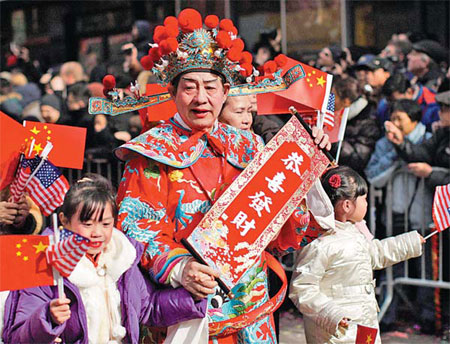
Revelers attend a Chinese New Year's parade in New York's Chinatown in January. Eduardo Munoz / Reuters

 The changing but still colorful face of US Chinatowns

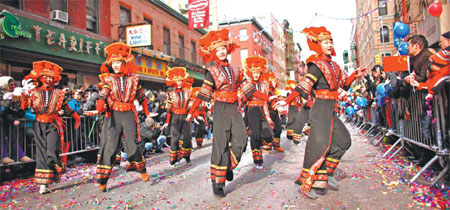
Revellers dancing at the Chinese New Year parade in New York's Chinatown earlier this year. Eduardo Munoz / Reuters

 The changing but still colorful face of US Chinatowns

Customers crowd into the Yunhong Chopsticks store in Chinatown in New York. Provided to China Daily

 The changing but still colorful face of US Chinatowns

A customer examines the produce at a market in Chinatown in San Francisco. Justin Sullivan / AFP

 The changing but still colorful face of US Chinatowns

President Barack Obama greets patrons during a visit to the Great Eastern Restaurant in San Francisco's Chinatown. Provided to China Daily

Traditional role of the urban communities survives, Kelly Chung Dawson reports from New York.

When 50,000-plus Chinese prospectors flocked to California during the mid-19th-century Gold Rush, makeshift communities sprang up seemingly overnight. They offered services, protection in numbers and familiar food to the new arrivals.

In 1848, the year historians consider the start of the Gold Rush, San Francisco's Chinatown - the first Chinese-immigrant enclave in North America - was founded. During subsequent decades, similar communities were established in New York, Boston, Philadelphia, Detroit and Chicago, among other cities. Many of these communities remain today, but the character and dynamics of "Chinatowns" have changed - largely due to shifting demographics, gentrification and the dispersal of Chinese among the "ethnoburbs", described by experts as satellite communities of middle-class immigrants.

In New York, the 100,000 or so residents of Manhattan's Chinatown - one of the most populous Chinese enclaves outside of Asia - are now outnumbered by the aggregate size of outer-borough communities in Flushing, Queens, and Sunset Park, Brooklyn.

The nominal Chinatown lost 17 percent of its population between 2000 and 2010, according to the US Census Bureau, while Flushing's rose by 93 percent and Sunset Park gained 71 percent.

"US Chinatowns are vulnerable and are in some cases fading out," said Wellington Chen, executive director of the Chinatown Partnership Local Development Corp, set up in 2006 by local businesses and the New York City government to revive the area.

"The Jewish, German and Italian immigrant communities all disappeared, but we're still here. What gives us hope is that there are certain attributes in the traditional Chinatowns that suburban satellite communities simply can't compete with. Here in New York, it's our location, our concentration of Chinese associations and businesses, and, most importantly, the type of history and roots we have," said Chen.

"I believe that Chinatown will remain, and it will continue to evolve."

Today, the Census Bureau estimates that 3 million Chinese-American adults live in the United States; three-quarters of them were born outside the country.

Transition gateways

Historically, a US city's Chinatown has been a gateway for new immigrants who need help with their transition, said Daniel Abramson, an associate professor of urban design and planning at the University of Washington, who has studied the development of US Chinatowns.

"For low-income immigrants, it's especially important to live in communities that are spatially concentrated," he said. "They don't have mobility, so they rely on public transportation. They can't afford to buy houses in the suburbs, and they need face-to-face communication in their own language. They also need the opportunities that come with a centrally located place, because they don't have settled careers."

Illegal immigrants are more likely to live in a traditional Chinatown like the ones Abramson describes, because the density of older neighborhoods makes them harder to police, he said. Additionally, Chinatowns offer cheap, and often substandard, housing that attracts the type of immigrants who see their situations as transient.

A Chinatown's population also includes "floating" workers in low-skill jobs at restaurants, grocery stores and other businesses, said Howard Shih, census programs director at the Asian American Federation, a New York-based nonprofit organization.

"You don't necessarily have to speak English to find a job in a place like Chinatown," Shih said. "That's the appeal. You slowly develop skills and learn about opportunities, and then hopefully you move on.

"Right now, we are still seeing a stream of working-class immigrants who are looking for economic opportunities in hopes of sending money home to China. There is a continued need to help them get on their feet, to find jobs and learn English. That hasn't changed."

For immigrants, the desire to cluster with others from one's country of origin is universal, Chen said. Chinatowns allow new arrivals to retain ties with their homeland while they get help finding a place to live, a job, legal services and other resources.

Abramson described the role of a traditional Chinatown in a 2006 article.

"Ethnic minorities themselves have found the notion of 'enclave' useful to maintain their identity, provide themselves with information and social and cultural services, and to empower themselves politically through mobilization and solidarity - all of which are made easier through spatial concentration," he wrote in the Journal of Architectural and Planning Research.

"North American Chinatowns can be seen as extreme cases of dichotomous urban ethnic space. They are typically among the most sharply-bounded urban enclaves to be found in American cities."

In recent years, the economic rise of China has helped alter the demographics of the United States' Chinese population and provided an impetus for the establishment of Chinese enclaves with new characteristics, said Sarah Swider, a sociology professor at Wayne State University in Detroit and an expert on immigration.

"The earlier wave of Chinese immigrants was more likely to be poor," said Swider. "Now, the situation is that these migrants include people across different social classes, from the global 1 percent to the poor."

The Census Bureau reports that recent arrivals from Asia are twice as likely to have a bachelor's degree as those that arrived in the US three decades ago. This shift has created a need for "one-step-up" Chinese communities such as New York's Flushing and Sunset Park, said Tunney Lee, professor emeritus of urban studies and planning at the Massachusetts Institute of Technology.

"Highly educated, higher-income immigrants are going directly to the suburbs," Lee said.

According to the Asian American Federation's Shih, the median household income in Flushing in 2011 was $45,810, with Sunset Park trailing at $32,371. The figure for Manhattan's Chinatown was $26,046.

Additionally, the population of Manhattan's Chinatown is aging, with younger generations opting for cheaper, more spacious living in Flushing and Sunset Park, Shih said. The Manhattan enclave saw a decrease of 1,858 children in its population between 2000 and 2010, according to census data.

Middle-class, educated immigrants aren't dependent on Chinatown-centered services in the way their lower-income counterparts are, the University of Washington's Abramson said.

"Wealthier immigrants tend to be better-educated and more likely to speak English," he explained. "They can get around, and they're able to hire support in the form of lawyers, insurance and real estate agents that will ease their transition. They will live like affluent Americans of the same wealth level in other areas, but they will still shop in Chinatown or other places where there's a concentration of good food and products they're familiar with."

In cities such as Seattle and Portland, Oregon, traditional Chinatowns have become almost entirely commercial districts, Lee said. He also pointed to Las Vegas' Chinatown, which is strictly commercial and actually pan-Asian in character.

This indicates a continued need for traditional Chinatowns, regardless of where Chinese choose to live, said Kevin Hsieh, who runs the online information platform SanFranciscoChinatown.

"Many students in San Francisco might live in another part of the city, but they come back to Chinatown to shop and eat," he said. "If you want to feel like you're home for a bit, and you know it'll be a while before you get to go home, Chinatown is where you go."

According to the 2010 census, the average Asian-American lives in an area where 20 percent of residents identify themselves as Asian; in contrast, most Hispanics live where 45 percent of people are self-identified Hispanics. However, Asian-Americans make up far less of the US population than Hispanics do, and are therefore statistically less likely to cluster, the report notes.

The 'Gold Mountain'

With China's emergence as an economic power, more overseas Chinese may be seeing their home country as "Gold Mountain" - a nickname applied to the US during the Gold Rush days. But Madeleine Sumption, a senior analyst at the Migration Policy Institute in Washington, believes China's growing wealth may actually be a driver of emigration. There has been evidence of immigrants returning to China after living in the US, but mostly among higher-educated Chinese, she said.

For lower-income immigrants (who are more likely to live in a traditional Chinatown), economic prospects still remain more attractive in the US, according to MIT professor Lee.

"Income inequality is still pretty large in China, and in the rural areas there are fewer opportunities," he said. "I think that both the higher- and lower-income immigrant groups here in the US will continue to grow. There is a continued influx of working-class Chinese people coming into the US, and there will continue to be a need for places like Chinatown."

Abramson pointed to cities in China such as Fuzhou, in the east coast province of Fujian, that have a long history of sending people to the US.

"It's part of the culture and tradition," he said. "But now people are here, and it's difficult to go back once their children have been raised here and they end up living a transnational kind of life. There is improved mobility now, and instead of people leaving China for a short period to make money and then going back to live out the rest of their lives in China, they travel back and forth and end up having lives on both sides."

In Swider's view, traditional Chinatowns will continue "because the ethnic enclave plays an important economic role in offering opportunities to migrants with capital to invest and in providing lower-skill- and language-level migrants with jobs".

Abramson agreed: "As long as migration doesn't stop, I don't think that Chinatowns are going to disappear. They will change their shapes and locations in some cases, but they have real heritage meaning for Chinese-Americans and for Chinese who have become full citizens.

"They still value this part of their history. There are all kinds of reasons that Chinatowns will continue to be relevant," he said.

Chen, of New York's Chinatown Partnership, said tourism will remain a boon to the Manhattan enclave.

"We have tremendous assets, and the way I see it we are sitting on a gold mine," he said. "We are within walking distance of Ground Zero, which over the next 50 years will be one of the most-visited places in New York. It's our job to divert those tourists to our neighborhood. It's up to us to combine forces and evolve."

In the wake of the Sept 11, 2001, terrorist attacks, the area lost thousands of garment-manufacturing jobs. And although the tchotchkes, counterfeit handbags and souvenirs sold on Canal Street remain a perennial draw for tourists, Chen looks to Japan as a model.

"After World War II, Japan's imitation knock-offs were a joke, but Japan emerged at the other end with manufacturing and design prowess," he said. "It's my hope that Chinese designers like Vera Wang and Nautica will be a bridge in leveraging Chinese design talent and creativity in utilizing our manufacturing capabilities.

"Chinatown is not going to be taken over. We can't count on our residents alone; we have to diversify, reconnect with our surrounding areas, and we have to re-imagine. What does Made in China mean? And what does Made in Chinatown mean today?"

Contact the reporter at kdawson@chinadailyusa.com

(China Daily 12/07/2012 page6)

...
...
...