left corner left corner
China Daily Website

The high life that borders on danger

Updated: 2012-12-04 07:59
By Hu Yongqi and Li Yingqing in Nujiang ( China Daily)

 The high life that borders on danger

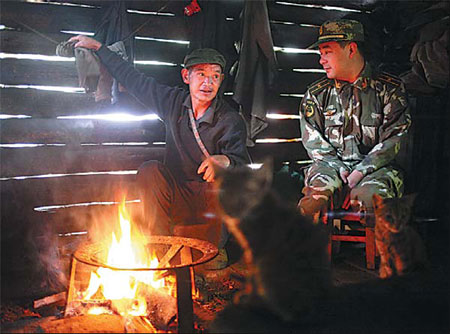
Huang Jianfeng (right), a political instructor at Dulongjiang Frontier Police Station, keeps in close contact with the villagers. Wang Jing / China Daily

 The high life that borders on danger

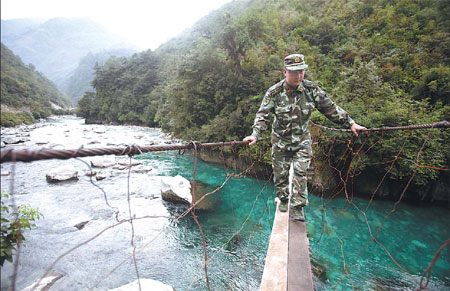
Huang Jianfeng, the political instructor at Dulongjiang Frontier Police Station, crosses the bridge he and his soldiers built at Pukawang village in Gongshan county, Yunnan province. Wang Jing / China Daily

 The high life that borders on danger

Gao Yaowang, a soldier from Dulongjiang Frontier Police Station, positions a villager before taking a photograph for her ID card. Xie Yong / for China Daily

The high life that borders on danger

The high life that borders on danger

Mountain passes and raging rivers are part of the daily experience for frontier soldiers, report Hu Yongqi and Li Yingqing in Nujiang, Yunnan province.

On an October morning, Huang Jianfeng, 34, drove down a rugged dirt road. He was on patrol along the border with Myanmar in Yunnan province.

Nearby, the misty mountains resembled the classic heaven of Chinese myth as plants swayed in the sunlight under a clear azure sky.

Huang, a political instructor at Dulongjiang Frontier Police Station, had little opportunity to enjoy the beautiful scenery, though. Instead, his eyes were fixed firmly on the newly built road that sliced like a knife cut through the mountainside.

Huang repeatedly glanced into the valley, watching the rocks tumbling down the hillside.

The ride was bumpy, jolting one of the five soldiers napping in the back who hit his head on the roof and woke up shocked. The car was easy to spot because of the huge dust cloud left in its wake.

As the only armed force in the border township of Dulongjiang, which neighbors Myanmar in the west and the Tibet autonomous region in the north, the small garrison patrols 115 kilometers of Yunnan's 4,000 km border with Myanmar, Vietnam and Laos.

Huang was driving the soldiers to the 41st boundary marker. As usual on their trips to the isolated region, they had brought a bag of rice and some cabbage prepared the night before. Having borrowed cooking pots from the residents of Qinlandang village, where the road ends, the men sat down to make lunch.

After eating, the soldiers walked 5 km to the marker and crossed the Dulong River via a bridge made from wooden slats connected by steel wires. When they reached the middle of the swaying bridge, a couple of the soldiers stopped, fearing that one false step could be fatal.

Huang took over and taught them a valuable lesson: Fix your eyes on the other end of the bridge, rather than the water down below.

One kilometer farther to the south, a 10-meter-wide waterfall "coming from nowhere" formed a tunnel across the road. Water from the cataract soaked their clothes as they stepped carefully underneath, aware that one slip on the washed-out stones could be deadly.

Difficult as it might sound, this journey is easier than in years gone by, when a routine patrol to the 41st marker took at least seven days.

"In some places, there was no road and soldiers had to explore the path, using a wooden stick to check for subsidence. Even horses couldn't be used because the road was so narrow," said Chen Jiawen, the station's deputy director.

Chen and Huang appreciate the roads that have shortened the walking distance. "Before, the soldiers had to walk all the way to the border, but now at least we can access the dirt road by car," said Chen.

Scores of people regularly cross the border from Myanmar at the 41st marker to buy daily necessities in Dulongjiang, and the locals find the soldiers' presence reassuring, said He Xiangxiong, the Party secretary of Dulongjiang.

The two other border markers in the area, 42 and 43, haven't been visited since 1996, because of the dangers of the journey and a shortage of soldiers, according to the patrol's records, but that may soon change.

"The station will try its best to conduct more patrols. It's important that we provide security for the locals and show our sovereignty over the land."

Long-distance love

Huang had dreamed of becoming a soldier since childhood. So, when he graduated from Yunnan University of Nationalities in 2001, he enlisted in the Yunnan Provincial Frontier Defense Corp.

After six months' training, Huang was allocated to the police station in Luobenzhuo, Lushui county in Nujiang Lisu autonomous prefecture. The tiny settlement only had two stores and one restaurant, but even those meager amenities were better than those in Dulongjiang when he arrived in September 2003. At that time, Dulongjiang had no restaurant and no cellphone coverage.

After a celebratory dinner on Chinese New Year's eve, Huang and his fellow soldiers eagerly lined up at the town's only landline to phone home and greet their families.

"We called our parents through the operator in Kunming (Yunnan's capital). Each of us was allowed to speak for just three minutes because others were waiting," he said. He recalled his dismay at hearing his parents crying on the other end of the line and knowing there was nothing he could do to ease their tears.

"Sometimes you have to choose duty and sacrifice time with your parents," said the veteran of 13 years.

Before 2004, letters provided the only method of communication with the outside world. The soldiers used the radio network to dictate messages to colleagues, who would then faithfully transcribe the words and then post the letters. Even then, one of Huang's letters took two years to reach its destination because the mail service was suspended during the winter months.

The lack of interaction with the outside world leaves the soldiers isolated. Huang was unable to talk to his girlfriend in either 2003 or 2004. When he completed his tour of duty in 2005 and returned to Kunming, he discovered she had married another man. The same thing happened to at least eight of the soldiers serving in the region.

In October, Huang had an argument with his wife who lives in Liuku, the capital of the prefecture. When he left home in May to take up his duties in Dulongjiang, Huang promised to celebrate his son's 5th birthday by going home. However, pressure of work meant he was unable to keep his promise and his wife had threatened divorce. For the following five days, Huang made peace by sending affectionate texts, calling his wife "sweetheart". It was the first time he'd ever called her that, he said.

This is Huang's second stint working at the remote station, located deep in a valley that nestles below the 4,000 meter-high mountains. Unlike other frontier stations in Nujiang, Dulongjiang has only one means of exit or entry and that is buried in 2-meter-deep snowdrifts from November to June. During the winter, no one enters the township and no one leaves.

"It's often very lonely in this sparsely populated place, so we are always happy to see the local people," said Chen Jiawen.

Because of the workload and isolation, few of the 22 soldiers in Dulongjiang have managed to take their 40-day annual leave.

"Things have improved during the past few years and I can talk with my son on the mobile phone," Huang said. "I know my wife was completely right, but still, I have duties to fulfill. I will ask for leave next month so we can be reunited."

Zhang Hui, 27, has married a woman in Liuku. However, three years later, he still hasn't officially completed his wedding because he hasn't been able to get away and complete the formalities in his hometown in Sichuan province.

"Technically I have had just half a wedding, according to Sichuan tradition. That's not acceptable to my grandparents, but I've been too busy here and couldn't take my wife back home to meet them," he said.

Lost lives

In addition to the pressures imposed by long-distance relationships and marriages, the soldiers have other challenges to face, such as a lack of medicine and the dangers posed by encounters with snakes, leopards and wild boars.

In 1952, a team of officials and soldiers from the county seat of Gongshan Dulong and Nu autonomous county, traversed the snow-capped Gaoligong Mountain. When they arrived in Dulongjiang, the local people were so scared that they ran away and hid in the mountains. The team lacked funds and so they traded medicine for salt and other daily necessities with any Derung people they could find. As their interaction with the locals increased, the locals became more used to their presence.

In 1978, a frontier station was established in Bapo village, but was moved to Kongdang village in 2003. Since then, eight soldiers have lost their lives in the rarely visited region.

In 1964, Zhang Pu, was diagnosed with acute appendicitis. Although the condition could easily be cured in the outside world, the township had no operating facilities or medicine. Zhou Enlai, China's premier at that time, arranged for a Chinese plane to fly through Myanmar airspace and drop medicine and equipment, but it was too late.

In 1977, Zhang Zhifan, aged 18, died when he fell into the valley as he explored new routes for the villagers. His body was never found. In 1991, Zhuang Yun was killed when he fell from a cliff edge as he helped locals cut firewood. Ten years later, Yu Jianhui, 20, who was helping to build a new road, fell into the Dulong River and drowned.

Every year, the soldiers pay their respects to their lost comrades at the graveyard in Bapo village. Although the ceremony consists of just a cigarette, a cup of wine and a formal bow of recognition, it's performed with due dignity.

Despite all this, the soldiers remain. Ma Guoxin, 50, of Maku village in the southern part of Dulongjiang, said his live has been saved by the soldiers on three separate occasions

In November 2002, Ma gashed his calf, losing a large amount of blood as a result. The flow was only staunched by Long Neiqing, the medical assistant at the station, who rushed to his aid late at night.

In 1983, Ma was bitten on the foot by a venomous snake. Another medical assistant, Fan Shide, was forced to suck out the venom because no anti-venom was available. Finally, in July 1996, Ma survived the same scenario when another soldier sucked out the venom.

"My mother gave birth to me once, but the soldiers have saved me three times," said Ma.

When Huang Jianfeng returned home in November, his son was exhilarated and was proud when his dad took him to the kindergarten the next day.

For Huang, it's a bittersweet period: "I'm going back to Dulongjiang on Dec 10, so I'm working hard to make my wife and son happy, because they won't see me for another six months."

Guo Anfei and Xie Yong contributed to this story.

Contact the reporter at huyongqi@chinadaily.com.cn

(China Daily 12/04/2012 page6)

...
...
...