Washington's foreign policy 'overstretched'

Updated: 2012-07-18 08:06

By Zhou Wa in Beijing and Tan Yingzi in Washington (China Daily)

  Print Mail Large Medium  Small 分享按钮 0

Washington's foreign policy 'overstretched'

Washington's foreign policy 'overstretched'

In trying to reassert its influence in the Asia-Pacific region and appease traditional friends in the Middle East, the United States foreign policy aims could be overstretched, analysts said.

Their comments came as US Secretary of State Hillary Clinton on Tuesday wrapped up her two-week trip to Asia and the Middle East.

When her plane lands at Andrews Air Force Base outside Washington on Tuesday, the former first lady will have completed an epic 13-day journey of 43,452 kilometers - 3,377 km more than the circumference of the Earth.

During her trip, Clinton extended an olive branch to new partners in Asia. In Egypt, her motorcade was met with protests and tomatoes. The issues of Syria, Iran, Israel and Palestine were left unresolved.

Although Washington has emphasized its strategic shift to the Asia-Pacific region, it is still distracted by thorny issues in the Middle East, said Tao Wenzhao, an expert on American studies with the Chinese Academy of Social Sciences.

"A renewed crisis in the Middle East could challenge US plans to rebalance to Asia, and history suggests it will," said Douglas Paal, vice-president for studies at the Carnegie Endowment for International Peace.

Clinton concluded her marathon trip with the last leg in Israel on Monday, with a renewed warning over Iran's disputed nuclear program and an appeal to resume the stalled Israeli-Palestinian peace talks.

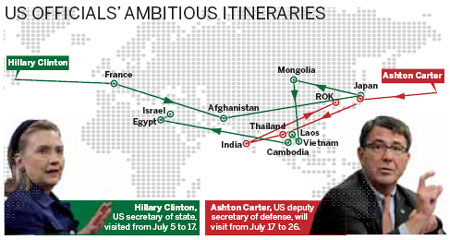
Clinton's trip began in Paris on July 5 at a "Friends of Syria" meeting, where a group of Western and Arab nations discussed the Syrian crisis.

Clinton then made an unannounced trip to Afghanistan, where she named the country a major non-NATO ally, clearing the way for the two countries to maintain defense and economic ties even after US troops withdraw.

After Afghanistan, Clinton traveled to Asia with stops in Mongolia, Vietnam, Laos and Cambodia as part of Washington's broader effort to bolster ties with Asia as China's power in the region grows.

By improving ties with Southeast Asian countries, the US aims to counterbalance China's growing influence in the region and increase its presence, said Shi Yinhong, an expert on international affairs at Renmin University of China.

China welcomes improved relations between the US and Southeast Asian countries, Tao said.

Clinton's marathon trip will be followed by Deputy Secretary of Defense Ashton Carter's visit to the Asia-Pacific region, where he will meet with partners on the US military's shift to the region, Pentagon press secretary George Little said on Monday.

During the 10-day trip scheduled to start on Tuesday, Carter will meet with US Pacific Command leadership in Hawaii, inspect facilities in Guam and meet with senior leaders in Japan, Thailand and India before concluding his visit in the Republic of Korea on July 26.

Carter will discuss how the US Defense Department and other militaries in the Asia-Pacific region "can work more closely together to ensure security and prosperity in the 21st century," according to Little.

The visit will be Carter's first as deputy defense secretary.

Some US experts said Washington will be able to manage the situations in both the Middle East and the Asia-Pacific region, as it recovers from an economic slump.

"This is more of a near-term challenge than a long-term one, because the US will be in a stronger economic recovery in two or three years and better able to manage both regions," Paal said.

But if the US makes deeper cuts in defense spending, Americans may not have the capacity to handle both regions at the same time, warned Michael O'Hanlon, director of research and senior fellow at Brookings Institution.

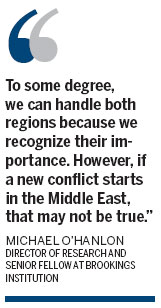
"To some degree, we can handle both regions because we recognize their importance," he said. "However, if a new conflict starts in the Middle East, that may not be true."

Contact the writers at zhouwa@chinadaily.com.cn and tanyingzi@chinadailyusa.com

(China Daily 07/18/2012 page12)