CSOFT helps Chinese companies go global
Updated: 2012-07-04 08:09
By Yang Cheng (China Daily)
|
|||||||||

As a leading global communications company that provides globalization and language solutions for businesses around the world, CSOFT has high expectations for Chinese firms looking to go global.
Such business is expected to generate a quarter of the company's revenue next year, whereas in the past, revenue was dominated by Fortune 500 clients requiring localization support in China.
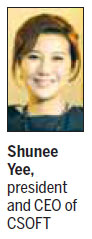
Shunee Yee, president and CEO of CSOFT, said Chinese firms are transforming themselves from OEM manufacturers for other brands into "world-class partners", which has added value to the global supply chain. Yee said this is comparable to China opening a new Silk Road to the West.

"For the purpose of confidentiality, we cannot currently specify which Chinese companies are clients of CSOFT. But for us, the timing is great and things are happening quickly," said Yee, the 2009 winner of the prestigious International Stevie Award for Best Asian Entrepreneur for Women in Business.
Many of the Chinese firms are State-owned enterprises that have a growing ambition to explore overseas ventures.
CSOFT helps firms build systems and processes for managing their language and communication while also serving as their linguistic and cultural navigators.
Yee finds that Chinese companies have a very palpable desire not only to go global but to journey westward.
"However, some are too intimidated to take the steps necessary to succeed. Others take too large of a step without adequate preparation or the necessary resources, and still others step forward without following through," the CEO stressed.
Echoing Yee, Gu Lei, vice president of top SOE automaker BAIC and president of its research institute BATC, noted at the recently concluded CSOFT ninth Annual World Summit, "the campaign for Chinese firms, in particular for those SOEs trying to evolve into 'global players', goes beyond tangible elements and involves hiring global talent."
"It's about building a global identity, one that the whole world can connect with and comprehend," he said.
BAIC recently joined hands with CSOFT and gained help from the top localization firm in building platforms for faster and better technology transfers in its globalization efforts, including BAIC's multi-billion yuan investment to buy SAAB's technology.
Yee said, "A company like BAIC understands that simply purchasing technology isn't going to advance them in foreign markets. It's about how that technology is deployed and understood."
Challenges
The business growth of CSOFT largely stems from the major challenges faced by Chinese enterprises as they make forays into the global market.
Yee emphasized that achieving a unified corporate feel that transcends national boundaries while also gaining global recognition is challenging Chinese firms now.
"I borrowed a quote from GE, and I feel that it really holds true: Culture is the foundation for any successful enterprise"
In the opinion of CSOFT's leadership, this does not just apply to corporate culture but to the broader sense of a company's image, its global brand. It is something that should be established right from the beginning.
In addition, technology transfer is also a critical element.
"Assumptions are often made about the applicability or usability of technology in different regions of the world."
Not all people share the same interpretation of the product itself or the user manual accompanying it.
Also, there are often issues with regulatory compliance for different industries and different countries.
Overlooking or inappropriately addressing such important and often technical information can lead to fairly disastrous consequences.
She also noted that language is a challenge for industries such as life science, energy and auto manufacturing in reaching their goal of becoming more global.
"As an inherent part of technical documentation writing - operational manuals, for example - terminological accuracy is the difference between comprehension and misunderstanding. Not only do such documents require a high level of precision in conception but also in comprehension," she said.
yangcheng@chinadaily.com.cn
(China Daily 07/04/2012 page15)