German, French leaders meet ahead of EU summit
|
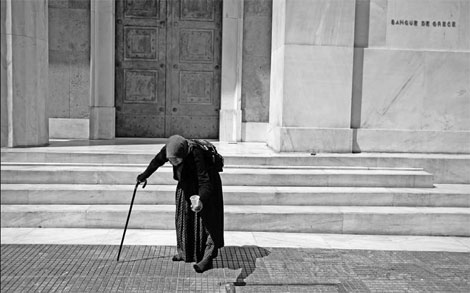
A woman begs outside Greece's central bank in Athens. G8 leaders on Saturday urged Greece to stay within the eurozone as polls in the country showed a close race between parties supporting and opposing the EU's bailout deal. Kostas Tsironis / Bloomberg |
Finance ministers work to balance growth with spending reductions
Greece lurched toward a possible exit from the eurozone and Spain's budget deficit widened as German and French leaders meet this week to map out a revised plan for the euro as the Group of Eight exposed disagreement on a rescue strategy.
German Finance Minister Wolfgang Schaeuble was scheduled to discuss the 17-nation currency with his newly installed French counterpart, Pierre Moscovici, in Berlin on Monday as European Union leaders prepare for a summit meeting in Brussels on Wednesday.
After three shorter meetings in the last week, Chancellor Angela Merkel and French President Francois Hollande will seek to balance France's desire to jump-start growth with Germany's preference for spending cuts.
"We're all very pleased that France wants to offer new initiatives with its newly elected president," Schaeuble told the Bild am Sonntag newspaper in an interview on Sunday. "The German government is ready to talk about anything," Schaeuble said, though he ruled out measures that would raise debt.
G8 leaders on Saturday urged Greece to stay within the eurozone as polls in the country showed a close race between parties supporting and opposing the EU's bailout deal. The country is preparing for June 17 elections, following an inconclusive May 6 ballot.
Spain revised its 2011 deficit upward - even as its borrowing costs approached levels that prompted bailouts in Greece, Ireland and Portugal.
Two more years
The euro has lost 3.5 percent against the US dollar this month and almost $4 trillion has been wiped from equity markets amid concerns over Greece. Schaeuble said on Friday that the turmoil could last another two years.
Yields on Spanish 10-year bonds climbed to close at 6.27 percent last week. That figure slid to 6.26 percent at 10:56 am in Madrid, while the euro traded down 0.01 percent to $1.2769 in Frankfurt.
US President Barack Obama joined G8 leaders including Hollande and Britain's Prime Minister David Cameron in embracing a renewed focus on growth, underlining the isolation of Merkel, who maintained resistance to new spending.
At the president's Camp David retreat in Maryland, G8 leaders said in their final statement that "the right measures are not the same for each of us".
As EU leaders prepare for their informal dinner, French Prime Minister Jean-Marc Ayrault told the Liberation newspaper that no potential solutions involving Greece should be rejected. Leaders shouldn't rule out measures such as state borrowing from the European Central Bank, he said.
Greek polls
Two weeks after elections in Greece yielded political deadlock and forced the once-taboo notion of leaving the monetary union into political discussion, euro leaders grappled with the possible fallout of such a scenario. Caretaker Prime Minister Panagiotis Pikrammenos will oversee a government that will prepare for a new election.
Opinion polls over the weekend gave a split message on the outcome, with two pointing to victory for New Democracy, which backs the international bailout program, and two favoring Syriza, which opposes it.
Syriza leader Alexis Tsipras said on Sunday in a speech in Athens that his faction's opposition to the terms of Greece's financial-aid program doesn't mean the country would have to abandon the euro if the party forms a government.
Luxembourg Prime Minister and Eurogroup President Jean-Claude Juncker said a majority of his peers have doubts about Greece's membership of the euro, Der Spiegel reported, without saying where it got the information.
Tsipras, who travels to Paris and Berlin beginning on Monday, denounced such talk, saying it would involve "huge costs".
'Clear message'
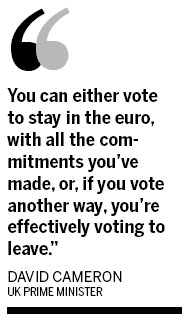
"We now have to send a very clear message to people in Greece," Cameron said on Sunday as he attended a NATO summit in Chicago.
"You can either vote to stay in the euro, with all the commitments you've made, or, if you vote another way, you're effectively voting to leave," he said.
European Central Bank Executive Board member Joerg Asmussen, speaking in Berlin on Monday, said that policymakers should stick to "plan A", keeping Greece in the euro. He said he didn't want to speculate on a "plan B".
"What's the alternative? My preference is that Greece stay in the euro," Asmussen said on Monday.
Bloomberg News in Berlin
(China Daily 05/22/2012 page17)