German factory orders up 2.2 percent in March
|
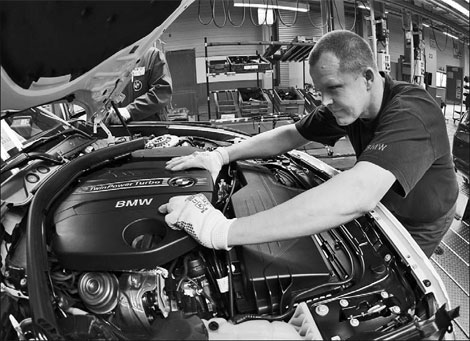
An employee works under the hood of a Bayerische Motoren Werke AG automobile as it travels along the production line in Regensburg, Germany. Domestic factory orders rose 1.3 percent in March while export orders climbed 3 percent, driven by a 4.8 percent increase in sales outside the eurozone, the Economy Ministry in Berlin said on Monday. Guenter Schiffmann / Bloomberg |
Firms tap demand in emerging markets amid weak EU economy
German factory orders increased more than economists forecast in March, driven by demand from outside the eurozone.
Factory orders, adjusted for seasonal swings and inflation, jumped 2.2 percent from February, when they gained a revised 0.6 percent, the Economy Ministry in Berlin said on Monday.
Economists forecast an increase of 0.5 percent, according to the median of 30 estimates. From a year ago, orders dropped 1.3 percent when adjusted for working days.
Companies in Europe's largest economy are tapping faster-growing emerging markets as the sovereign debt crisis curbs demand in the eurozone.
Business confidence climbed to a nine-month high last month and investor confidence unexpectedly rose to a two-year high. Still, economic growth will slow to 0.6 percent this year from 3 percent in 2011, according to the Bundesbank, as fellow eurozone members drop back into recession.
"Germany lives in a world of two speeds," said Ulrike Rondorf, an economist at Commerzbank AG in Frankfurt. "European demand is weak, while demand from countries outside the euro-area is strong. For the year, growth should be slightly positive."
Domestic factory orders rose 1.3 percent in March while export orders climbed 3 percent, driven solely by a 4.8 percent increase in sales outside the eurozone, Monday's report showed.
Orders from within the currency bloc were unchanged from February, when they fell 3.3 percent.
'Turning positive'
Orders for investment goods rose 4.2 percent and those for consumer goods jumped 5 percent, while basic goods orders slipped 1.1 percent. The Economy Ministry said overall orders fell 0.7 percent in the first quarter from the fourth quarter of 2011. The volume of big-ticket items in March was average, it said.
"After the expected weakness in winter, the trend is gradually turning positive again," the ministry said in a statement. "Industrial production should also benefit."
First-quarter profits at German carmakers Bayerische Motoren Werke AG, Volkswagen AG and Daimler AG all beat analyst estimates. VW's Audi unit will create 2,000 new jobs in Germany to keep up with demand.
Schuler AG, a German maker of metal-forming machines, last week raised its full-year forecast on higher investment spending in Asia and Europe. "The order situation is very good," CEO Stefan Klebert said on Wednesday.
Still, governments and households across Europe are reducing spending in response to the debt crisis.
Spanish industrial production declined the most in more than two years in March. Output at factories, refineries and mines adjusted for the number of working days fell 7.5 percent from a year earlier, the most since October 2009, the National Statistics Institute in Madrid said on Monday.
US consumers
In the United States, Federal Reserve figures may show consumer borrowing rose by $9.65 billion in March, according to the median estimate of 28 economists.
In Australia, retail sales jumped 1.8 percent in the first quarter from the final three months of last year, the Bureau of Statistics said in Sydney on Monday.
Puma SE, Europe's second-largest sporting-goods maker, on April 25 reported first-quarter profit that trailed analysts' estimates and said it faces challenges as European consumers cut back. German unemployment unexpectedly increased in April.
"The German economy is in relatively good condition," said Jens-Oliver Niklasch, an economist at Landesbank Baden Wuerttemberg in Stuttgart. "But we have perhaps reached a turning point and the economic outlook could worsen."
Bloomberg News in Frankfurt
(China Daily 05/08/2012 page17)