Boosting blood donations urgently needed
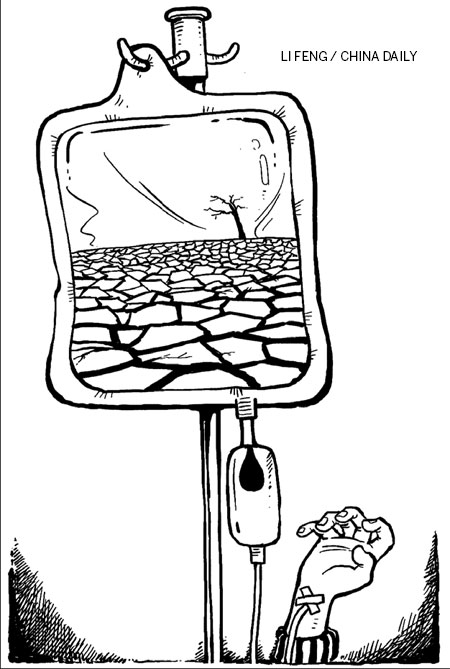
Every year, blood transfusions save millions of lives, but still millions of patients needing transfusions do not have access to safe blood because of insufficient donations. China is one of the countries where a lack of donated blood continues to be a problem despite efforts to raise people's awareness of this need. Hospitals in Beijing, and in Shandong, Shanxi, Yunnan and Jiangxi provinces suffer from acute blood shortages, which result in delays to surgical procedures.
According to official figures only 84 out of 10,000 people donate blood in China, in spite of the fact that China's first Law on Blood Donation was enacted in 1998, encouraging all citizens between the ages of 18 and 55 to donate blood. This is far below the 454 people out of every 10,000 people who donate blood in high-income countries.
The problem in China will be solved not only when technical issues are addressed, but also when people's cultural beliefs are also taken into consideration. The concept of blood (xue) as it is used in Traditional Chinese Medicine is different from the way the term is commonly used in Western medicine. According to Chinese medicine, blood is a dense form of body fluids that has been energized by qi, and has a synergistic relationship with it. That is why the Suwen, also known as Basic Questions, a text that covers the theoretical foundation of Chinese medicine and its diagnostic method, states, "blood and qi are the spirits of man." This is one of the reasons that explain why many people in China are reluctant to donate blood.