Sputtering US economy gets temporary relief

Updated: 2011-08-02 08:10

By David Lawder (China Daily)

  Comments() Print Mail Large Medium  Small 分享按钮 0

Sputtering US economy gets temporary relief

WASHINGTON - The tentative US deal to avoid a crushing debt default is at best a mild relief for the US economy, which nearly stalled in the first half and has yet to show signs of any realistic pickup.

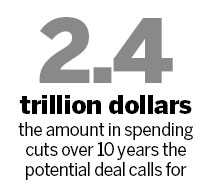
The plan for $2.4 trillion in spending cuts over a decade, if backed by lawmakers, would help lift some of the uncertainty that has weighed on investors, businesses and consumers unsettled by talk about a possible new and deep US financial meltdown.

Still, the plan does not decisively remove the threat that the nation's AAA credit rating could be downgraded, an action that would raise borrowing costs across the board, and the prospect of further cuts ahead will cut short any celebrating.

"This will have minimal impact on the economy. The cuts are not there for the first couple of years, which really makes you wonder if they're really going to happen at all," said Peter Morici, an economics professor at the University of Maryland.

Economists were stunned on Friday when data showed the US economy grew just 0.4 percent in the first quarter - perilously close to contraction - and picked up unimpressively to 1.3 percent in the second quarter.

Against the backdrop of the weak economic recovery, the divided political parties in the US Congress appear to have agreed on one thing early on in their dispute over how to raise the US debt ceiling: That spending cuts to narrow the deficit should be phased in slowly. They will be phased in from 2013.

US President Barack Obama told reporters on Sunday that the initial discretionary cuts, expected to be about $917 billion, "wouldn't happen so abruptly that they'd be a drag on a fragile economy".

He added that "job-creating" investments in education and research would be preserved. But the bulk of the austerity has yet to be defined.

About $1.5 trillion of the planned savings will be decided by a bipartisan congressional commission, leaving unanswered the question of whether the United States has the political will to tame its growing debt pile once and for all.

Troy Davig, US economist at Barclays Capital, estimated that the deal would cut only $25 billion to $30 billion from government spending in the first year, which could shave about a tenth of a percentage point off economic growth.

"It's not a major drag on growth but when the economy is only growing a point and a half, a lot of economists feel that this is not the right time to be finding fiscal restraint. We will be shifting from massive stimulus to massive restraint," he said.

Little scope

Proposals discussed just a week ago included possible new fiscal stimulus measures, such as extending payroll tax cuts for employees and offering them to employers as well.

There appeared to be no room for them in the preliminary deal, which is expected to be voted on in the Senate on Monday and sent to the House of Representatives for approval.

The bipartisan panel, which must draft more cuts by November, could revisit the issue.

There could be some relief among US employers and consumers that taxes won't rise under the new, hard-fought deal and that the worst-case scenario has been avoided.

The talks have been punctuated by warnings from the Obama administration that financial chaos would ensue if the $14.3 trillion federal borrowing limit was not raised by Tuesday.

That angst has added to a pile of worries slowing consumers' spending decisions such as car purchases, according to Detroit executives.

Existing-home sales in June fell sharply due a big jump in canceled sales contracts.

Obama, too, said he has been concerned about the debt limit battle's effect on consumer and business confidence. He said he hoped Sunday's deal "will begin to lift the cloud of debt and the cloud of uncertainty that hangs over our economy".

Any relief, however, is likely to be short-lived. US jobs data due on Friday will probably prove another reminder of the weak US economy. Unemployment is expected to remain at 9.2 percent, according to a Reuters poll.

The budget deal "does nothing to restore household and corporate confidence", said Mohammed El-Erian, chief executive of bond fund investment giant PIMCO LLC.

"So unemployment will be higher than it would have been otherwise, growth will be lower than it would be otherwise, and inequality will be worse than it would be otherwise," El-Erian told ABC's This Week with Christiane Amanpour.

To prevent the 2007-2009 recession from spiraling into a depression, the US central bank slashed interest rates to zero and pumped $2.3 trillion into the ailing economy by buying debt.

The Federal Reserve is not expected to rush in to make up for the loss of any stimulus to boost growth.

Atlanta Federal Reserve President Dennis Lockhart said on Friday there would be a "very high bar" for more stimulus.

At least the deal taking shape in Washington would push the scary prospect of a US debt default out until after the 2012 presidential election.

Reuters

(China Daily 08/02/2011 page14)