Getting even closer to Russia
|
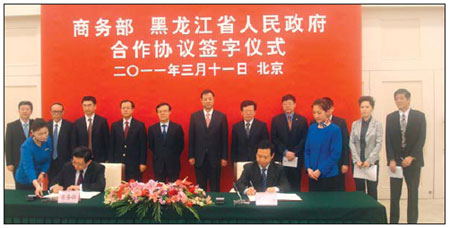
China's Ministry of Commerce signed an agreement with the Heilongjiang government last month, putting its weight behind the province's move to increase trade with Russia. Cheng Yingpeng / For China Daily |
Heilongjiang's government wants to improve its trade with Russia, in structure, scale and development speed.
This decision comes in response to a decrease in trade between Heilongjiang and Russia over the past three years.
Heilongjiang was a leader in Sino-Russian trade for a long time: as recently as 2008, it hit an historical high of $11.08 billion.
But last year, that trade was only worth $7.47 billion, lagging behind Zhejiang and Guangdong provinces for the first time.
The financial crisis that began in the second half of 2008 was partly to blame, but outdated methods and structure are also reasons for the drop of trade.
To correct this, the provincial government is looking for new international trade resources and more innovative methods.
Construction machines, farm equipment, household electric appliances, and automobile exports are increasing, and the government hopes that exports of produce, textiles and many other exports will increase.
It also plans to increase imports of energy and raw materials, such as timber, pulp, petroleum, fertilizers and electricity to ensure adequate supplies for economic growth.
Over the past five years, the province imported 15 million tons of crude oil and petroleum products, 7.7 million tons of iron ore, more than 40 million cubic meters of timber, and 4.27 billion kilowatt-hours of electricity from Russia.
"To improve the trade quality, we plan to expand trade with Russia to many fields and a higher level," the provincial foreign trade bureau has said.
Heilongjiang now has 1,280 non-State-owned companies engaged in Russian trade, making it the province's main force.
But, the provincial and local governments have programs for more comprehensive cross-border trade and cooperation. These include more trade and development zones, logistics parks, and wholesale markets in border towns on both sides.
As part of this, a Heilongjiang-Russia electric power organization was established on January 10, 2010, with 44 members.
The province's next step is to build more partnerships with Russia in the petroleum, natural gas, wood, mineral resources and infrastructure fields.
The foreign trade bureau is also looking at greater trade and business cooperation with Russia through various shows and events.
There is already the annual Harbin International Economic and Trade Fair - China's largest Sino-Russian business cooperation show. But, the bureau will try to find local Heilongjiang businesses to take part in commodity exhibitions and fairs in Russian cities, including Vladivostok, Blagoveshchensk, or even Moscow.
The provincial government in fact has some big goals for the future. It wants to turn the province into a Russia-oriented distribution center - with border cities such as Suifenhe, Tongjiang, and Heihe as regional hubs - but with its influence reaching across the nation and even to the rest of Asia and Europe.
In fact, it is already cooperating with 225 countries in foreign trade, which amounted to $25.5 billion in 2010, up 57.2 percent from the previous year.
(China Daily 04/30/2011 page6)