![]() |
Large Medium Small |
|
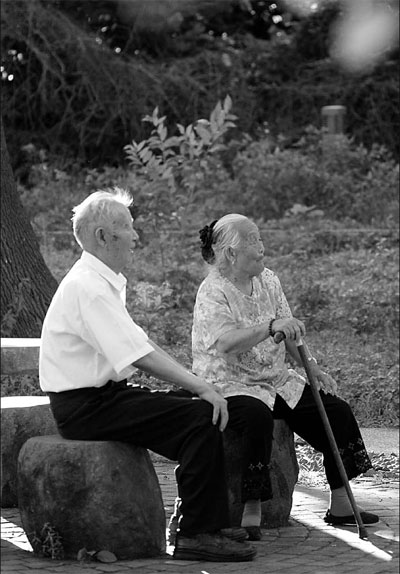
Watching For, a documentary by Liu Chen-Hua, features his grandparents, who met again after being apart for 50 years. Grandpa Liu fled to Taiwan in 1949, while his wife stayed on the mainland. Photos provided to China Daily |
|
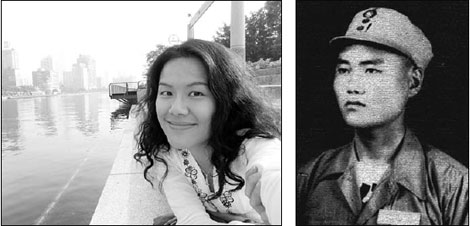
Above left: First-time filmmaker Chen Hsin-Yi presents her 86-minute documentary, The Captive, at the on-going festival in Beijing. Above right: A file photo of Chen Shuyan, father of Chen Hsin-Yi. |
A young lady hoping to smooth relations with an ill-tempered father chances upon the touching stories of thousands of 'Taiwan mainlanders'. Chen Nan reports
In 1949, Chen Shuyan, a former PLA soldier from Jiangsu province, was taken captive by the Kuomintang when they lost their rule on the mainland.
Chen, 90, has been living there for the past 60 years but never once did he reveal he was once a Communist Party member.
Not until, that is, his daughter, first-time filmmaker Chen Hsin-Yi, put a camera in front of him two years ago. That momentous occasion is now the 86-minute documentary, The Captive.
"We have a bad relationship because my father is ill tempered. My memories of him are mostly of him getting drunk and shouting at everyone in the family. I never understood why he behaved like that and I hated him deeply," says Chen, who studied political science in university and worked as a political reporter for a Taiwan-based newspaper.
The director says she didn't set out to make the film; she merely wanted to smooth the family's relationship with the old man.
But as she listened to Chen, a whole new world of homesickness, prejudice and fear, opened up.
"Taiwan's political situation was a mess for decades and relations between Taiwan and the mainland were sensitive. My father worried that revealing his identity would spell harm to my family so he kept silent," Chen says. "But now I understand his pain and how his life was altered. We have good communication now."
Like Chen's father, more than a million people fled to Taiwan from the mainland because of the war. Besides prisoners-of-war, whose number Chen puts at around 7,000, there were soldiers and their families, and other civilians.
The locals called them mainlanders, or waishengren.
The Captive is the opening film of the ongoing "Memories of Taiwan - Mainlander of Taiwan Documentary Festival" being held in the Ullens Center for Contemporary Art (UCCA), in the 798 Art District in Beijing. Bringing together eight other documentaries, the festival aims to tell the story of these mainlanders.
According to Chou Siu-Nuo, secretary general of the Taiwan Mainlander Organization, which initiated the event back in 2008, the nine directors are all second- generation Taiwan mainlanders.
"Few know about the first generation mainlanders in Taiwan. Most of the attention has been focused on historical figures and celebrities such as the children of the Chiang Kai-shek family and famous kungfu novel writer Louis Cha (Jin Yong)," says Chou, a third-generation Taiwan mainlander from Zhejiang province. "But we want to focus on the ordinary people."
According to Chou, Taiwan residents can be put into four main groups: Southern Fujian migrants, Hakkas, mainlanders and ethnic minorities. Of these, mainlanders account for 13 percent of the total.
"For decades, they have been struggling with their identities. There are single retired soldiers, poor families, drifters and others with family problems such as director Chen," Chou says.
According to him, the Taiwan identity card used to carry the name of a person's hometown but now only has the birth place.
"The younger generation does not have a clear idea of their mainland origins, as compared with the first generation of Taiwan mainlanders," Chou continues. "The first generation is in their 80s or 90s, which means this special group of people is dying; their culture is dying."
It was to preserve this culture that the Taiwan Mainlander Organization founded a film class two years ago, called Rong Guang Juan Ying, or, Film about the Old Soldiers in Juancun Village, so the younger generations of Taiwan mainlanders could use their cameras to capture the lives of these people.
Chou says there are some military dependant's villages like Juancun, with a high concentration of mainlanders. Zhongyi village, located in the middle of Taiwan, is home to former air force men who have been living there for generations. But it cuts a sorry figure with its slums and poverty.
Liu Kung-chan, head of the village, has recorded its state and that of the lives of its residents for his 40-minute documentary, Right of Abusing, which is also showing at the ongoing festival.
"I was shocked by what I saw in those documentaries as I have never seen Taiwan from that angle," says Liu Lifang, one of the curators of the event from Ningbo, Zhejiang province.
"People living in the mainland know only of the Taiwan of beautiful pop idols and well-produced TV series.
"These documentaries made by first-time directors are not very sophisticated. But these are real and touching stories."
Liu Lifang also plans to show two films in Shanghai.

(China Daily 05/22/2010 page11)