![]() |
Large Medium Small |

Fossils provide window into period when hominids committed to life on the ground, instead of in the trees
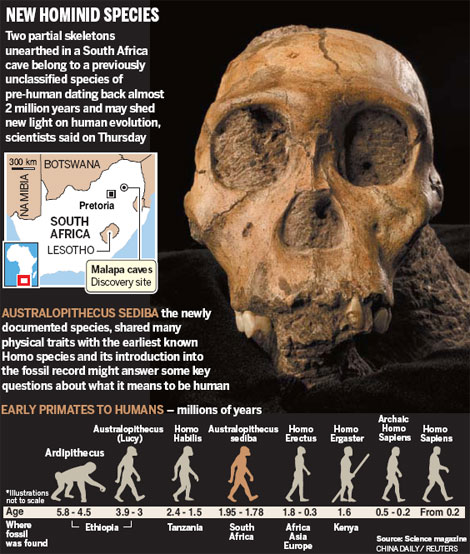
WASHINGTON - Two skeletons of a new hominid species dating back two million years and found in South Africa have shed light on a previously unknown stage in human evolution, studies published Thursday showed.
Baptized Australopithecus sediba, the partially fossilized specimens - an adult female and a juvenile male - were found in good condition in 2008 in a cavern 40 kilometers (24 miles) from Johannesburg.

"These fossils give us an extraordinarily detailed look into a new chapter of human evolution, and provide a window into a critical period when hominids made the committed change from dependency on life in the trees to life on the ground," said Lee Berger, principal author of the paper to be published in the journal Science.
The hominids walked upright and share a number of traits with the first known species of homo sapiens, having long arms like apes but short and powerful hands, the paper said.
They have an evolved pelvises, small teeth and long legs that would enable them to run like a man. It is also probable that they could climb trees.
"Australopithecus sediba appears to present a mosaic of features demonstrating an animal comfortable in both worlds," said Berger, a paleo-anthropologist at the University of Witwatersrand in Johnnesburg.
Both specimens were about 1.27 meters (4 feet 2 inches) in height. The female weighed about 33 kilos (72.6 pounds) and the young male, thought to have been around 10 years old, at 27 kilos.
The species had small brains - measuring about a third of the volume of those of modern humans.
But Berger noted during a telephone press conference that the shape of their brains appears to have evolved from those other species of Australopithecus.
The new species had many physical characteristics similar to those of early hominids that would help to explain what it means to be human, he said.
The skeletal structure of the two fossils is similar to those of the first Homo species, but the new examples appear to have employed it in the same way as "Lucy," perhaps the world's most famous fossil.
Found in 1974, Lucy dated back 3.2 million years and was considered the common ancestor of humanity until the discovery of the 4.4 million-year-old "Ardi", which points to a common ancestor with the chimpanzee.
Berger said it was not possible to establish the "precise" position of the new species in relation to early man.
"We can conclude that this new species shares more derived features with early Homo than any other known australopith species, and thus represents a candidate ancestor for the genus ...," he said.
The site of the discovery is rich in fossils and at least two other specimens of sediba have been excavated and are being analyzed, Berger said.
The searchers have also identified the fossils of at least 25 other animal species, including a hyena, a wild dog, antelopes and a horse.
Agence France-Presse
(China Daily 04/10/2010 page6)