![]() |
Large Medium Small |
|
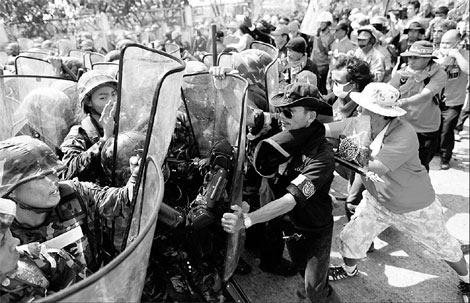
Anti-government "red shirt" protesters fight with Thai army soldiers at Thaicom Teleport and DTH Center on the outskirts of Bangkok in Pathum Thani province on Friday. Damir Sagolj / REUTERS |
Security forces use water cannons, tear gas to disperse protestors

LADLUMKAEW, Thailand - Thai protesters stormed a satellite station on Friday, breaching an army cordon and forced their TV channel back on the air in the first major confrontation in a three-day state of emergency.
The "red shirt" protesters have started leaving the satellite station, Nattawut Saikua, one of their leaders, told Reuters.
Police and soldiers had earlier fired water cannon and tear gas in a failed attempt to disperse thousands of protesters who climbed over rolls of barbed wire and forced open the gate of the compound, defying an emergency decree and upping the ante in their broader push for fresh elections.
Most of the soldiers pulled back from the Thaicom Pcl satellite station about 60 km (35 miles) north of Bangkok, leaving the grounds largely in control of the "red shirt" protesters, supporters of former Prime Minister Thaksin Shinawatra who was ousted in a military coup in 2006.
The protesters had not entered the main building, which houses a satellite uplink facility broadcasting the red shirts' People Channel. On Thursday, authorities entered the station and seized equipment that took the channel off air, saying it was inciting violence. Other channels were not affected.
"We want our TV back. You cannot shut our eyes and ears," Jatuporn Prompan, a red shirt leader, said from the back of a truck after leading the protesters into the compound.
Government spokesman Panitan Wattanayagorn said the channel cannot go back on air. "They are still distorting information and we cannot allow that," he told Reuters.
The protesters, who briefly besieged parliament on Wednesday, seized guns, batons, shields, bullets and tear-gas cannon from police and soldiers and displayed them at the station. A Reuters photographer earlier saw a policeman hitting a protester with the end of a rifle in the commotion.
Investors unperturbed
Many investors doubt even a violent impasse will derail a rebound in Southeast Asia's second-biggest economy and one of the world's fastest-rebounding emerging markets. Thai stocks are up 76 percent over the past 12 months, Asia's third-best performer.
"We are not so concerned about the political situation in Thailand," high-profile emerging market investor Mark Mobius, executive chairman of Templeton Asset Management Ltd in San Mateo, California, told Reuters. Frequent protests, violent riots, airport blockades and three changes in government in the past 19 months have dented consumer spending, economists say, but the prospect of prolonged strife is already priced into Thailand's relatively cheap stock prices.
Despite the latest escalation of a five-year political crisis, foreigners bought $1.8 billion in Thai stocks between Feb. 22 and Wednesday, often citing Thailand's relatively low stock valuations and robust economic rebound.
Even if Thailand faces new elections, and more protests, few expect a big shift in fiscal and monetary policies. Five out of six economists surveyed by Reuters this week said they expected an interest rise in June regardless of the latest unrest, the same prediction they have made for several months.
"We have been investing in Thailand for almost 15 years or more. And we think that this kind of change in the Thai political environment has happened many times before," Mobius said.
The stock market was up 0.7 percent on Friday. The local baht currency also recovered from early weakness.
Prime Minister Abhisit Vejjajiva had said he will not order a crackdown on the mostly rural and working-class protesters who have also ignored orders to leave Bangkok's main shopping district since Saturday.
Abhisit faces pressure to either compromise and call an election he could easily lose, or launch a crackdown that could stir up even more trouble.
Most analysts doubt the authorities will use force to remove thousands of protesters from the shopping area.
Reuters
(China Daily 04/10/2010 page7)