![]() |
Large Medium Small |
|
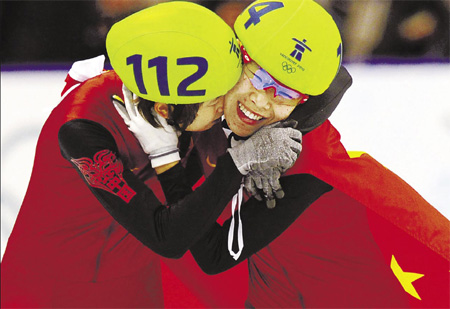
Gold medalist Wang Meng (left) celebrates with compatriot Zhou Yang during the 2010 Winter Olympics. Wang won gold in the women's 1000m short-track final at Pacific Coliseum in Vancouver. YURI KADOBNOV / Agence France-Presse |
Nation must look past Olympic glory to building its own strong sporting brands, say industry experts. Tang Yue and Craig McIntosh report from Beijing.

As the Vancouver Olympics draw to a close, China is again celebrating unprecedented sporting success on the world stage. Before this year, the country had won only four gold medals in the history of the Winter Games- within a matter of weeks it has more than doubled that tally.
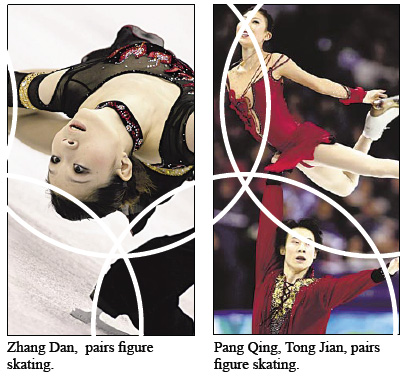
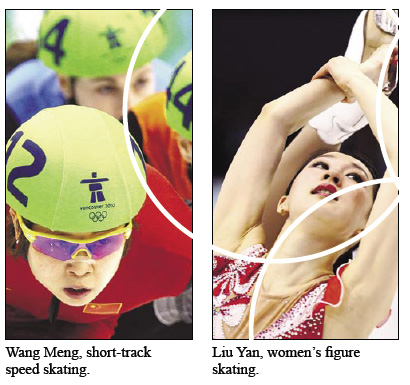
By taking top prizes in figure skating and short-track speed skating events, as well as six silver and bronze medals, the nation's athletes ensured their Canadian adventure maintained the momentum that promises to take Chinese sport to dizzying new heights.

Coupled with the success of tennis aces Zheng Jie and Li Na, who both reached the semifinals of the Australian Open in January, and the national team's victory in the East Asian Soccer Championship in Japan last month, sports and business analysts predict 2010 could prove a major turning point for the Chinese sports industry.
However, experts warned that only through investment in domestic professional leagues and, above all, by creating strong sporting brands will China ever really profit from such success on the world stage.
For all the passion of the fans and emotion on the field, make no mistake: Sport is big business.
In the United Kingdom and United States, the nations that boast the world's two biggest sporting brands - Manchester United in the English Premier League and New York Yankees in Major League Baseball (MLB) - sport contributes about 2 percent of GDP.
However, in China the sector contributed less than 0.7 percent of GDP in 2009, representing about $20 billion, said Yi Jiandong, a sports industry expert and professor with the Beijing Sport University, who cited estimates based on economic analysis.
For a nation with a 1.3 billion population and arguably the largest market in the world, improving the standard of teams and leagues, and boosting confid-
ence in "China-made sport", is the only way to make it a valuable commodity the nation can export.
"Exports of sports-related products fall mainly into two parts: sporting goods and sporting services, the latter including performing in continental and international competitions, the brokerage industry and broadcasting," explained Yang Zaihui, a professor on sports economics at the Central University of Finance and Economics in Beijing.
Local sportswear brands like Li Ning and Anta are growing, with export volume hitting a peak of about 8 billion yuan ($1.17 billion) in 2008 and dropping only slightly during last year, she said. "But China is doing almost nothing in the sports service sector and we still have a long way to go. As a commodity, our basketball and soccer leagues are of low quality, so the majority of people in China turn to the NBA for basketball and the European leagues for soccer," he said.
|
Wang Beixing of China, who won a bronze medal in the women's 500m speed skating at the 2010 Winter Olympics in Vancouver, Canada, gets her breath back during training on Feb 11. chris carlson / Associated Press |

The recent match-fixing and illegal betting scandal that has rocked the nation's soccer league - the China Football Association said this week it has "solid evidence" to expel one team the competition, while two others have been demoted to lower divisions as punishment - has not only shaken fans' belief in the domestic game but also harmed the international brand of Chinese sport, said analysts.
"The soccer scandal adds insult to injury. The government have not been giving it proper supervision and I'm afraid foreigners will take it as an example of a bad 'made-in-China' product. The professional game here as a whole has lost creditability," said Yang.
China's largest sporting brand, in reputation and height, is arguably one man: Yao Ming. The Huston Rockets all-star center, who has become one of the NBA's most popular players since his arrival in 2002, topped the Forbes Rich List of Chinese celebrities for the fifth year in a row in 2009 with earnings of almost 360 million yuan.

Although struggling with a foot injury since early last year, his stock has only risen higher in the eyes of the Chinese people since he reinvested some of his vast personal wealth into buying his former club, Shanghai Sharks, last November.
But it is perhaps the less high-profile deal done between QSL Sports Limited and the Chinese Basketball Association (CBA) that is expected to have more impact on the domestic game.
The historic dollar agreement sealed last week, which will see QSL manage the National Basketball League, which is independent of the elite CBA, is the first time a private enterprise has been allowed to completely take over a professional league in China. Previously, sports associations under the State General Administration of Sport governed all leagues.
"The National Basketball League will be dedicated to finding homegrown stars through college recruitment projects, while it will also have stricter policies on the use of foreign players," said Kenneth Huang, co-founder of QSL, who in November also bought Jilin North East Tiger, a team in the CBA.
The 45-year-old businessman, who is originally from Guangdong province and has a master's degree from Columbia University in New York, has successfully brokered marketing deals with the Yankees and the Rockets, and in June last year his company won the contract to promote MLB in the Chinese youth market.
He said China is shifting its focus from Olympic medals to boosting its professional leagues to attract more investors.
"I knew the self-confidence and enthusiasm for sports would definitely keep rising after the Beijing Olympics (China topped the Games medals table in 2008) and making the day of the opening ceremony National Fitness Day was a very positive signal," said Huang.
To make money from Chinese sport, however, people need to be patient. "Investing in sport is not like investing in real estate. It always takes about five to 10 years to see any returns in sport," he said. "It's OK to look forward to another Yao Ming in the NBA but our own leagues deserve more attention and effort to help them grow.
"Investors also have to cooperate with government here. That's the rule you work with in China, and a lot of foreign investors are not fully aware of this and so they fail easily."
He Wenyi, director of Chinese Sports Industry Research Center, welcomed the introduction of private capital into the country's professional leagues, citing the QSL deal as a hugely positive step.
...
"Hopefully, it will set an example for the CBA and other leagues in China. We need diversified investment in the management of leagues and the sports industry as a whole," he said. "It is fundamentally wrong to develop the sports sector solely through the State General Administration of Sport as the industry relates to so many fields.
"We urgently need to break the administrative monopoly, which would surely encourage more resources to flow in."
Creating a successful product is only half the battle, however. The next major challenge is pushing China's brands abroad, according to Niu Haipeng, a professor on marketing at the Renmin University of China.
"It will take a long time for Chinese leagues to be as influential as the NBA or soccer leagues in the Europe. Although the approach to setting up a brand image for a professional league is different from those for other products, it follows the same principles," he said.
A product needs to be of good quality, such as the NBA, which has the best basketball stars. However, Niu warned against relying on stars from overseas to boost the market. "You need very strong local players. If the foreigners are not helping the homegrown talent to grow, a league will not make any progress."
Once China has a quality product, the country needs to promote it, all the while continually adjusting the product to meet the needs of the market, he said.
"The government's involvement in the management of leagues is surely bad for its development. When it is a real commercial thing, stakeholders will try their best to meet the needs of the consumers by providing various products so they can make a fortune. This in turn makes the league more popular. But the government is not always driven by money," he said. "Also, administrative power over a profitable business always leads to the risk of corruption, like with the soccer scandal."
The establishment of National Fitness Day by the central government was a good move, agreed analyst Yi Jiandong, but he warned the country still needs to replace simple advocacy with firm preferential policies and mandatory regulations. "I used to live in a housing estate called Yuxin, a neighborhood of about 20,000 people in Beijing. All we had was eight ping-pong tables and a 200-sq-m gym for exercise," he said.
He Wenyi added: "It's pathetic. If the government really wants everyone to have access to sport they should have rules about the proportion of the public recreational space in all real estate projects. There is no such thing at the moment."
Tax rates were also a problem, said the research director, adding that some sports clubs are charged the same 5- to 15-percent rate as companies in the entertainment industry, such as pool halls and bowling alleys. The tax rate for golf clubs is about 20 percent, he said.
Liu Fumin, head of the finance department for the State General Administration of Sport, told China Daily that a plan to accelerate the development of the sports industry, which took four years to draft, has been submitted for approval to the State Council. However, the proposal still only contains voluntary guidelines, he said.
...
There is certainly no question that the Chinese have a passion for sport. The Beijing Olympics was a sell-out success and, although the butt of many jokes after their dismal show at the 2002 World Cup in South Korea and Japan, the national soccer team also has a strong fanbase.
And like anywhere, China's young sports viewers are desperate to emulate their heroes.
Experts predict Li and Zheng's performances this year will spark another rush in Chinese kids picking up tennis rackets - Zheng and partner Yan Zi claimed the country's first Grand Slam title when they won the women's doubles in Australia in 2006.
The success of figure skating duo Shen Xue and Zhao Hongbo, who broke Russia's 46-year stranglehold on the Winter Olympics pairs event by winning gold in Vancouver on Feb 15, is also expected to see more people take to the ice. "The Games have been a dream come true," said their coach Yao Bin. "I hope more young people will love the sport, which is demanding but very attractive."
But while Chinese sports teams were once a symbol of national pride in the 1960s and 1970s, when they paved the way for bilateral communications with the West, the industry is now more about marketing and fighting for a share of the global market.
After collecting more than 170 Olympic medals, the nation has already proved its sporting prowess, so sportsmen and women can concentrate more on commercial success, said Yi Jiandong.
One example of this shift is "Hammer" Lang Ping. She helped the Chinese women's volleyball team to win five straight world titles in the 1980s, making her a national hero. But in 2008, she led the US women's team to silver at the Beijing Games and received huge support from the home crowd - even after her squad beat China in the group stages.
|
Chinese tennis ace Li Na returns the ball to Tatjana Malek of Germany during their match at the WTA Malaysian Open in Kuala Lumpur last Tuesday. Li and compatriot Zheng Jie reached the semifinals of the Australian Open in January. Lai Seng Sin / Associated Press |
She now earns an estimated 5 million yuan a year coaching Evergrand, the first fully professional women's volleyball team in China.
Zheng and Li were also among four of China's top women's tennis players who were allowed by the country's authorities to take complete charge of their careers, making them responsible for hiring their own coaches and medical staff. Sports experts say the move is a major factor in the pair's recent good form.
Xiao Tian, the vice director of the State General Administration of Sport, said China is looking at long-term plans to build on its Olympic successes.
"It's hard for us to surpass what we've achieved at the Beijing Games but the Olympics only last for 16 days, professional leagues run throughout the year," he said. "We need to adjust our sights and start making our mark in more professional sports."
Lei Lei in Vancouver contributed to the story
the only way to make it a valuable commodity the nation can export.
"Exports of sports-related products fall mainly into two parts: sporting goods and sporting services, the latter including performing in continental and international competitions, the brokerage industry and broadcasting," explained Yang Zaihui, a professor on sports economics at the Central University of Finance and Economics in Beijing.
Local sportswear brands like
Li-Ning and Anta are growing, with export volume hitting a peak of about 8 billion yuan ($1.17 billion) in 2008 and dropping only slightly during last year, she said. "China is doing almost nothing in the sports service sector and we still have a long way to go. As a commodity, our basketball and soccer leagues are low quality, so the majority of people in China turn to the NBA for basketball and the European leagues for soccer," she said.
The recent match-fixing and illegal betting scandal that has rocked the nation's soccer league - the China Football Association said this week it has "solid evidence" to expel one team from the competition, while two others were demoted to lower divisions as punishment - has not only shaken fans' belief in the domestic game but also harmed the international brand of Chinese sport, said analysts.
"The soccer scandal adds insult to injury. The government has not been giving it proper supervision and I'm afraid foreigners will take it as an example of a bad 'made-in-China' product. The professional game here as a whole has lost credibility," said Yang.
China's largest sporting brand, in reputation and height, is arguably one man: Yao Ming. The Houston Rockets all-star center, who has become one of the NBA's most popular players since his arrival in 2002, topped the Forbes Rich List of Chinese celebrities for the fifth year in a row in 2009 with earnings of almost 360 million yuan.
Although struggling with a foot injury since early last year, his stock has only risen higher in the eyes of the Chinese people since he reinvested some of his vast personal wealth into buying his former club, Shanghai Sharks, last November. But it is perhaps the less high-profile deal done between QSL Sports Limited and the Chinese Basketball Association (CBA) that is expected to have more impact on the domestic game.
The historic dollar agreement sealed last week, which will see QSL manage the National Basketball League, which is independent of the elite CBA, is the first time a private enterprise has been allowed to completely take over a professional league in China. Previously, sports associations under the State General Administration of Sport governed all leagues.
"The National Basketball League will be dedicated to finding homegrown stars through college recruitment projects, while it will also have stricter policies on the use of foreign players," said Kenneth Huang, co-founder of QSL, who in November also bought Jilin Northeast Tigers, a team in the CBA.
The 45-year-old businessman, who is originally from Guangdong province and has a master's degree from Columbia University in New York, has successfully brokered marketing deals with the Yankees and the Rockets, and in June last year his company won the contract to promote MLB in the Chinese youth market. He said China is shifting its focus from Olympic medals to boosting its professional leagues to attract more investors.
"I knew the self-confidence and enthusiasm for sports would definitely keep rising after the Beijing Olympics (China topped the Games medals table in 2008) and making the day of the opening ceremony National Fitness Day was a very positive signal," said Huang.
To make money from Chinese sport, however, people need to be patient. "Investing in sport is not like investing in real estate. It always takes about five to 10 years to see any returns in sport," he said. "It's OK to look forward to another Yao Ming in the NBA but our own leagues deserve more attention and effort to help them grow. Investors also have to cooperate with government here. That's the rule you work with in China, and a lot of foreign investors are not fully aware of this and so they fail easily."
He Wenyi, director of Chinese Sports Industry Research Center, welcomed private capital to the country's professional leagues, citing the QSL deal as a hugely positive step.
"Hopefully, it will set an example for the CBA and other leagues in China. We need diversified investment in the management of leagues and the sports industry as a whole," he said. "It is fundamentally wrong to develop the sports sector solely through the State General Administration of Sport as the industry relates to so many fields.
"We urgently need to break the administrative monopoly, which would surely encourage more resources to flow in."
Creating a successful product is only half the battle, however. The next major challenge is pushing China's brands abroad, according to Niu Haipeng, a professor of marketing at Renmin University of China.
"It will take a long time for Chinese leagues to be as influential as the NBA or soccer leagues in Europe. Although the approach to setting up a brand image for a professional league is different from those for other products, it follows the same principles," he said.
A product needs to be of good quality, such as the NBA, which has the best basketball stars. However, Niu warned against relying on stars from overseas to boost the market. "You need very strong local players. If the foreigners are not helping the homegrown talent to grow, a league will not make any progress."
Once China has a quality product, the country needs to promote it, all the while continually adjusting the product to meet the needs of the market, he said.
"The government's involvement in the management of leagues is surely bad for its development. When it is a real commercial thing, stakeholders will try their best to meet the needs of the consumers by providing various products so they can make a fortune. This in turn makes the league more popular. The government is not always driven by money," he said. "Also, administrative power over a profitable business always leads to the risk of corruption, like with the soccer scandal."
The establishment of National Fitness Day by the central government was a good move, agreed analyst Yi Jiandong, but he warned the country still needs to replace simple advocacy with firm preferential policies and mandatory regulations. "I used to live in a housing estate called Yuxin, a neighborhood of about 20,000 people in Beijing. All we had was eight ping-pong tables and a 200-sq-m gym for exercise," he said.
He Wenyi added: "It's pathetic. If the government wants everyone to have access to sport they should have rules about the proportion of public recreational space in all real estate projects. Now there is no such thing at."
Tax rates were also a problem, said the research director, adding that some sports clubs are charged the same 5- to 15-percent rate as companies in the entertainment industry, such as pool halls and bowling alleys. The tax rate for golf clubs is about 20 percent, he said.
Liu Fumin, head of the finance department for the State General Administration of Sport, told China Daily that a plan to accelerate the development of the sports industry, which took four years to draft, has been submitted for approval to the State Council. However, the proposal still only contains voluntary guidelines, he said.
There is certainly no question the Chinese have a passion for sport. The Beijing Olympics was a sell-out success and, although the butt of many jokes after their dismal show at the 2002 World Cup in South Korea and Japan, the national soccer team also has a strong fanbase. And like anywhere, China's young sports viewers are desperate to emulate their heroes.
Experts predict Li and Zheng's performances this year will spark another rush in Chinese kids picking up tennis rackets - Zheng and partner Yan Zi claimed the country's first Grand Slam title when they won the women's doubles in Australia in 2006.
The success of figure skating duo Shen Xue and Zhao Hongbo, who broke Russia's 46-year stranglehold on the Winter Olympics pairs event by winning gold in Vancouver on Feb 15, is also expected to see more people take to the ice. "The Games have been a dream come true," said their coach Yao Bin. "I hope more young people will love the sport, which is demanding but very attractive."
But while Chinese sports teams were once a symbol of national pride in the 1960s and 1970s, when they paved the way for bilateral communications with the West, the industry is now more about marketing and fighting for a share of the global market.
After collecting more than a total of 170 Olympic medals, the nation has already proved its sporting prowess, so sportsmen and women can concentrate more on commercial success, said Yi Jiandong.
One example of this shift is "Hammer" Lang Ping. She helped the Chinese women's volleyball team to win five straight world titles in the 1980s, making her a national hero. But in 2008, she led the US women's team to silver at the Beijing Games and received huge support from the home crowd - even after her squad beat China in the group stages.
She now earns an estimated 5 million yuan a year coaching Evergrand, the first fully professional women's volleyball team in China.
Zheng and Li were also among four of China's top women's tennis players who were allowed by authorities to take complete charge of their careers, making them responsible for hiring their own coaches and medical staff. Sports experts say the move is a major factor in the pair's recent good form.
Xiao Tian, the vice-director of the State General Administration of Sport, said China is looking at long-term plans to build on its Olympic successes. "It's hard for us to surpass what we achieved at the Beijing Games but the Olympics only last for 16 days, professional leagues run throughout the year," he said. "We need to adjust our sights and start making our mark in more professional sports."
Lei Lei in Vancouver contributed to the story
(China Daily 03/01/2010 page1)