> Life
From discord to harmony
By Mu Qian (China Daily)
Updated: 2009-12-01 08:07

Rocker Askar Mamat is caught between worlds on several levels.

The Uygur musician finds that both members of his and the Han ethnic groups are either lured or repelled by his stage performances and blended identity.

From discord to harmony 

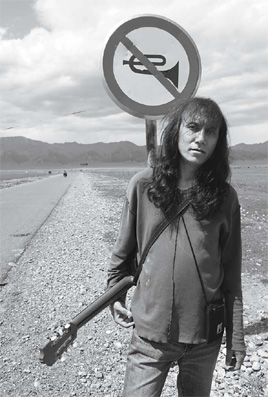
'I love my people ... but I don't want to limit my music to a certain ethnic group,' says Askar. Photos courtesy of Askar Mamat

And he's also trapped between the smaller live shows that he truly loves and the stage-managed, lip-synching big gigs that provide his livelihood.

He also faces the same challenges as everyone else in China's rock scene - piracy, the absence of a mature commercial live music network, and a general lack of knowledge about, and interest in, the genre.

The musician, who is also known as Askar Grey Wolf, has over the past two decades established himself among the most successful of China's minority rockers. He has performed for the CCTV Spring Festival Gala Show and toured about 10 foreign countries. He owns an apartment in Beijing, where he lives with his wife Dilibar, a professional dancer, and their two children.

But his rise to the top hasn't been easy and things remain challenging despite his acclaim.

A recent Saturday night gig at a Beijing live house exemplifies how tough it can be.

When the band splits up its share of the ticket revenues, the 1,100 yuan ($161) amounts to just a little more than 100 yuan each, which hardly covers their cab fares.

But such is life for most Chinese rockers.

Askar's identity - or rather, identities - compounds the difficulties he faces in the scene.

Although he speaks and sings in perfect putonghua, his rock melodies and Uygur face still intimidate some audiences, who usually prefer the likes of Daolang, a Han singer who adds a little Xinjiang roughness to his tunes.

At the same time, many Uygurs don't accept Askar because of his long hair and putonghua lyricisms.

About a tenth of the audience at his first show in Xinjiang's capital Urumqi came from his ethnic group. It is only recently that his concerts in the autonomous region have started attracting roughly equal numbers of both Uygurs and Hans.

Askar often sings in both putonghua and his mother tongue, and his band is an even mix of both nationalities.

"I love my people, but as a musician, I don't want to limit my music to a certain ethnic group," he says. "My music is rock that fuses Uygur and Han cultural elements."

Askar attended a putonghua school in Urumqi and grew up with mostly Han friends. Because he was among the first of Xinjiang's rockers, many viewed him as rebellious, including his father, who was Party Secretary of the Cultural Bureau of Xinjiang Uygur autonomous region.

From discord to harmony

It was nearly impossible for him to hear foreign music when he started playing in the 1980s, aside from a few tapes his brother sent from Beijing. And he met few people he could discuss rock with, until he visited Beijing in 1988.

"Beijing seemed like a totally different world, where I found so many different kinds of music," he says.

"I felt that we were so pathetic in Xinjiang, because only traditional music was available there. I made up my mind to create modern Uygur music."

In 1991, he gave up his job as an actor at the Tianshan Film Studio in Urumqi and moved to Beijing to become an independent rock musician. Since then, he has released three albums and a DVD, and shared the stage with many famous musical acts.

Askar gradually began incorporating different elements into his music. His songs feature a diversity of instruments, including distorted electric guitar, rawap (a plucked Uygur instrument), dap (Uygur hand drum) and the Middle Eastern dombak drum.

"I often thought about my music and exchanged ideas with other musicians after I came to Beijing," he says.

"I tried different things until my music became a fusion of everything. I believe that Uygur people need to learn from other cultures.

"Actually the muqam (classical suites of Uygur dance music) resulted from the convergence of cultural influences from different ethnic groups traversing the Silk Road."

His recent compositions include more traditional Uygur sounds, which he once shunned as "outdated".

He found the muqam he heard on the radio as a boy had a deeper influence on him than he had originally thought.

Askar sings about life, love and environmental protection.

In Tears of Kashgar, a song from his 2005 album, Those Who Embrace the Sun, he sings: "I want to see your smile. I want to hear the birds sing. Although you are smiling, I can't think of a good song. Although the birds are singing, their forests are disappearing."

The album's music videos foretell the vanishing of Kashgar's old town, which has since become a reality.

Askar was recently involved in a project initiated by singer Zhu Zheqin (Dadawa) to preserve minority culture. He and Zhu traveled throughout Xinjiang to document traditional Uygur music in June and July, until the July 5 riot cut their journey short.

He returned to Urumqi, and spent a special summer there with his family.

 From discord to harmony

Uygur musician Askar Grey Wolf with children in Lijiang, Yunnan province.

"Every summer is a great holiday for my family, because my wife and I take our children back to Xinjiang, but this year we couldn't have a good time," he says.

"The atmosphere was so depressing. My 13-year-old son grew up in Beijing and speaks better putonghua than Uygur. When he went into the streets of Urumqi, he was scared of both Han and Uygur people."

Askar had originally planned to organize a music festival in Urumqi this year, but that has become impossible. More importantly, he found that the violence has changed lives in Xinjiang more deeply, as the relationship between Han and Uygurs is tenser, even among his friends.

"When I grew up, the division of 'gangs' was more important than of ethnic groups," he recalls.

"I used to fight alongside my Han friends against other Uygurs. But now it seems Han and Uygur people are more wary of each other, which is really sad."

While touring the country, Askar had many people tell him they wished to visit Xinjiang after hearing his music. He has always told them it is a safe place but now many people don't believe this.

"Some rioters even beat up Uygur girls in short skirts: Are they trying to make Xinjiang like Taliban-controlled Afghanistan?" he asks.

"I also go to mosques to pray, but I'm for a more open Xinjiang, and I believe in equality between men and women."

In August, Askar and his group toured Australia, performing at the Darwin Music Festival and Sydney University. Journalists often asked him questions about Xinjiang during the trip. He responded by telling them he had not gone there to talk about politics but will preach peace in his music.

The highlight of the trip for him was when one old man said he understood Askar's music, even though he knew neither putonghua nor Uygur.

"I'm a Uygur, but I'm also a member of the world," he says.

"I hope there will come a day when the division of ethnicities are no longer important."

(China Daily 12/01/2009 page18)