> Chongqing Jiangbei District Special
Chongqing's prime district aims for cultural success
By Ma Chuan (China Daily)
Updated: 2009-11-30 07:42

Chongqing's prime district aims for cultural success

Science, technology, education and healthcare have all benefited from the recent economic successes of Jiangbei, one of the most prosperous districts in the southwestern city of Chongqing. These accomplishments have seen the district designated as a model area for popularizing science and listed among the first tranche of national pilot urban areas for intellectual property right (IPR) protection by the State Intellectual Property Office.

Within the district, the Wulidian industrial design center has been designated as a national pilot park by the State Intellectual Office, whilst the Shuangxi Village has been named as one of the first of a small number of model villages for new rural construction.

At present, the district has 33 hi-tech companies, making it number one among all the districts and counties of Chongqing.


The district is also rich in educational resources. It is a pioneering zone for quality education in primary and secondary schools and a national training center for teachers. In total, the district has 71 public primary and secondary schools.

Its abundant historical sites have also helped create a distinct cultural dimension for the district.

With a history stretching back more than 2,000 years, Jiangbei has five city-level historical protected sites, including the former residence of Xu Beihong, a renowned painter. It is also home to 18 district-level conservation sites. These rich cultural resources have boosted the development of its local tourism and cultural industries.

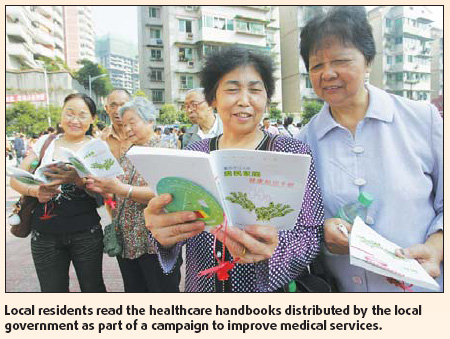
In terms of healthcare, the local authorities have improved access to public healthcare services for both urban and rural residents. In 2005, a national residential community model area for healthcare services was established in the district.

In 2007, the district authorities launched a public healthcare service system, upgraded the following year. This was designed to reduce the disparity in healthcare services between urban and rural areas.

In 2008, Jiangbei was selected as one of the four national pilot areas for the provision of basic healthcare system, under a strategy jointly researched by the WHO and the Ministry of Health. Currently, the district has 376 medical organizations, including eight hospitals.

(China Daily 11/30/2009 page6)