> Insight
The price of green revolution
By Fu Jing (China Daily)
Updated: 2009-11-18 07:49

 The price of green revolution

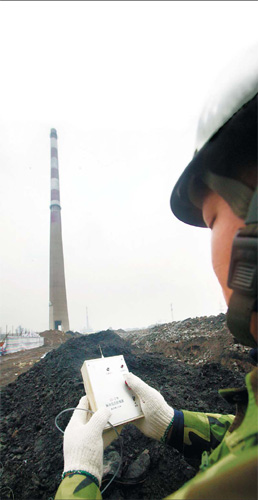
A worker prepares to press the detenation button to destroy a 180-m tower at a coal-fired power plant in Nanjing, capital of Jiangsu province. Wu Jun

Crouched behind his fruit stand in a small mountainous town, Zhou Jian had neither the opportunity nor the inclination to watch the live broadcast of Barack Obama's visit to Beijing yesterday.

Yet, although the welcome party for the United States president was far from his mind, the 52-year-old fruit seller's situation will likely be an important topic of discussion when Obama and President Hu Jintao sit down to talk about climate change.

For 30 years, Zhou worked in a coal-fired electricity factory in the poverty-stricken Tongjiang county, Sichuan province, earning 20,000 yuan ($2,900) a year, just enough to support his family and pay for his son's education. But in 2007 he was among around 200 staff laid off when the national grid switched to powering the country from a hydroelectric plant on the upper reaches of the Yangtze River.

His unemployment was a massive blow to the family, especially as the prospects of Zhou finding another job were bleak due to the central government's decision to shut down almost all thermal electricity generators with capacities lower than 100,000 kilowatts.

By 2020, China is expected to close all generators with less than 300,000 kilowatts in capacity and build larger ones in an effort to cut the country's dependency on coal, which is currently used to produce 70 percent of its primary energy.

With his son at a college in the provincial capital Chengdu and his wife also unemployed, the 700-yuan monthly allowance from the local authorities was not enough for the family to survive. Zhou had no option but to open a fruit stall last spring.

"I badly need vocational training. I'm no good at touting for customers, so there is no future in me staying here with no business," he said, shivering in the freezing cold.

Zhou's story highlights perfectly the multi-faceted impact of China's drive to mitigate global warming.

The price of green revolution

Yesterday, Hu and Obama agreed to inject political will into the deadlocked climate change negotiations ahead of the December summit in Copenhagen, Denmark, despite the sacrifices of workers like Zhou.

China has closed thousands of energy-inefficient factories in the power, steel, iron, coal, petrochemical and textile sectors to meet the energy intensity target set in its 11th Five-Year Plan (2006-10) - cutting energy consumption per unit of gross domestic product by 20 percent from 2005 levels.

The cap has cut 1.5 billion tons of greenhouse gases in five years, Hu announced at a New York summit in September, and he will likely refer to the achievement when urging Obama to act faster on climate change.

But the price of progress is not cheap. By closing just small coal-powered generators, more than 600,000 workers will lose their jobs by 2020, says a report by a Chinese Academy of Social Sciences research team headed by Professor Pan Jiahua.

At the same time, the government is also shutting at least 10,000 small coal shafts, leaving many more miners and migrants jobless.

It is the second wave of mass lay-offs in China within 10 years. Between 1998 and 2005, the country restructured thousands of State-owned enterprises, making around 30 million workers redundant.

The price of green revolution

Liu Junsheng, a researcher for the Ministry of Human Resources and Social Security, said the impact is obvious as many Chinese factories are labor intensive and energy inefficient.

"These closures will be long lasting and will continue to cause unemployment," said Liu. "Fortunately, China has put a basic social security umbrella in place and those who are unemployed can now benefit from jobless allowances. It is about time the leadership began to balance the short-term losses with the long-term environmental welfare of future generations."

The urgency, and delicacy, of the situation is one Hu is all too aware of. During his private talks with Obama, he likely reiterated China will "notably cut" carbon intensity by 2020, although a concrete target is still unknown, and no doubt commit his country once again to raising the share of non-fossil fuels used for primary energy to 15 percent by 2020.

"China's actions are much faster than international negotiations," said Dennis Pamlin, a visiting Swedish scholar at the Chinese Academy of Social Sciences who is actively involved in low-carbon innovation projects and closely observing the global climate change talks.

Despite the job losses, the actions to cut carbon emissions have also created new opportunities.

Himin Solar Group, a rising force in green energy, plans to establish a "solar valley" in East China's Shandong province and has already enrolled around 1,000 graduates this year. To meet its growing workforce demand, the company has also set up a college for technical and business management training.

There are about 6,000 solar factories of varying scales nationwide, creating an urgent need for 200,000 skilled workers, said the China Association of Renewable Energy in a recent report.

With an abundance of cheap, unskilled labor, China faces mounting challenges in shifting workers from traditional high-carbon industries into green jobs.

Any move towards low-carbon development involves job losses in traditional industries, said Gregory T. Chin, an assistant professor at York University in Toronto, Canada, who specializes in studies on China's role on the global stage. "But the key challenge is acquiring and integrating the new technologies needed to make the shift, while minimizing employment loss and maximizing job creation."

So how can those working in traditional factories be guaranteed jobs with green energy enterprises? That would take retraining a large portion of the industrial workforce, according to Chin.

"One challenge would be the coordination of such retraining programs," he added, pointing out that some of the programs would have to be handled by the green energy companies.

Some segments of the workforce would need to rely on public sector retraining support, however, which could be costly. It would also require new government-corporate partnerships to devise financing solutions for retraining programs and technology transfers, said Chin.

He warned it would be a painstaking process for China to realize its low-carbon aims.

"How long will it take? It's hard to say. An optimistic guess would be one generation," he said, adding that much will depend on advances in cooperation at the global level and whether the main corporations holding the leading green technologies are willing to share.

The price of green revolution

Meanwhile, the necessary changes in lifestyle that would accompany a shift to low-carbon lifestyles will take time to build, especially outside advanced or developed economies. "It will likely take more than a generation to really see the embedding of the new mindset in many parts of the developing world," added Chin.

Jean-Pierre Lehmann, a professor at the world-renowned Institute of Management Development in Switzerland, said China's growth model would ultimately have to change if the country is to achieve its energy goals, and the difficulty will be in persuading all stakeholders to follow suit, especially "ignorant provisional officials and irresponsible entrepreneurs".

"If China undertakes serious green reforms and implements the goals set, the transition could take 10 to 15 years. So between 2020 and 2025 the new paradigm should be in place," he said.

However, Charles H. Wells, chief scientist for the center of excellence at OSIsoft, an energy efficiency software firm in the US, argued that the transition in China "could be done immediately". He said the workforce is available in China to build the panels, inverters, capacitors and batteries necessary to install solar microgrids and other energy-efficient networks, putting the country at a "distinct advantage over the US in implementing change".

"This is because decisions are made at high government levels and then implemented, but this is impossible in the US due to its current highly fragmented infrastructure," he said.

Wells explained that long-term green projects are almost non-existent in the US and that it is nearly impossible to build a new power plant or transmission line. The power industry is also very conservative and slow to make changes. Even with $3.4 billion in stimulus money from Washington, it will still take at least three years to see significant results, he said.

"The biggest challenge is the lack of engineering skills to implement smart green systems," he said.

China produces 300,000 new qualified electrical engineers every year. However, Wells said far fewer electrical engineers graduate college in the US, while those that do mostly specialize in solid state devices, such as transistors or microprocessor chips, and not power systems.

He believes China could provide help in this area if the US relaxed immigration and work permit policies, and China accepted more US advanced technology to improve efficiency.

To realize a green shift in the US would not be easy, said Lehmann. "Partly because the US is quite far behind in many green technologies, including behind China."

In the cases of climate mitigation and climate adaptation, the US has no model for China or other nations to follow, making "the US a major part of the problem, not part of the solution", he said.

Citing a survey by the US-based PEW Research Center, he said that among industrialized countries and other nations such as China, Brazil and India, the US has the lowest level of "public awareness".

"US Congress (the nation's legislature) is likely to be reticent. Many US companies are actively resisting and some still negate the scientific evidence," he added.

Obama has strong views on climate change, as opposed to his predecessor George W. Bush, but when he heads to Copenhagen, Lehmann believes the president will have neither a popular nor a political mandate.

China is different, he said. On the ground, there are many impressive initiatives being taken. There are, of course, still problems, notably in the nation's intensive manufacturing process and poor energy efficiency, while China also uses more energy than it produces. However, the messages from Hu and Premier Wen Jiabao have indicated China is committed to a low-carbon economy.

"In terms of commitment, China is in a forefront position. What people worry about is whether China will be able to fulfill the commitments," he added.

The price of green revolution

(China Daily 11/18/2009 page6)