> Planet Parade
US pavilion will rise above low expo-tations
By Brad Webber (China Daily)
Updated: 2009-11-06 08:34

 US pavilion will rise above low expo-tations

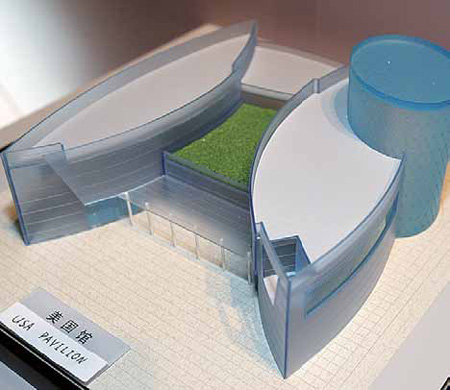
A model of the US pavilion for the Shanghai 2010 Expo is unveiled at an expo-themed exhibition. Imaginechina

Six months before the opening of the Shanghai 2010 Expo, the team assembling the United States pavilion is racing to raise $20 million of the $61 million needed for the structure.

Yes, my native land is No 191 to sign up for the world's fair, out of 192 countries and 50 international organizations (and no matter that the International Network for Bamboo and Rattan whipped past the Americans to the starting line), but fear not: The pavilion will not resemble the mobile home shacks the Bush administration gave to Southerners displaced by Hurricane Katrina.

 US pavilion will rise above low expo-tations

Artist impressions of the Romanian pavilion, above, and British pavilion for the Shanghai Expo. Courtesy photos

Do expect a nice blast of air and a spray of water - in a good way, though, said Jose H. Villarreal, the US commissioner-general for the expo. He dispelled any notion of America as the subprime exhibitor.

Villarreal, an earnest Texas businessman and backer of the presidential run of Secretary of State Hillary Clinton - who in her current position was authorized to appoint him to helm the quasi private-public pavilion venture - was surprised to discover that Team USA was then at risk of being a no-show.

"It's a once-in-a-lifetime event," Villarreal said. "We will use this as an opportunity to build stronger US-China relations. The red carpet has been rolled out for us. The Chinese have been very accommodating and very patient in understanding our particular challenges."

He was referring to the restriction that government money can not be spent on international fairs.

The competition for the hearts and minds of an expected 70 million visitors is considerable.

Take, for example, the Britain's inventive fuzzy-whatsit, a six-story framework tucked inside a shell armored with 60,000 slender, 7.5-m transparent rods, which according to planners "will extend from the structure and quiver in the breeze".

How do you keep up with a whimsical porcupine of a building, let alone hold muster against the delectable little apple (plus a half-slice on the side) that is the Romanian pavilion?

The Swiss are constructing an exhibition hall with a chairlift ride. We gave the world Mickey, and now we're getting outdone on theme park rides.

And can the US possibly contend with the Principality of Toblerone, which will be dispensing free nougats? OK, I made that one up, though it should be a country; after all, what has Kiribati done for you lately at the duty-free?

Kiribati, a very real place - for Google tells me so - is a small island nation that straddles the equator smack in the middle of the tropical Pacific Ocean, and yes, among the multitude of exhibitors that committed to the expo long before the US.

Pavilion envy is palpable.

US pavilion will rise above low expo-tations

Thankfully, the US pavilion has escaped the grasp of geodesic dome fetishists, but the angular, shiny shell contrasts with the organic and traditional architecture of its neighbors. Inside, however, the 5,500-sq-m pavilion's innards - particularly its multimedia presentation, will dazzle, Villarreal promised.

"We have a very compelling story to tell through a sophisticated hi-tech video program," he said. The program is being developed by California-based BRC Imagination Arts, a company behind 16 pavilions and shows at six major world's fairs since the 1986 Expo in Vancouver, Canada.

"You will be able to feel it. It's not just watching a show. It will have five 15-m high screens in a circular space. You feel like you are part of an American city in the future through a multidimensional, three-act show of theatrical production, exhibits and post-show staging," he said.

Smell-O-Vision is out, but visitors should anticipate the thrill of rumbling seats and (spoiler alert!) bring towels.

It is a far cry from what I remember of my first and only trip to a world's fair at age 13.

Expo 1974 was not a world's fair on the measure of those that delivered the Eiffel Tower, the Crystal Palace or the Space Needle, but it still drew about 5 million visitors although fewer than 10 countries participated. Prospective attendees may have mistaken the expo's "Celebrating tomorrow's fresh new environment" slogan for a toothpaste ad.

After Mexico withdrew, fair organizers flew to Mexico City to convince its government to reconsider. Such was the Spokanite power of persuasion that the Mexicans relented - and sent a mariachi band.

The Spokane fair's centerpiece was the US pavilion, a white-tarped amphitheater less evocative of the intended tepees of Native Americans than of cotton underpants draped languidly over a tumbleweed, the unofficial flower of arid eastern Washington state.

Inside the compartmented pavilion was something called "Trash Mountain" and nine oversized plastic insects. I do not recall whether the bugs were meant to show that insects are our friends in the eco-scheme of things or to portend gigantic alien critters if we did not get our environmental house in order.

In another section of the Jockey shorts-covered venue, a stage offered performances by Jack Benny, Harry Belafonte and Marcel Marceau. Up With People, a song-and-dance troupe, cavorted daily with beatific looniness.

If only the US' corporate sponsors could go back in time and channel that relentlessly positive vibe.

Today, the big question is why US companies are shying from the opportunity to reach the world's biggest group of consumers through the expo.

"I don't think companies are necessarily scaling back on overseas sponsorships any more than domestic partnerships," said William Chipps, senior editor of IEG Sponsorship Report, a Chicago-based newsletter that tracks and analyzes sports, arts, entertainment and cause-related marketing.

That makes the tailor-made corporate hairshirts all the more perplexing.

"Whilespending is down, sponsorship overall is still holding its own.It'sa highly effective marketing platformdue to its ability to connectwith consumers on an emotional level andability to be leveraged through multiple channels.

"Corporate marketers are asking themselves, 'Will this sponsorshipgenerate new or incremental business, or accomplish some other marketing objective?' " added Chipps. "If they can accomplish that through a sponsorship of the pavilion, they will be interested."

While sponsors hardly expect to schlep over to China's pavilion, buckets in hand ("Pssst, can you spare some of that red paint?"), they are not exactly stepping up with can-do spirit, either.

Regardless, Villarreal vowed the situation is hardly dire. Pavilion organizers will "close out the funding by the end of the year", he said.

In other words: No need to donate your skivvies.

The author is a copy editor for China Daily who comes from the United States

(China Daily 11/06/2009 page7)