|
Obama tells troops he will not rush Afghan decision
(China Daily)
Updated: 2009-10-28 08:05
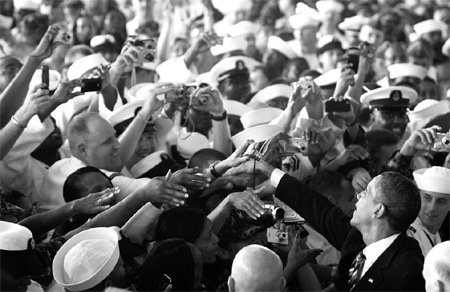
JACKSONVILLE, US: President Barack Obama, accused by some of dithering over a new strategy for Afghanistan, vowed yesterday not to be rushed into a decision over whether to send more US troops to the war zone. Obama spoke to US Navy personnel in Jacksonville late on Monday, the same day 14 Americans were killed in helicopter crashes in Afghanistan and shortly after he met top advisors for a sixth time about a new Afghan strategy that the White House said was still weeks away. Yesterday, eight American soldiers and an Afghan civilian were killed in bomb attacks in southern Afghanistan Obama is debating whether to follow the advice of his military commander in Afghanistan, General Stanley McChrystal, who wants to send at least 40,000 more US forces there. Two weeks ago in Beijing, Afghan Vice President Mohammad Karim Khalili expressed hope and confidence that the West's military support would continue. "Fighting terror is a shared burden," Khalili told China Daily in an exclusive interview. "We appreciate the support we get from many NATO nations, but we understand that they are not in Afghanistan simply to help our country. They are part of a worldwide effort to protect their own people as well." Just last week, the White House rejected former Vice President Dick Cheney's charge that Obama was "dithering" over the strategy review and needed to send more troops. "I will never rush the solemn decision of sending you into harm's way," Obama said to applause from the sailors at the event and their families. "I won't risk your lives unless it is absolutely necessary. And if it is necessary, we will back you up to the hilt." "Because you deserve the strategy, the clear mission, the defined goals as well as the equipment and support you need to get the job done," Obama said, vowing not to have a situation where troops in the field are not supported by people at home. Opinion polls show flagging public support for the war effort and members of Obama's own Democratic Party are divided over whether to send more troops. The US now has 65,000 troops in Afghanistan, which is expected to reach 68,000 later this year. Other countries, mainly NATO allies, have some 39,000 troops there. Presidential condolences Obama expressed condolences to the families of the latest 14 Americans killed in Afghanistan. Three special agents from the Drug Enforcement Administration were among those who died in the helicopter crash in western Afghanistan, said US Attorney General Eric Holder, who hailed their work in fighting the drugs trade there. The White House said Obama's decision on a new strategy will take place "in the coming weeks." ABC News cited unnamed sources as saying Obama's decision likely will come between Afghanistan's run-off election on November 7 and his departure for Japan on November 11. The Pentagon carried out internal assessments of the two main proposals for troop levels - sending roughly 40,000 more troops or a far smaller number, an option McChrystal and other defense officials see as having a higher risk of failure. Senator John Kerry, who heads the Senate Foreign Relations Committee, gave conditional support for additional troops. He told the Council on Foreign Relations he would support more troops only if there were enough "reliable" Afghan forces to partner with as well as local leaders who could deliver basic services to the people. "What we need, above all, what our troops deserve - and what we haven't had - is a comprehensive strategy, military and civilian combined," Kerry said. Obama is also looking at a "civilian surge" of boosting staff in areas stabilized by the military and seeking to improve the capacity of the Afghan government. Kerry, who was in Afghanistan last week to put pressure on President Hamid Karzai to accept a run-off election, was scathing of the US civilian effort so far. "Our civilian presence there is disgraceful compared to what it ought to be relative to the challenge," Kerry said. But Deputy Secretary of State Jacob Lew sought to squash criticism, telling reporters earlier that the State Department was on track to get nearly 1,000 people in place by year-end. US diplomat resigns A former Marine turned diplomat has become the first US official to resign in protest of the Afghan war, the Washington Post reported early Tuesday. Matthew Hoh fought in Iraq and joined the State Department after leaving the military. He resigned from his post as the senior US civilian in Zabul province, a Taliban stronghold. Hoh said he believes the war is simply fueling the insurgency. "I have lost understanding of and confidence in the strategic purposes of the United States' presence in Afghanistan," Hoh wrote in his resignation letter, dated September 10 but published early yesterday. "I have doubts and reservations about our current strategy and planned future strategy, but my resignation is based not upon how we are pursuing this war, but why and to what end." Richard Holbrooke, the Obama administration's special representative for Afghanistan and Pakistan, told the Post he disagreed that the war "wasn't worth the fight," but did agree with much of Hoh's analysis. Reuters-AP- China Daily

![]() (China Daily 10/28/2009 page11) |