|
World's top urban planners envision new Beijing CBD
(China Daily)
Updated: 2009-10-19 07:58
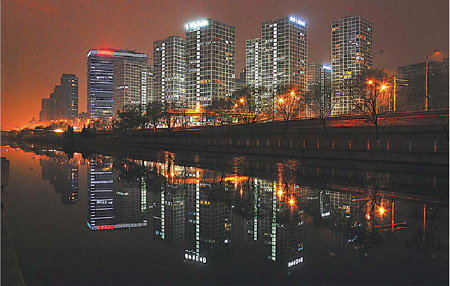
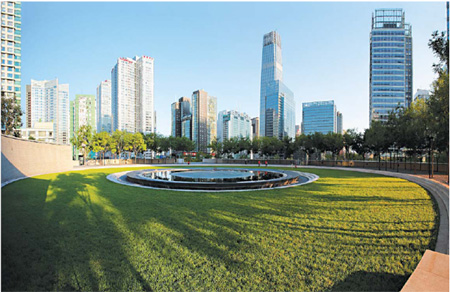
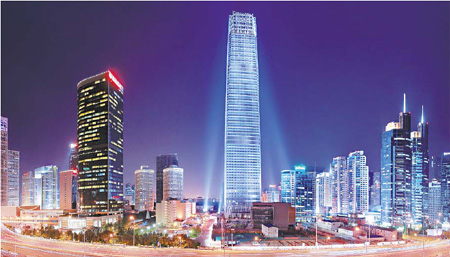
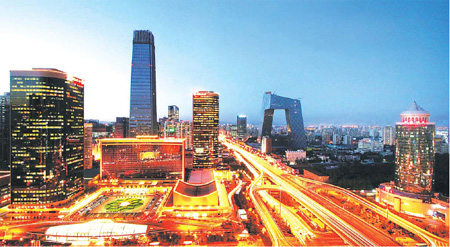
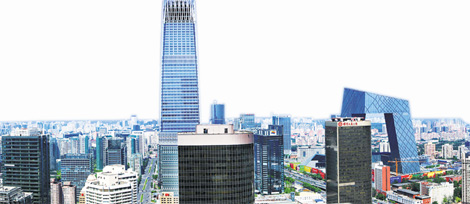
Ten years after Beijing's famed Central Business District (CBD) was founded, the 4-sq-km cluster of modern highrises and international office buildings is set for an expansion eastward that will almost double its size after the Beijing municipal government approved the move in May. The public got its first view of possible plans for the new area at the opening ceremony of the 10th Beijing CBD International Business Festival on October 12, when seven urban planning and design firms unveiled their visions. The municipal blueprint calls for the boundaries of the CBD be extended to the East Fourth Ring Road, an expansion of about 3 sq km. The existing business zone is bordered by Jianguomenwai Street on the south, Chaoyang Road on the north, Dongdaqiao Road in the east and West Dawang Road in the west. Developed for industries such as finance and media, the expanded area is intended to further consolidate Beijing CBD's position as a leading international business hub in China. Firms and partnerships whose plans made it to the finals of the selection process included Skidmore, Owings and Merrill LLP (SOM) from the US, Foster & Partners from Britain, a joint team comprised of US-based Kohn Pedersen Fox Associates (KPF), Beijing Institute of Architectural Design and Zhonghong Design, ADP-i from France, as well as a joint team of China Academy of Urban Planning and Design and Space Syntax from Britain, the Tsinghua Urban Planning and Design Institute and Guangzhou City Planning and Design Institute. A panel of experts from home and abroad announced their decision on October 16, when SOM took first place honors, followed by the team of KPF, Beijing Institute of Architectural Design and Zhonghong Design. Third-place went to the team of China Academy of Urban Planning & Design and Space Syntax Ltd. "The competition marks the start of Beijing CBD's eastward expansion," said Cheng Lianyuan, head of the Chaoyang district where the CBD is located. "We will make a final blueprint based on proposals from the seven participants while considering suggestions from other experts and the concerns of the public," he added. Experts said they were "very impressed with the wisdom and innovative ideas in the proposals", the highlights of which are: SOM: One feature of the plan proposed by SOM is three public parks connected by two boulevards and separate zones for recreation, retailing and exhibitions. Efficient traffic flow was also a major element of the plan, which proposes use of trolley buses and more parking spaces in the CBD's new area. SOM also asserted that every road in the area would have bicycle lanes. SOM is one of the largest architectural design companies in the world, with businesses in more than 50 countries and regions. Its designs in China include the third phase of World Trade Center in Beijing. KPF, Beijing Institute of Architectural Design and Zhonghong Design: The plan from KPF, Beijing Institute of Architectural Design and Zhonghong Design firm highlights renovation of Chaoyang Road and construction of four public squares Under its design, Chaoyang Road, one of the main arterial roads in the area, would be changed into a street friendly to both pedestrians and motorists through the innovative solution of building an elevated pedestrian street 6 m above the existing road. Four public squares are also proposed, among them the "Beijing Arena", a comprehensive facility including a museum, a library, hotels, shops and office buildings, and "CBD East Square", which would be home to a number of new city landmarks to symbolize the east gate of Beijing. Also one of the world's top design firms, KPF's iconic building designs include the World Bank and IBM headquarters. Its partner Beijing Institute of Architectural Design designed the Great Hall of the People, the National Museum and Terminal 3 of Beijing Capital International Airport. China Academy of Urban Planning and Design and Space Syntax: The proposal by China Academy of Urban Planning and Design and Space Syntax would change CBD's skyline with design of new landmarks, including one called the "Tower of Life". The plan also projects building an 8-hectare central park and office buildings tailor-made for small and medium-sized businesses. To minimize impacts from additional traffic, the plan suggests adding three subway stations - a branch to Line 7, a line to link the airport and an extension from Line 1. China Academy of Urban Planning and Design is one of the top design companies in China, while Space Syntax is based in London. Guangzhou City Planning and Design Institute: The plan by Guangzhou City Planning and Design Institute focuses on the pressing challenge of traffic congestion. Its solution is to build underground, surface and elevated traffic facilities - an idea borrowed from the city of Guangzhou. The plan's designers estimate 70 percent of people in the new CBD can arrive and leave by public transport with the completion of the facilities. Guangzhou City Planning and Design Institute is famous for its design for the Guangdong Olympic Center. Foster & Partners: The design by Foster & Partners proposes development of zones differentiated by function. The area surrounding the new CCTV headquarters and the People's Daily Newspaper Group would highlight information services, while Chaoyang Road would be the shopping hub, the residential quarters would be in the southeastern sector and a green belt from the north to south would be built near the East Fourth Ring Road. Sustainable development is another concern of the plan, demonstrated in the layout of buildings. It envisions building that will drop in height from north to south to utilize natural ventilation and light, meeting the CBD's demand for a low-carbon and energy-saving development. A famed architectural firm from Britain, Foster contributed to the design of Terminal 3 of Beijing Capital International Airport, designed the new Bundestag building in Germany and HSBC headquarters in Hong Kong and London. Beijing Tsinghua Urban Planning and Design Institute: The plan from Beijing Tsinghua Urban Planning and Design Institute envisions that the subway system would be the main means of transportation to and from the CBD. It proposes building more subway stations, especially near office buildings. Tsinghua Urban Planning and Design Institute is known for planning the Caofeidian New Area in Tangshan in Hebei province. ADP-i: A major feature of the plan from ADP-i is a long cableway to transport passengers in the area. It also proposes construction of a circle trolley line to encompass the area. Under its design, a second core area with a number of skyscrapers would emerge in the new area. ADP-i, another of the top urban planning firms in the world, gained fame with its designs for Paris Charles de Gaulle Airport, the United Tiara in Dubai, the China National Center for the Performing Arts in Beijing and Pudong Airport in Shanghai.

![]() (China Daily 10/19/2009 page6) |